Before Debbie Wei Mullin asked Americans to buy her coffee, she gave it away. She bought Vietnamese coffees, worked on a bottled version, printed her own labels and handed samples to friends and family. A focus group at the WeWork where she rented space provided another test. The first question was pleasantly ungrand: would anyone want more?
It was a reasonable place to begin for someone leaving the World Bank. Mullin had worked on development projects, but she wanted a working life with more room to make things and move quickly. Vietnamese coffee offered a way to connect that appetite for action with something she already knew intimately. The drink belonged to her family. The business would have to earn its place in other people’s homes.
That distinction runs through the story of Copper Cow Coffee. A founder can know exactly why a product matters to her and still have years of work ahead figuring out why a stranger will reach for it on a Tuesday. Mullin’s education has taken place in kitchens, at trade shows, on television and in conversations with farmers. The kettle is the comparatively uncomplicated part.
Two kinds of coffee at the same table
Mullin grew up in Mill Valley, California, with two coffee traditions within reach. Her father was absorbed in specialty coffee and pour-over brewing. Her mother brought the flavors of Vietnam into the household. One side offered a close interest in beans and brewing; the other offered the sweet, creamy Vietnamese coffee she loved. There was a company somewhere in the overlap, though nobody had yet put it in a box.
Her mother had moved from Saigon to the United States in 1975. The family’s cooking drew on Vietnamese, Chinese and Jewish-American traditions. Ingredients did not always cooperate with geography: when a Vietnamese ingredient was unavailable at the local grocery store, her mother substituted. Mullin remembers a kitchen where adaptation was ordinary. Keeping a flavor recognizable could require changing how it was made.
“My family communicates through food.”
Debbie Wei Mullin
Her formal training gave that family experience another dimension. She earned a BA in economics at the University of California, Berkeley, and a master’s degree in international development at MIT. At the World Bank, she worked in finance and supply chain management. The interest in economic opportunity remained. The institutional pace was a less comfortable fit.
She began selling Vietnamese cooking ingredients in 2014. That earlier venture helped her think about the difference between food she cared about and a category with enough customers to sustain a growing business. Coffee offered a larger everyday market. Discovering Vietnam’s scale as a coffee producer made the opportunity more concrete: a country could be central to the trade while its coffee remained unfamiliar to many American shoppers.
A small filter, a large assumption
Early work on Copper Cow began in 2016, in her sister’s garage; the commercial launch followed in 2017. The bottled-coffee experiment gave way to the format that made the brand recognizable: a single-use filter, already filled with ground coffee, whose folded arms perch on the rim of a mug. Add hot water and let gravity do its modest job.
The format drew on the portable pour-over filters popular in Japan. Paired with a packet of sweetened condensed milk, it made a Vietnamese-style coffee possible without asking the buyer to acquire a collection of equipment. The product still involved brewing. It simply made the first attempt easier to picture.
Even the name came out of making something tangible. The packaging was to feature copper foil, and the dairy creamer suggested a cow for the logo. A designer put “Copper Cow Coffee” into the working design as placeholder text. It stayed. An elaborate naming exercise might have produced something considerably harder to explain.
The family connection extended beyond the kitchen. During an early sourcing trip to Saigon, Mullin timed her visit with a reunion involving her mother and her mother’s eleven siblings. Relatives accompanied her first trip to coffee fields. The origin story therefore has an unusually crowded supporting cast. A supply chain visit could also be a family outing.
The company around the cup
There were people to lean on in California, too. Mullin credits her sister and brother-in-law with encouraging her to start a business and providing a home during its first year. The late-night conversations covered business problems and strategies. A garage may be the convenient symbol of a startup, but people willing to listen after dinner are part of the infrastructure.
Other relationships formed through the repetitive work of selling. In Los Angeles, she kept crossing paths with entrepreneurs Sashee Chandran and Lori Sandoval: at markets, in commercial kitchens and around trade-show booths. Their conversations led to WomenMadeLA. They were dealing with many of the same practical questions about space, distribution and hiring. Proximity gave them a reason to compare notes.
Investors brought a different set of assumptions. Some heard “Vietnamese coffee” and imagined a product only for Vietnamese people. Mullin’s answer was compact enough to fit on a spoon: “Greek yogurt isn’t just for Greek people.” A country of origin can help explain a product without defining the outer boundary of its audience.
She also found investors who understood the proposition. Binh Tran helped introduce her to coffee-industry contacts and encouraged further research before Copper Cow entered 500 Startups. The company completed that program in June 2018 and raised a $2 million seed round that December. An $8.5 million Series A followed in 2021. Those figures describe company financing, with all the obligations that accompany it.
Separate financing rounds, not revenue or personal wealth.
A television audience has its own shopping list
In 2021, Mullin presented Copper Cow Coffee on Shark Tank. The program made a national audience part of the tasting room, although television adds a complication: the person presenting becomes part of the product’s public introduction. In her later account, she described feeling daunted by appearing on screen as a “real, dorky civilian.” It is a more appealing description than the usual founder biography allows.
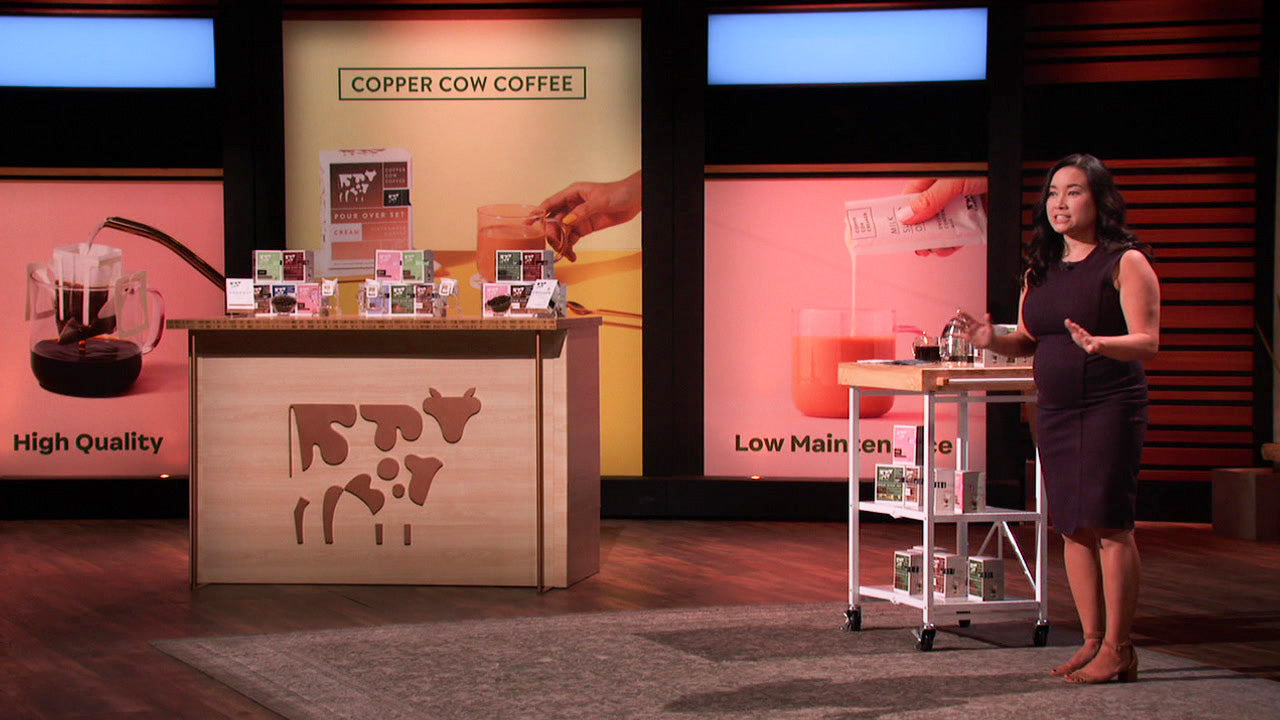
She noticed that viewers shopped differently from the company’s usual customers. Demand increased for products such as decaf, which had previously occupied a smaller place in the mix. Television delivered customers with their own preferences. Exposure could change what sold as well as how much.
Her attention remained on the everyday drink. In a 2022 founder Q&A, she named lavender as her favorite flavor, inspired by a local coffee shop. That detail makes the creative process less mysterious. A person likes something, wonders how to reproduce the pleasure, and starts working. The difficulty begins when everyone else gets to express an opinion.
The customer gets a vote
Mullin has been candid about that difficulty. Cardamom was a flavor she personally enjoyed, but customers did not readily understand it. The preference was real; the confusion was real, too. Loving an ingredient did not automatically make it an easy product to sell. A founder’s palate is a useful starting point and a fairly small focus group.
Listening also changed the format. Some customers loved Copper Cow yet ordered only a few times a year. Asked why, they wanted an everyday option. Bagged ground coffee offered a way to make the drink within a routine they already had. The portable filter had opened the conversation. A familiar bag could make the next purchase easier.
This gives the business an interesting rhythm. Mullin introduced something she knew from home, then had to let other households determine how it fitted into their lives. The product could carry her heritage while accommodating somebody else’s equipment, schedule and shopping habits. That requires curiosity after the sale, when the customer has taken the box away and the founder is no longer there to demonstrate.
The harder work happens before the kettle
Making the coffee convenient was only one ambition. Mullin wanted the business to improve opportunities for producers in Vietnam. Copper Cow says it pays its farmers twice the market rate. The promise connects a consumer product to the terms on which its main ingredient is grown. It also makes sourcing a central part of the company’s identity.
Copper Cow says it pays farmers twice the market rate in Vietnam.
Her organic-coffee project required more than finding a suitable supplier in a directory. It involved working with farmers and processors to develop a certified supply chain. By 2025 she was describing that process publicly, including the decision to begin with a limited line that the company could reliably supply. An ambition about farming had to become a sequence of workable commitments.
Her interest in robusta follows the same logic. In her writing about Vietnamese coffee, Mullin has argued that the bean’s reputation reflects a history of unequal investment in quality. She points to improvements in cultivation and processing as opportunities. It is a development professional’s question expressed through a coffee business: what might happen if a familiar commodity received different attention?
A different job, the same coffee
On August 26, 2026, Mullin announced a change in her own responsibilities. After a decade as CEO, she would step back from day-to-day operations and become Chief Coffee Officer. Her stated priorities were the coffee itself, sourcing relationships in Vietnam and products. She would continue on the board. The founder was choosing a different place to work inside the company she had built.
The change brings the story back to its original interests. Food that connects people. Producers with a chance to earn more. A drink that deserves a wider introduction. Those interests have survived changes in packaging, sales channels and job title. They now come with years of feedback from people who have actually bought the coffee.
At the beginning, she printed labels and asked whether anyone wanted another bottle. The work has grown considerably since then. The useful part of that first question remains: make something, let people try it, listen to what they do next. A coffee company gets its answer one cup, and then one repeat purchase, at a time.