The first clue arrived in a school lunchroom. Robert Mock had moved his family from Texas to California during the financial crisis, and his children returned from their new school talking about seaweed. Among their classmates, the thin green sheets had acquired the status of playground currency. Children traded snacks, and seaweed, Mock later recalled, was the gold standard.
Mock understood the children before he understood the ingredient. He had grown up in Dallas with a taste memory built around tortilla chips and queso. Seaweed belonged to someone else's pantry. Yet his children had crossed that cultural distance without a seminar or a strategy deck. They simply liked the stuff.
For a man who had spent years selling financial derivatives, it was an unusually domestic market signal. Mock began at JPMorgan Chase in the 1990s and later became a director and sales team manager at Bank of America Merrill Lynch. His education had moved through political science at the University of Texas, Spanish studies in Salamanca, international business coursework in Monterrey, and an MBA in accounting and finance at Southern Methodist University. Nothing in that sequence announced seaweed. Then dinner and the schoolyard did.
“I love seaweed too, but I'm used to tortilla chips and queso.”Robert Mock, explaining the original product instinct
Four dads and a troublesome crunch
Mock and three friends formed New Frontier Foods in 2011. The founding group joined finance, technology, communications, and Korean business experience. Their shared idea was to make an ingredient familiar to Asian households easier for a broader American audience to approach. The first vehicle would be a chip: seaweed with the structural confidence of a Frito, crisp enough to dip.
The cast helps explain the company's geography. Mike Shim brought experience from Yahoo and Groupon. Michael Buckley worked in global communications at Facebook. Shin Rhee had held leadership roles at LG Electronics and in Korean business. Mock supplied the original vision and a financier's concern for how the pieces might fit. Korea was not decorative provenance. It was where the company could form relationships with experienced seaweed producers, learn the mechanics of ocean farming, and eventually secure its material. California was where four friends could watch an Asian staple meet an American school lunch.
It sounded obvious in the way difficult inventions often do after one clean sentence. The founders experimented in their own kitchens, discovered that enthusiasm was not food chemistry, and worked with professional developers. Ocean's Halo launched its green, ribbon-like Seaweed Chip in 2013. The product made news because it did not resemble the delicate roasted sheets already on shelves. It also proved painfully hard to manufacture with consistent quality and crunch.
Then came the part founder stories are tempted to sand smooth. After roughly 18 months on shelves, the chip was caught in a national recall for gluten contamination. Starbucks, Target, Whole Foods, and other retailers removed it. One co-founder departed. Mock has described the moment plainly: the company could have stopped.
Five people chose to continue. Their choice mattered less as a display of stubbornness than as an act of revision. The surviving team did not make the first chip sacred. They kept the larger ambition and changed the operating system beneath it.
The episode also reordered Mock's understanding of leadership. A recall is not an abstract setback. It is phone calls, retailer decisions, stranded inventory, bruised trust, and colleagues wondering whether another launch is rational. His later accounts of the period do not reach for lone-founder mythology. He talks about the five who remained. Survival was plural. The useful decision was not merely to endure the embarrassment, but to build a process less dependent on the founders' own appetite.
The basket gets a vote
Ocean's Halo's reset began in 2015 with consumer data. Mock later said data became the driver of innovation, helping the company decide what to launch and what to avoid. This was a notably unromantic answer to a romantic founder problem. The team had already paid to learn that originality alone does not earn permanent shelf space.
The clearest example was almost comically literal. Retail analysis showed that people buying Ocean's Halo broths frequently bought noodles in the same shopping trip. The cart had assembled a product roadmap. The company developed packs of organic rice and ramen noodles, then combined broth, noodles, and seasonings into shelf-stable bowls ready in minutes.
Retailers helped edit the language, too. Kombu might be the precise name for the kelp in a broth, but some buyers advised leading with the more immediately legible phrase “veggie broth.” Mock accepted the translation. Accessibility was not a retreat from the ingredient. It was a route toward it.
“We've made a lot of mistakes and you learn humility pretty quickly in this business.”Robert Mock on building Ocean's Halo
By 2017, the company's kelp-based broths were moving through Walmart, Whole Foods, Sprouts, Safeway, and Albertsons. Mock told an industry publication that behind-the-table testing at Expo West had produced an arresting response from retailers: make this, and we will stock it. A company once organized around one strange chip was becoming a platform for meals.
Move the ingredient, not the sermon
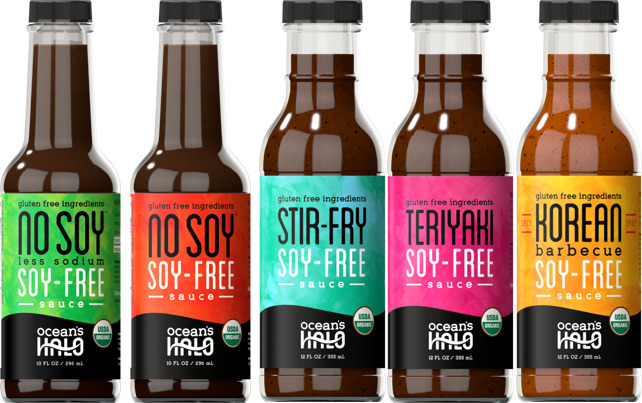
Mock's recurring phrase is “mainstream.” He has wanted seaweed to become a staple rather than a novelty. That goal explains why Ocean's Halo's catalog now reads less like a snack company and more like a guided tour through a grocery store: roasted seaweed, broth, noodles, dressings, soy-free sauces, seasonings, rice wraps, and frozen kimbap-style rolls.
The cleverness lies in refusing to make the consumer perform all the cultural translation. A seaweed snack can sit near potato chips. Broth can invite ramen. A bottle of teriyaki can place kelp inside a familiar cooking habit. A frozen roll can answer the weeknight question before anyone asks for an ingredient lesson. The company changes the format while the underlying thesis stays put.
That same pragmatism reached the supply chain. Ocean's Halo sourced organic seaweed from farms off South Korea, where it was grown, harvested, dried, and sent to the United States. A Southern California production partnership allowed the company to import raw seaweed in bulk and roast, season, and package it domestically. Mock said the change reduced trans-Pacific container shipments by almost ten-fold compared with moving finished, feather-light packages across the ocean. Private-label production helped fill the capacity.
Private label is hardly the part of a founder story that gets printed on a tote bag. Here it solved an adult problem: a new plant needs volume whether or not a young brand can supply all of it. Ocean's Halo approached five large retailers and, Mock said, won four private-label accounts. The branded product created recognition; the behind-the-scenes production helped justify the machinery. Mission met utilization rate, as it eventually must.
A new seaweed chip leads the brand onto national shelves.
A recall forces the team to reset around shopper evidence.
Broths lead to noodles, then ready-in-minutes bowls.
Frozen rolls, fried-rice kimbap, dashi, and trayless snacks widen the map.
Packaging became another product problem. The plastic tray inside a typical seaweed-snack pack protects fragile sheets, but it also consumes space and material. Ocean's Halo introduced a trayless format, saying the redesign fits five times more product on a shelf while eliminating the tray. It is a satisfying example of operational work doing several jobs at once: less plastic, tighter transport, and better shelf density.
The useful kind of conviction
Mock's story is sometimes told as a dramatic career swap: banker discovers seaweed, quits finance, and becomes a food founder. The contrast is real, but it misses the continuity. Derivatives and grocery products both punish a thesis that refuses to meet evidence. In one world the evidence is a price. In the other it is repeat purchase, velocity, distribution, manufacturing consistency, and the quiet testimony of two items traveling through checkout together.
His finance background did not tell him how to season a broth. It may have made revision feel less like betrayal. The original chip was a position. The recall delivered a brutal mark. Mock and the remaining team absorbed the loss, preserved the broader thesis, and found other instruments.
There is also a visible appetite for the ordinary in his recent public posts. He shares family attempts at recipes, applauds colleagues who developed new products, and points followers toward shortcuts for home cooking. In 2025, Ocean's Halo added organic fried-rice rolls to its frozen range after earlier noodle and vegetable kimbap launches reached Kroger, Target, Walmart, and Whole Foods. In 2026, Mock promoted new dashi broths at Whole Foods. The horizon keeps moving, one dinner at a time.
Ocean's Halo says it works with 1% for the Planet to direct at least one percent of annual revenue from several product lines toward environmental causes including ocean conservation. Its Expo West profile now counts more than 50 products. Those facts suggest scale, but the smaller story remains more instructive: a child trades a snack; a father pays attention; a chip fails; a basket supplies the next clue.
Mock did not make the first idea immortal. He made the observation useful. That is a quieter form of persistence, and a much harder one to package.