Rupert Morrison once built a server room and forgot that servers get hot. His young analytics business occupied an attic in London’s Borough Market. The equipment needed somewhere to live; a plasterboard enclosure seemed an adequate answer. Then the temperature began to rise. Air conditioning followed, with pipes travelling through a doorway, across the floor and through a meeting room to an open window. The future of organizational efficiency required everyone to watch their step.
He tells the episode against himself. It is a pleasingly physical introduction to someone whose career concerns the relationship between an elegant plan and the awkward business of making it work. A diagram can give every component a place. It cannot, by itself, get the heat out of the room.
He had help with the less tangible dependencies, too. Richard Thompson, an early chairman and investor, became a mentor. His advice arrived in handwritten letters; meetings lasted no more than an hour. Morrison valued that combination of attention and discipline.
Six months after the farewell
Before London, there was a sheep farm in Wairarapa, New Zealand, and a family line of farmers with Scottish roots. Morrison grew up riding motorbikes. The family’s loss of the farm changed his direction. Economics and management consulting followed, taking him into a working life quite different from the one he had inherited.
His education included an MSc in economics at Erasmus University Rotterdam. His interests within the subject included game theory and micro general equilibrium modelling. These are useful preparations for a career spent considering how connected parts behave, although business would supply plenty of complications of its own. At A.T. Kearney, he worked on supply chains and organization design, becoming a Principal.
Consulting gave him variety: different clients, different industries, another problem to solve. It also gave him a recurring irritation. The calculations generally lived in Excel, their conclusions in PowerPoint. Clients wanted to know how they would keep the analysis useful once the consulting team had departed. Six months later, what would they do?
Morrison’s response was to combine consulting knowledge with software. An organization changes after the final presentation. Its analysis ought to change with it. That premise became central to Orgvue, the platform he helped create through Concentra Analytics, founded in 2008. The client’s question had identified a business opportunity hiding inside the handover.
His explanation of organization design reaches beyond the reporting chart. Start with strategy, understand the activities required to execute it, establish accountabilities and work out the capabilities needed. Roles and positions belong in that picture, alongside the people who fill them. Drawing the boxes is relatively straightforward. Working out what belongs inside each one takes rather more curiosity.
The spreadsheet gets investors
By May 2018, Concentra had announced a £41 million growth equity investment led by One Peak Partners. Morgan Stanley Expansion Capital, Joseph Schull, Connected Capital and existing shareholder City Securities participated. Schull joined as chairman. The money would support international expansion and further development of the software business.
The company then employed 170 people, with offices in London, Philadelphia and The Hague, and a Hong Kong opening planned. Its funding announcement reported OrgVue revenue growth of 112 per cent a year on a compound basis over the preceding four years. Those figures describe that period, rather than a permanent condition. They nevertheless show how far the business had travelled from the attic.
Morrison’s attitude to expansion had changed too. In 2018, he described an earlier caution followed by a readiness to accelerate, having demonstrated that the business could grow and make a profit. The timing is part of the story. Building software demands investment before every possible use of it has been proved; building a company demands enough restraint to stay around for the proof.
The next ownership chapter arrived in September 2026. Main Capital Partners acquired a majority stake in Orgvue. Main described a business with approximately 250 professionals and close to 200 global enterprise customers. Its announcement named Oliver Shaw as CEO. Morrison’s founding idea now had a substantial organization of its own.
A dictionary before a dashboard
For someone who sells the usefulness of data, Morrison spends a fair amount of time worrying about words. Consider headcount. A finance team and an HR team can use the same term while counting different things. One may be considering positions and vacancies; another, employees. The arithmetic can be correct while the conversation goes nowhere.
His remedy begins with agreement. Define the terms, distinguish people from positions and make the definitions common across the business. Buying another tool cannot settle a disagreement nobody has acknowledged. The dictionary has work to do before the dashboard gets its moment.
This emphasis gives his argument a practical scale. Organizational design can sound remote, something conducted upstairs with a laser pointer. A shared definition is a task people can actually undertake. It also exposes a less glamorous dependency of business analysis: before teams compare their answers, they need to know whether they have asked the same question.
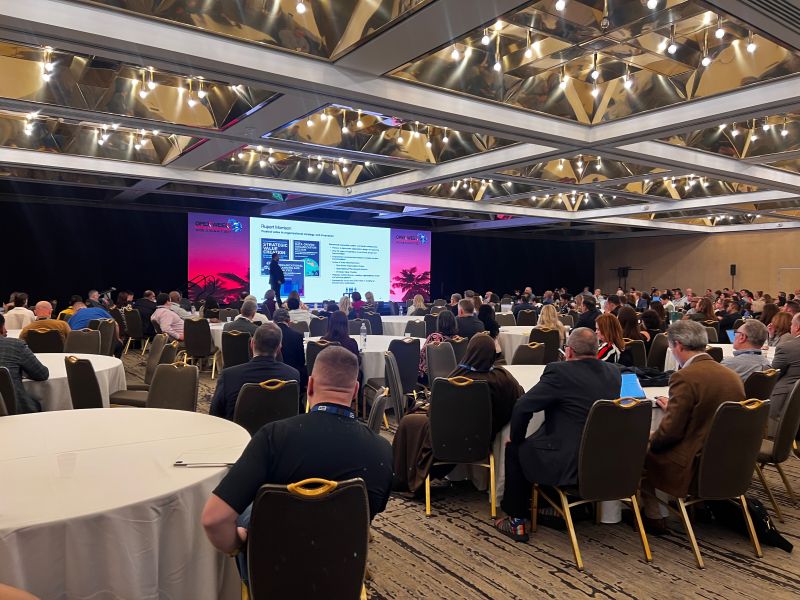
There is a human consequence to getting the larger exercise wrong. At OPEX Week in Miami in 2025, Morrison made a blunt demand: “You have a moral duty to be competent at transformation.” A new reporting line, responsibility or workplace can reach into someone’s family life. He argued for explaining why changes happen and treating the work with the care its consequences deserve.
“You have a moral duty to be competent at transformation.”
Rupert Morrison · OPEX Week, 2025
Three books, one unfinished job
Morrison has written his way through successive parts of the problem. Data-Driven Organization Design appeared in 2015, followed by a second edition in 2021. It sets out a method for designing an organizational system, moving between the larger operating model and the detail of roles. The revised edition added material including job architecture, position management and delta reporting.
Organizational Planning and Analysis, published in 2022, takes the organization forward in time. Its concerns include workforce supply and demand, strategic and operational planning, and building a function that can maintain the work. Finance has a planning discipline; Morrison wants the organization itself to receive similarly sustained attention.
Then came Strategic Value Creation, written with Jon Andrew and published in June 2024. It moves the discussion towards customers, differentiation and execution. Its four-part framework runs through diagnosing the present, designing the future, drawing the plan and delivering with data. Across the books, a consistent concern emerges: the work continues after a structure or strategy has been agreed.
There is a disarming admission behind the third book. After years in consulting and leadership, Morrison still questioned how clearly he could explain strategy. He went back to reading, working through more than 50 books. Experience had given him material; it had also given him reasons to examine his own thinking.
He describes one moment at home with coffee and Richard Rumelt’s Good Strategy/Bad Strategy. The useful realization concerned design: strategy could be approached as something to create, give shape to and make usable. It is a modest scene for a business revelation. A chair and a book are considerably cheaper than an executive retreat.
That appetite for learning is something Morrison discusses in public as well. He has written about the pleasure of reading a book or listening to an hour-long podcast, and the need to keep learning as the world changes. It is a useful detail in a career built around advising others: his own explanations remain open to revision. The books offer methods, but the reading habit suggests how those methods develop. There is always another problem to understand, another practitioner to hear from, another assumption that could use a closer look.
The boardroom needs a plot
In 2021, Morrison co-founded Ārahi with Andrew. The two shared a frustration with the relationship between investors and the businesses they backed. Morrison brought experience as an investment-backed founder; Andrew brought a career in private equity value creation. The new business combines consulting and technology around strategy and its execution.
Board reporting is one of its concerns. In conversation with HRchat host Bill Banham, Morrison explained his preference for a concise opening view: highlights, lowlights, key issues and recommendations, supported by the detail that follows. A board should be able to locate the decisions within the reading material. Anyone who has searched a large pack for its actual point will appreciate the ambition.
His broader approach connects the things customers value with the capabilities that deliver them. A plan then ties the strategic choices to measures, targets and initiatives. Reporting becomes a way to check progress against those choices. For investors, the same logic extends across a portfolio, asking how performance relates to the investment thesis.
The conversation remains open elsewhere. With Shradha Prakash, Morrison co-hosts Unpacking organizations, a podcast about the practical questions of organization design. His public work includes learning from other practitioners as well as explaining his own frameworks. Away from the books and board packs, his interests have included coaching rugby. Roles, teamwork and execution can be discussed in less upholstered surroundings.
The early office, the client handover and the board pack share a small but persistent problem. Something has been assembled; now it must work for the people using it. Morrison keeps finding new versions of that question. The servers needed somewhere for the heat to go. The client needed a way to keep thinking after the consultants left. The board needs to know what to do next.
Continue the conversation
- Ārahi · Morrison’s biography
- Orgvue · founder profile
- LinkedIn · Rupert Morrison
- Books · Kogan Page
- Watch · Unpacking organizations on YouTube
- Listen · HRchat on strategy and board reporting
- Read · Data literacy and definitions
- News · September 2026 Orgvue acquisition
- Read · The 2018 investment announcement
- Interview · Early business lessons