A vacancy is a wonderfully tidy answer to a question an employer may not have asked properly. What work needs doing? Which parts require experience, which could be taught, and which might be automated? Beamery, a London enterprise software company that built its business helping recruiters cultivate candidates, now wants a say before the job advertisement exists.
That is a considerable expansion of the recruiting brief. Its platform brings together information about people, roles, skills and tasks, giving employers tools to find candidates, maintain relationships and plan changes to their workforce. The proposition is appealing precisely because it is practical: understand the work, understand the people, then decide whether to hire, develop or redeploy.
It also makes Beamery an interesting test of HR software’s ambitions. A system that helps send a better candidate email has an observable job. A system advising on the shape of an organization enters much messier territory. Beamery is trying to connect those two worlds, with recruiting tools at one end and workforce modeling at the other.
A better memory for the recruiting department
The original idea borrowed from sales. Businesses keep records of prospective customers, learn their interests and stay in touch until a purchase becomes possible. Beamery applied that logic to prospective employees. A promising candidate who was unavailable last spring could remain a useful contact for next winter’s vacancy.
Talent CRM gives recruiting teams a shared place to organize those relationships. Sourcing and matching tools help identify people against a role’s requirements; talent marketing supports campaigns and candidate engagement. Career sites, recruiting events and analytics extend the process. The value is partly better information and partly less repetitive administration: fewer scattered records, fewer forgotten conversations.
Its audience is the enterprise with complicated hiring needs. Public customer references include Salesforce, Flex, Wells Fargo, General Motors and Johnson & Johnson. These are organizations where a candidate can be relevant to more than one team, and where useful knowledge can disappear between departments. Beamery’s pitch is to make that knowledge reusable.
The garage had a point of view
Beamery dates its founding to 2013, when brothers Abakar and Sultan Saidov and Michael Paterson began the business in a London garage. The legal paperwork starts slightly earlier: the UK entity was incorporated as Seed Jobs Limited in December 2012 and renamed Beamery Ltd in July 2015. Startup birthdays are occasionally less punctual than company registers.
The Saidovs’ experience as children of immigrants informs the company’s stated mission of widening access to work. In interviews, Sultan has described helping young people who struggled to find opportunities during the financial crisis. Conversations with HR leaders moved his thinking beyond a marketplace for graduates toward software that could help employers recruit proactively.
The early investment was personal. Sultan told the Dealmakers podcast that he paid an engineer from his Goldman Sachs salary while working on the venture. Eventually, he could not give both jobs the attention they required. His account makes the decision to leave finance sound less like a lightning bolt than a calendar that had become impossible.
“The first challenge was simply building a sufficiently mature and expansive solution to get our first enterprise customer.”
Sultan Saidov · HR Tech interview, 2021
That challenge matters. Enterprise customers bring requirements before they bring recurring revenue. Beamery chose a market where product depth, integration and implementation would be part of the sale. Getting the first large employer comfortable was an early hurdle, well before the company began discussing digital models of entire workforces.
First, pick the skills nobody can find
Balfour Beatty offers a more concrete account of how the software gets used. The infrastructure group wanted to reduce manual recruiting work and reliance on agencies. Its resourcing team selected job families where talent was scarce: commercial, engineering, planning and project management. It then built candidate pools and used targeted communications to keep people interested.
Beamery’s published 2022 case study describes personalized emails, company updates and webinar invitations. It reports average campaign open rates of 70% and click-through rates of 36%. Those are customer-story figures, not a controlled experiment or proof that every recipient became a hire. Still, they show what a recruiting relationship can look like before anyone submits an application.
The transferable lesson is the sequence. Choose a difficult hiring problem, define the relevant group, give people a reason to stay connected, then measure whether that relationship produces useful outcomes. Buying a CRM does not perform the first two steps. A large database without a clear recruiting purpose can remain a very expensive address book.
Now take the job apart
Skills Intelligence addresses another obstacle: different records describe similar capabilities in different ways. Beamery extracts and standardizes skills information from materials such as job descriptions and résumés. Its support documentation gives a simple example of normalization: recognizing that “AWS” and “Amazon Web Services” name the same thing.
But a list of skills does not fully describe how someone spends Tuesday. In July 2025, Beamery launched its Workforce Intelligence Suite with Task Intelligence, breaking roles into units of work. The announced capabilities include role-to-task mapping, analysis of automation opportunities, and scenarios for reskilling or redeployment. This is the company’s attempt to connect workforce plans with the activities beneath the organization chart.
Consider an illustrative engineering team where senior staff repeatedly handle basic troubleshooting. A task-level view could prompt a different allocation of work before management requests another senior engineer. The interesting question becomes whether the team lacks expertise or assigns existing expertise poorly. Beamery’s launch material uses that kind of scenario to explain the product’s purpose.
Ray, introduced alongside the suite, is the conversational adviser in this broader proposition. Beamery says it uses organizational data, skills and task insights to offer contextual recommendations and help model workforce changes. The product page emphasizes human control and pre-approved permissions. Its usefulness depends on the quality of the organizational picture it is given.
There is a necessary distinction between the umbrella pitch and individual features. Beamery’s January 2026 support guide labels Ray for Sourcing as beta and lists several other agentic applications as future plans. Buyers should therefore examine the particular workflow they need. “Agentic” on a product page does not establish that every advertised ambition is available in production.
The bill, the balloons and the cuts
Beamery’s expansion has required substantial backing. It announced a $138 million Series C in June 2021, led by Ontario Teachers’ Pension Plan Board, with investors including Accenture Ventures, EQT Ventures, Index Ventures, M12 and Workday Ventures. A $50 million Series D in December 2022 took its valuation above $1 billion.

Within weeks of the unicorn announcement, the company was cutting staff. Tech.eu reported a planned reduction of around 12% in January 2023, following other cost-saving measures, including changes to executive bonuses. Another reduction, reported at 25%, followed that November. The percentages describe separate rounds and should not be added as though they share an unchanged starting workforce.
The record undercuts any comfortable assumption that a large funding round guarantees an easy operating future. In October 2024, CIBC Innovation Banking announced debt financing to support Beamery’s growth as it worked toward profitability. Its own public account now describes roughly 200 full-time employees. That is a different picture from the exuberance in the fundraising photograph.
For customers, the financial question is what the software and the organizational effort produce together. Beamery sells through an enterprise sales process and offers implementation, enablement and advisory services. A sensible business case has to account for data preparation, integrations, training and ongoing ownership alongside the software agreement.
A Beamery-commissioned Forrester study published in 2023 reported a three-year ROI of 467%, drawing on interviews with one client organization. It also described more than 30,000 recruiting hours saved. Useful evidence, with a specific scope: a modeled result informed by that organization’s experience, rather than an average return across Beamery customers or a price quotation.
The connections are part of the product
Beamery sits beside established HR systems. Its Workday and SAP SuccessFactors partnerships connect recruiting and skills information with systems employers already use. In May 2025, it announced LinkedIn CRM Connect, allowing actions such as exporting profiles and syncing candidate interactions. The integration was offered without additional platform fees for eligible customers holding LinkedIn Recruiter seats.
Competition is substantial. Avature offers enterprise candidate relationship management and engagement; Eightfold offers AI-powered talent acquisition and matching. Beamery’s distinctive argument is the combination of candidate relationships, skills information and task-level planning. That positioning is a reason to investigate the product, not evidence that a rival cannot solve a particular employer’s problem.
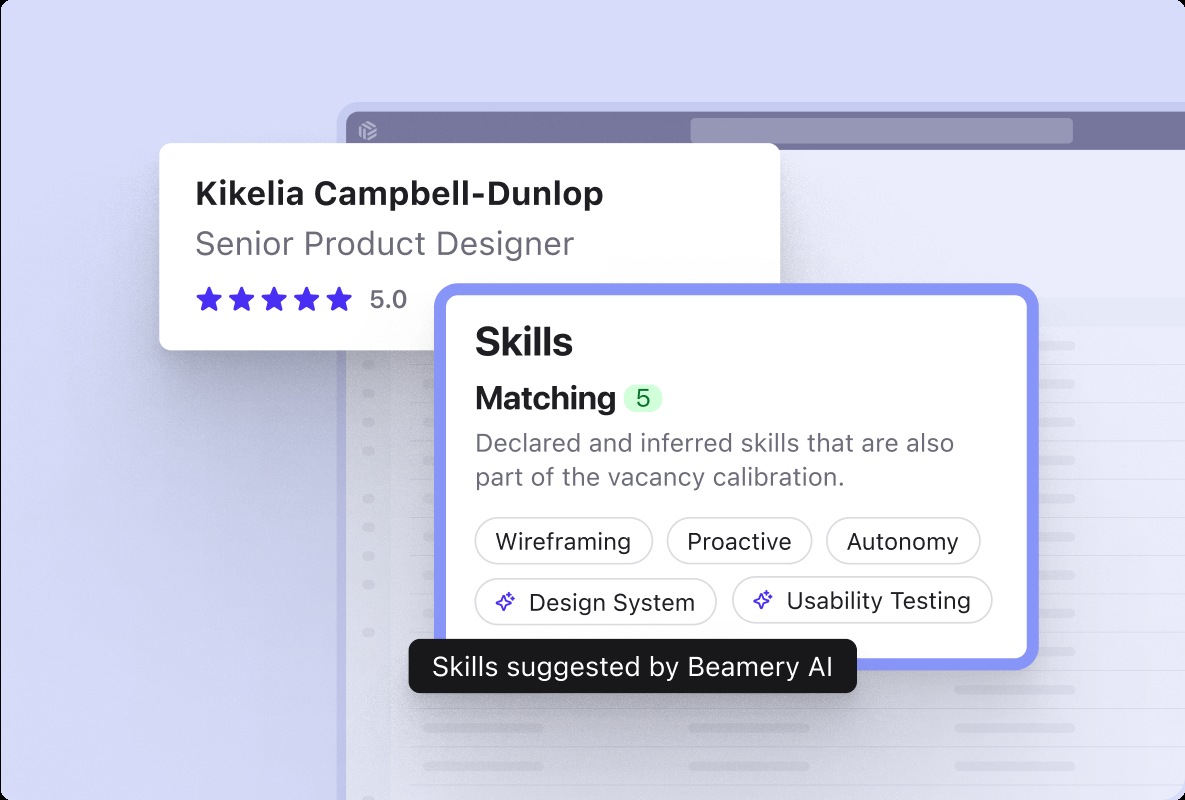
Its own documentation supplies a useful reality check: skills may be declared or inferred, and AI additions do not erase existing skills. An inferred capability is a reason to investigate, not a demonstration of proficiency. If managers will not validate the data, or will not allow people to move between teams, recommendations can stall at the dashboard.
Access to work, with work still to do
Sultan became CEO in April 2025, with Abakar appointed executive chairman. The announced transition put the co-founder associated with product innovation in charge as Beamery expanded its workforce proposition. The company’s stated values emphasize curiosity, bravery, kindness and impact; its August 2025 announcement of ISO 42001 certification adds a concrete AI-management milestone to that language.
The unresolved business test is whether the broader product can repeatedly turn better information into better decisions. For an employer with fragmented data and complex talent needs, that is a meaningful prospect. For a small team making occasional hires, the integration and operating effort may outweigh the benefit. Beamery’s most useful question travels further than its software: before adding another person to the organization chart, can you explain the work?