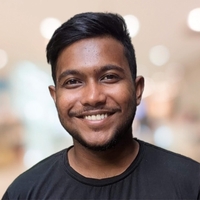
The Kid Who Decided Your Laptop Was Obsolete
In Kalyani, a small university town outside Kolkata where most ambitions stop at landing a tech job in Bengaluru, Rounak Adhikary was 19 and already running a consulting company to fund a different idea entirely. Woldix, the consultancy, was never the point. It was the instrument. The point was ProjectX - a bet that the personal computer, as we know it, was finished.
That bet is now backed by Y Combinator. Spring 2026. Batch X26. A kid from West Bengal sitting in one of the most exclusive startup programs on earth, building what he calls Infinity: the first cloud-native distributed OS for GPU applications. Run Blender. Run DaVinci Resolve. Run Unreal Engine 5. From a Chromebook. In a browser. Under 20 milliseconds of latency. No downloads. No configuration. No GPU required on your end.
No downloads, no env set-up, no resource management - just start WORKING.
- Rounak Adhikary, on Infinity OSThe pitch sounds like a magic trick. The engineering behind it is closer to a controlled detonation of several cloud infrastructure assumptions at once: GPU slicing via NVIDIA MIG, WebRTC for low-latency streaming, eBPF-based security, Kubernetes orchestration, and a containerized compute layer that makes your browser behave like a workstation. The result is 70% cheaper than Citrix or AWS VDI, and fast enough that the latency becomes a footnote rather than a punchline.
What Infinity Actually Does
Any GPU-heavy app runs inside a containerized cloud environment. You access it through a browser tab. The session persists. Windows and Linux run side by side. AI agents can share the same environment as the human working in it. The device becomes irrelevant. The compute is elastic. The setup time is zero.
From Consulting Revenue to YC Stage
The Woldix chapter matters because it was deliberate. Rounak didn't wait for permission or funding to start. He built a revenue-generating business specifically to give himself the runway to build the one he actually wanted. That instinct - turning constraints into instruments - shows up in everything ProjectX does. GPU access is expensive? Slice it and share it. Setup is friction? Remove it entirely. Enterprise VDI is legacy and overpriced? Build something faster and charge less.
Before Y Combinator, the credentials were stacking up in the way that only makes sense in retrospect. A Bachelor's in Interaction Design from Lovely Professional University (the UX sensibility would later explain why Infinity's zero-friction premise isn't an afterthought, it's the product). Certifications from IIT Bombay in Human-Computer Interaction. A social psychology honors from Wesleyan. Draper University. Stanford ASES India.
Then IIT Bombay's Eureka! competition. 17,000 registered startups from across Asia. ProjectX walked away with the World Trade Center Innovation Award. Then Princeton. Tiger Launch - the world's largest student-run entrepreneurship competition. Rounak represented India. These are not the credentials of someone being carried along by circumstance.
Infinity OS - by the numbers
The Co-Founders Who Make It Real
Rounak doesn't build alone. The ProjectX core team is a notable assembly: Bishal Karmakar as CTO, a systems and cloud infrastructure specialist; Sourya Majumder as COO, an IIT Bombay and IIM Bangalore graduate who previously scaled an IT consulting practice to ~$120K MRR and founded Stanford ASES India; and Ronit Banerjee, a CNCF Ambassador and GSoC contributor who knows the DevOps landscape from the inside. The combination of product intuition, infrastructure depth, and business chops isn't accidental.
What "Infinite Compute" Actually Means
The phrase "infinite compute" gets thrown around carelessly. ProjectX means it structurally. NVIDIA MIG (Multi-Instance GPU) slicing lets a single GPU serve multiple users simultaneously, making high-end GPU resources economically shareable. The elastic scaling model means you only pay for what you use. The session persistence means you don't lose your environment when you close the tab. The WebRTC infrastructure means the stream is optimized for real-time human interaction, not just data transfer.
For a 3D artist in Lagos running Blender on a $300 laptop. For a developer in Manila who needs a GPU to fine-tune a model. For an enterprise team in Chicago that refuses to pay Citrix prices. Infinity's premise is that the compute divide - the gap between people who can afford workstation hardware and those who can't - is now a solvable infrastructure problem, not a hardware problem.
Introducing Infinity - the first OS where humans and agents work with no limits.
- ProjectX product announcement, 2026The AI angle isn't cosmetic. Infinity is built from the ground up to support human-AI collaboration inside the same environment. Agents can run alongside the human user, sharing the same workspace, the same GPU resources, the same persistent session. In a world where the dominant workflow is increasingly human-plus-agent rather than human-alone, that architectural choice matters more than any marketing claim.
The Stack Under the Hood
The technology choices tell a story about priorities. Kubernetes for orchestration - choosing developer-community momentum and flexibility over proprietary lock-in. eBPF for security - a Linux kernel-level approach that provides observability and enforcement without the overhead of traditional agents. WebRTC for streaming - the same protocol that powers video calls, repurposed for GPU-accelerated application streams. Route 53, AWS, Google Apps for the infrastructure layer. These are not the choices of a team building a demo. They are the choices of a team that expects to scale.
The Person Behind the Pitch
Rounak calls himself "Your friendly neighbourhood computer nerd." He is a cricketer and a musician. He was born on July 18, 2002, in Kalyani - a planned township built for academics and engineers. He studied Interaction Design because he cared about the experience of computing, not just the computation. The HCI certification from IIT Bombay and the social psychology honors from Wesleyan weren't detours. They were the architecture of a product philosophy: computing should disappear into the background and let people work.
At 23, he runs a YC-backed startup with six people, has beaten 17,000 competitors in Asia's largest startup competition, has Google Cloud backing his infrastructure, and is in San Francisco pursuing a $3 million seed round. He went from a small city in West Bengal where the dominant ambition is a stable tech job, to one of the most competitive startup ecosystems on the planet, in roughly two years of deliberate motion.
There is a particular kind of founder who seems to move faster than the circumstances around them - not by ignoring constraints but by converting them. Rounak built a consulting company to fund the real company. He studied design to build better infrastructure. He competed in student competitions to reach global stages. The throughline is consistent: use what's available to get to what matters.
The Thesis in One Line
The device you own should never determine the compute you can access. Infinity makes that true.
Accepted into YC Spring 2026 batch - one of the world's most selective startup programs, backing ProjectX's cloud-native OS vision.
Won the World Trade Center Innovation Award at IIT Bombay's Eureka! competition against 17,000+ registered startups from across Asia.
Represented India at Tiger Launch - the world's largest student-run entrepreneurship competition, held at Princeton University.
Secured $200,000 (Rs 1.7 Cr) in Google Cloud infrastructure support - validation of ProjectX's technical architecture and market potential.
Officially recognized as India's best student startup, marking national-level recognition before YC acceptance.
Total funding of $350K raised including seed round and strategic grants, all before the age of 23 - bootstrapped from consulting revenue first.