Rony Chammas needed somewhere to sit with a small team and think. Manhattan had plenty of places to sit. Thinking was the more difficult accommodation. He was an MBA student doing consulting work, and the available meeting spots had a knack for making the meeting feel like an inconvenience.
In his account, the choices included a crowded café and a hotel lobby. On the way to class, meanwhile, he kept passing an art gallery. Around ten in the morning, it was open, staffed, and largely empty. The city appeared to be suffering from a peculiar administrative error: the people needed a room, and the room needed people.
Chammas went inside and asked whether his group could meet there. The gallery agreed. He remembered the artwork, atmosphere, and natural light making the session feel more productive. That was a useful discovery. Trying to repeat it elsewhere exposed the bigger problem. Finding another suitable space meant searches, conversations, and negotiations. A good room could be around the corner and still be remarkably difficult to book.
A city full of rooms, with no way in
The experience became the seed of Peerspace, the company Chammas co-founded with Matt Bendett. By its public debut in February 2014, the proposition encompassed offices, studios, restaurants, theaters, and other spaces that could accommodate productive activity. An owner with idle hours could meet a customer who needed those hours. Neither party had to acquire another building.
The observation extended beyond a student's calendar. A restaurant could have a useful kitchen outside its service hours. A theater could have time between performances. What looked like a fixed piece of real estate could contain several businesses' worth of possibility, provided someone worked out how to connect the schedules.
Chammas's contribution was to take that mismatch seriously enough to build around it. The difficult part was getting an arrangement that could happen informally to happen repeatedly. Word of mouth might find one room. A marketplace had to help strangers find each other, understand what was available, and agree on a reservation.
A conceptual view of the hourly model. Uses and availability depend on the host.
The education before business school
His route into entrepreneurship included a stretch inside Electronic Arts. There, he worked in product management; his game credits included work on franchises such as Harry Potter, The Godfather, and Tiger Woods PGA Tour Golf. He also holds a bachelor's degree from the University of Southern California and completed his MBA at NYU Stern in 2013.
In a 2016 essay, Chammas made an unfashionable case for the big-company apprenticeship. Speaking to large internal audiences had helped prepare him for investor pitches. Demonstrating products had taught him how to handle early bugs. Those skills traveled rather well from a games publisher to a young booking business.
The early acquisition strategy was more pedestrian, literally. The team walked San Francisco neighborhoods to recruit its first fifty host spaces, then used Craigslist to attract customers. A company built around discovering overlooked rooms began with its founders going out to look for them.
Recruited door to door in San Francisco, Chammas recalled in 2016.
That detail is a useful antidote to the frictionless version of marketplace history. Before a guest could browse a selection, someone had to assemble one. Before an owner could believe in demand, someone had to bring a customer. The elegant diagram concealed a considerable amount of walking.
The room gets a second job
By the time Peerspace expanded into Los Angeles in 2015, its early Bay Area inventory had included rooms in the Ferry Building and an abandoned train station in Oakland. General Assembly had used the service on both sides: listing its own workspace and reserving a separate loft for a job fair. A venue could be a supplier on one occasion and a customer on another.
The attraction for Chammas was practical as well as aesthetic. A room already paid for could help cover its owner's costs during hours when its original business had little use for it. Small enterprises had something to offer besides the products or services on their signs.
In San Francisco, the American Bookbinders Museum became one example of that arrangement. It rented space for business gatherings to help offset operating costs. A museum could keep its cultural purpose and earn money from a meeting. The extra use did not require it to stop being a museum.
“Small enterprises are the hidden gems of our city.”
Rony Chammas, 2016
There is a pleasing reversal here. The qualities that might make a building awkward for standardized office use can make it interesting for a gathering. Its history, unusual proportions, or existing identity become reasons to visit. Chammas was building a way for those differences to appear in someone's search.
Returning to the place that supplied the problem
In November 2015, Chammas announced Peerspace's New York launch. He described moving back to San Francisco, his hometown, to work on the product after the Manhattan experience. Returning with a working marketplace gave the expansion a personal symmetry. The place that had frustrated him as a student was now a place where he could offer an answer.
Los Angeles had already widened the range of bookings to include film and television production. The company was learning from what customers wanted to do, rather than asking every customer to reproduce the original meeting. The gallery experiment had opened a door; other people were carrying cameras through it.
Seattle followed as the fourth market in January 2016. Customer demand helped determine the destination: local businesses had used Peerspace elsewhere and wanted access closer to home. Chammas described an ambition to reveal locations people would otherwise never know were available.
He also identified familiar hotel meeting venues as competition. The distinction was tangible. Guests were choosing a setting for an activity they hoped would go well, and the surroundings were part of that choice. A room had to work. It could also give people a reason to look forward to arriving.
A gallery, again
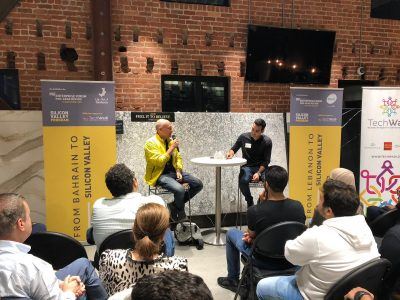
In September 2018, Chammas sat opposite Turo CEO Andre Haddad at an event organized by LebNet and TechWadi in San Francisco. Appropriately, they met in a gallery. Haddad's marketplace connected people with cars; Chammas's connected people with space. Both businesses depended on persuading owners that an asset could serve someone else for a while.
By then Chammas had changed jobs inside his own company. In January 2018, Peerspace appointed Eric Shoup, a former Ancestry and eBay executive, as CEO. Chammas became chairman and chief product officer. The announcement framed the move as a return to his product development roots, with a focus on making Peerspace a destination for planning events.
A founder's biography can flatten all these responsibilities into one permanent title. Chammas's career at Peerspace has involved several. Building the original proposition, running the company, and developing its product are related kinds of work, each with a different daily agenda.
- 2014Co-founder & CEO at launch
- 2018Chairman & chief product officer
- 2023Chief strategy officer
- 2026Founder & chief growth officer
The sequence also gives the gallery photograph another meaning. Here is the co-founder listening and asking questions, in a room filled with people interested in how a marketplace works. A venue is doing the sort of thing his company was created to make possible. It is a modest demonstration of the idea, without a product presentation: people with a shared interest have found somewhere to gather. The gallery supplies the setting. The conversation supplies the reason to be there.
In September 2022, he appeared on The Big Wedding Planning Podcast to discuss unconventional venues. The episode’s agenda included finding locations within a budget and simplifying the booking process. A wedding carries rather different expectations from a student consulting session, but the practical questions overlap: where can people gather, what will it cost, and how difficult will the arrangement be? Chammas was now explaining the product to people planning an occasion they might organize only once.
What happens after the reservation
When Preethi Ramani joined as chief product officer in 2023, Chammas moved into the chief strategy officer role. Ramani brought experience from Expedia Group and Rent the Runway. In 2024, Chammas welcomed Kevin Yuann as the next CEO, succeeding Shoup, and emphasized Yuann's experience developing new lines of business.
The subject of those new lines was already implicit in the original reservation. People booking a room generally want something to happen there. Finding the address solves one part of the problem. The food, drinks, equipment, and coordination can still occupy the rest of the organizer's afternoon.
By June 2025, Chammas was discussing a range of uses that included music videos, business beginnings, and content made by YouTube creators. The same physical inventory could support a celebration one day and a production on another. Its value depended on the activity a guest brought to it.
In September 2026, Peerspace launched All Inclusive Venues in New York, San Francisco, Los Angeles, and London. The category bundled space, food, drinks, and staff into a single booking with an upfront price. The announcement identified Chammas as founder and chief growth officer.
“We wanted to take the guesswork out of party planning,” he said. The business had traveled from finding a usable room to simplifying more of the occasion inside it. His stated concern was familiar: fewer vendors to coordinate and a clearer idea of the final cost.
The first gallery meeting remains a helpful way to understand the career. Chammas had encountered a small obstacle, noticed an available resource, and asked an owner a fairly ordinary question. Years of product decisions and changing responsibilities followed. The question still fits: could someone else use this space for a few hours?