Consider the last slide of a sales pitch. It usually asks somebody to do something: book a call, register interest, try the product. Then the presentation ends, and the somebody has to go somewhere else. Faces built a business around making that gap smaller. A form could sit inside the slide. The audience could answer it there.
- The idea: AI presentations with working web elements.
- The audience: creators, founders and teams explaining ideas.
- The present: a product winding down, with an exit route for existing work.
That last point now governs the others. On October 13, 2026, Faces announced its sunset and closed new signups. Existing users can edit, present, publish and share through December 31. Subscriptions will be cancelled automatically by then; customers can request earlier cancellation and refunds. The useful question has changed from what to build in Faces to what can travel beyond it.
The small gap after the pitch
Faces, operated by Perhaps, Inc., called its output software slides. Its Forms plugin made the phrase concrete: describe the questions, have the tool construct the fields, and collect responses back in the project. A pitch could gather leads. A talk could include a poll. A published deck could collect registrations without handing the audience another destination.
The distinction mattered after the meeting, too. Faces separated sharing a project with collaborators from publishing a browser link. The published version retained its live elements. That made a deck something a recipient could explore, rather than a sequence whose meaning depended entirely on the speaker being there.
“Slides worth presenting.”Faces’ public company tagline
The positioning was deliberately familiar at the edges. You still had slides, layouts and a Present button. Inside that frame, Faces II, released June 2, added plugins including Runway Avatars, which could converse with an audience by microphone. The familiar container gave unfamiliar behavior somewhere recognizable to live.
Three people who had shipped together
The founders brought different pieces of product work from the same previous employer. Platanus’ portfolio profile describes Ignacio Soffia’s design and brand work at Fintual, Gonzalo Enei’s growth leadership there, and Joaquín Ossandón’s engineering experience. Ossandón dates his Perhaps co-founding period to 2023. By the Faces II announcement, Soffia was identified as CEO; Enei had publicly announced his departure.
Those backgrounds help explain the product’s combination of presentation, design and executable interfaces. The customer was someone with an idea to communicate, often without the time or appetite to commission a separate website. Earlier company messaging described “everyday sites,” small web creations for ideas and projects. Later messaging concentrated on presentations.
There were concrete users behind those descriptions. Platanus partner Paula Enei said she used Faces to propose products internally and help colleagues picture them before committing to development. OpticksAI chief executive Juan de Dios Hernández Grebe reported reducing functional-mockup work from as much as a week to thirty minutes. That is one customer’s account, rather than a general speed guarantee.
The second edit is the real test
Generating a first version is only part of making software useful. Someone will want a different price, a different label, a different color. In a chat-driven workflow, every adjustment can become another request, followed by another wait. Ossandón’s May essay, “Let the model ship the controls”, described a more direct approach already used at Faces.
The model could produce both an artifact and the controls for changing it. Users could adjust content and design themselves. This is a practical design lesson other teams can copy: identify the decisions people repeat, then give those decisions visible controls. Asking for a new version should not be the only way to change a number.
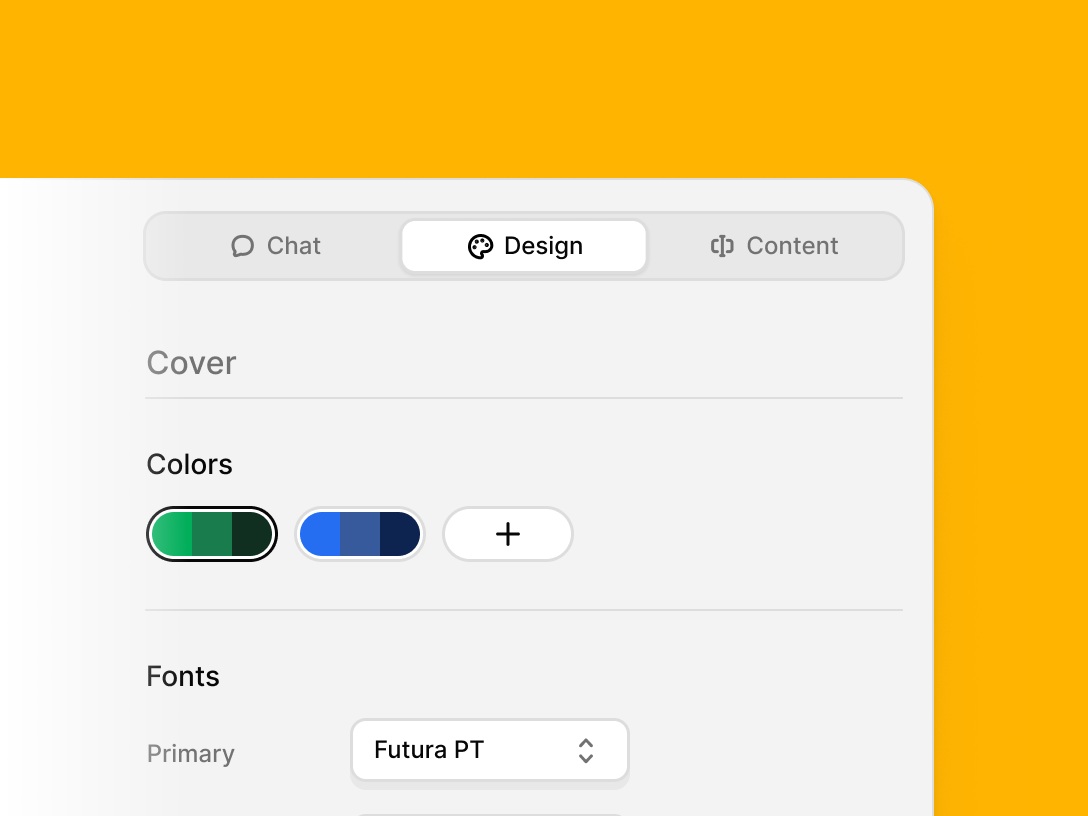
Faces’ Design tab applied palette, font and layout changes across a presentation. Its team-template feature addressed a related annoyance: rebuilding something that already worked. A team could save a presentation as a template, then create fresh copies without disturbing the original. The useful unit of automation was sometimes the second deck, rather than the first.
Presenting also had its own interface. A July guide described automatically saved speaker notes and a separate Presenter Mode window, giving the speaker private prompts while the audience saw the full-screen deck. These ordinary conveniences matter: a new format still has to accommodate the person standing in front of the room.
The price of a working slide
The posted pricing describes the business Faces was trying to build: a free entry tier, paid seats and metered AI usage. Under yearly billing, Plus was listed at $15 per member per month and Pro at $30. These are historical product terms, not an invitation to subscribe now.
Plus included 200 monthly credits, custom domains, analytics and larger uploads. Pro increased credits to 400 per seat and allowed larger workspaces. That combination reveals two buyers: the individual who needs a polished link, and the team that wants a repeatable system for producing them.
AI alone was a crowded selling point. Gamma offers AI-assisted presentations, documents and websites; PowerPoint offers AI-driven editing and collaboration. Faces’ more specific proposition was the behavior inside the slide. Its MCP tools extended that logic: a compatible assistant could author slide code, inspect the result and publish the project, rather than merely supply text for someone to paste.
Keep the work, reconsider the container
The wind-down added React ZIP and single-file HTML exports. Those formats offer a route beyond the original service. They also make an old distinction newly important: keeping what a presentation looks like and keeping what it does are different tasks.
Faces already documented PDF and PowerPoint exports for static handoffs. A live form or conversational avatar asks more of its environment. The practical inference is to test exported behavior, especially anything dependent on hosted services. For a fixed handout, interactivity may add little. For a product somebody needs to explore, it can be the reason to open the deck.
Faces leaves a useful design question behind: which part of an explanation should the audience be able to touch? A working control can answer something that another paragraph cannot. That remains an idea worth borrowing.
Explore the experiment
Website · Product journal · Developer docs · LinkedIn · X · Instagram
WATCH THE PRODUCT
▶ Forms inside a presentation ▶ Sharing and publishing ▶ Changing a deck’s design