Pitch is for the unlucky person who owns the deck after everyone else has developed an opinion about it. The sales lead wants a new case study. The founder has rewritten slide three in Slack. Design would like the purple to remain the correct purple. Finance has replaced the chart. A prospect opened yesterday’s link at 11:47 p.m. and nobody knows whether that is promising or alarming. Traditional presentation software can draw the slides. Pitch is interested in the whole little drama.
That makes it most useful to teams that produce presentations repeatedly: startups raising money, agencies pitching clients, sales teams tailoring proposals, marketers policing a visual identity, and executives assembling board updates. If you make one school report a year, the free plan will do, but much of Pitch’s appeal will pass unnoticed. If a deck is a shared asset that must be drafted, approved, delivered, measured, and reused, the product starts to make unusual sense.
The short answerA deck with a pulse
Pitch began in Berlin in 2018, founded by eight friends including veterans of Wunderlist, the beloved to-do app Microsoft acquired in 2015. The original pitch was tidy: make presentation software for the Slack generation. The public launch arrived in October 2020. Collaboration was native, the editor felt contemporary, and the templates did not resemble a quarterly review conducted inside a beige airport hotel.
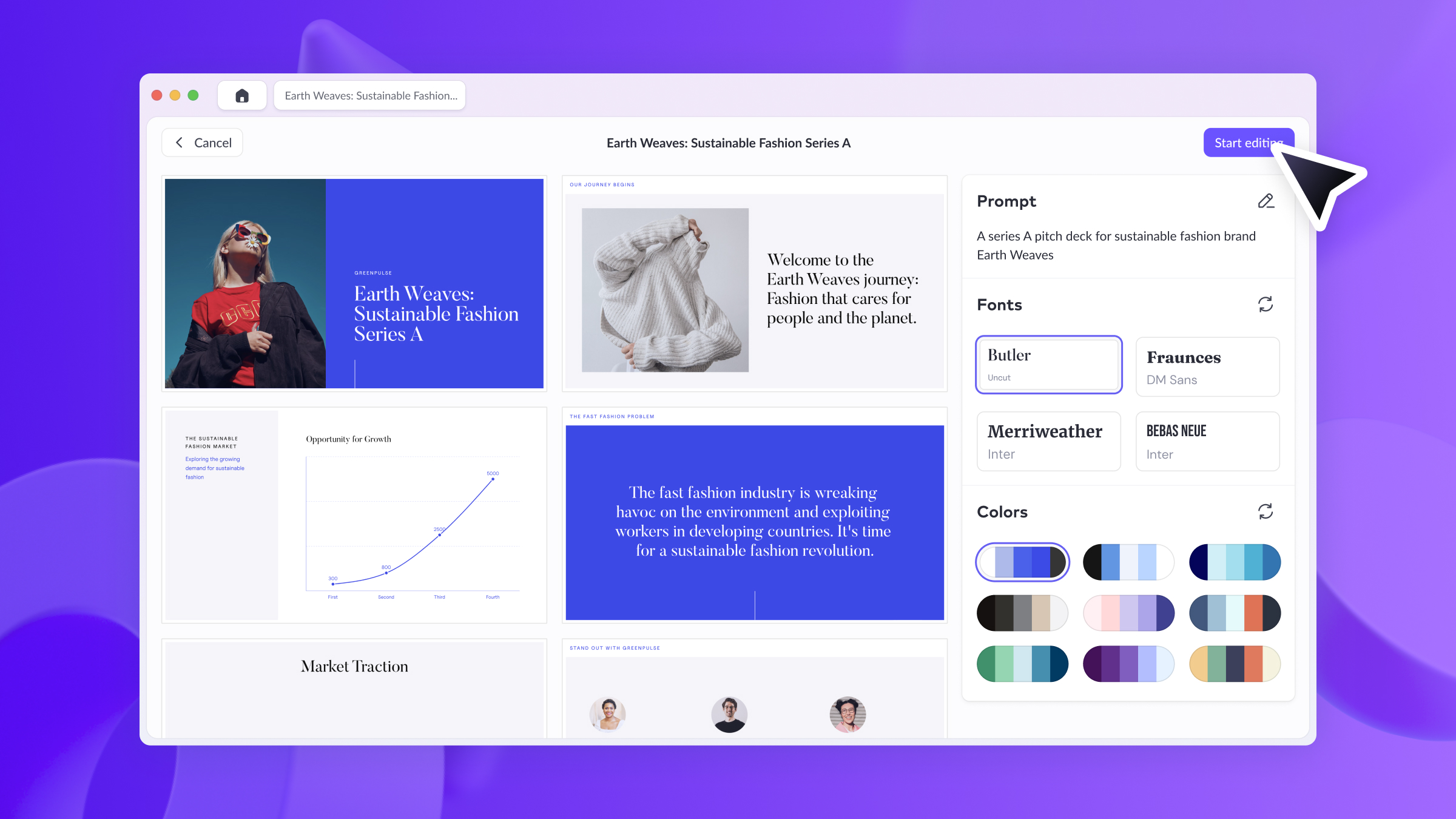
The product now describes itself as an AI presentation workspace. That label is broad, but the evolution is concrete. A team can generate a first pass, work on it together, assign slides, preserve brand assets, present live, record a narrated version, publish a link, assemble a pitch room, and inspect engagement afterward. Pitch wants the presentation to remain alive after it leaves its maker’s hands.

The handoff is the product
The editor is pleasant, but attractive editing is no longer scarce. Canva has templates by the acre. PowerPoint can perform astonishing acts for anyone patient enough to learn its machinery. Google Slides is already waiting inside millions of work accounts. Pitch earns its place in the moments between people.
A slide can have an owner and a status. Comments live beside the work. Multiple people can edit together. Shared templates, fonts, colors, images, and videos keep enthusiastic colleagues from inventing a fifth shade of company blue. For a design team, the benefit is not merely control. It is fewer tiny rescue missions on Friday afternoon.
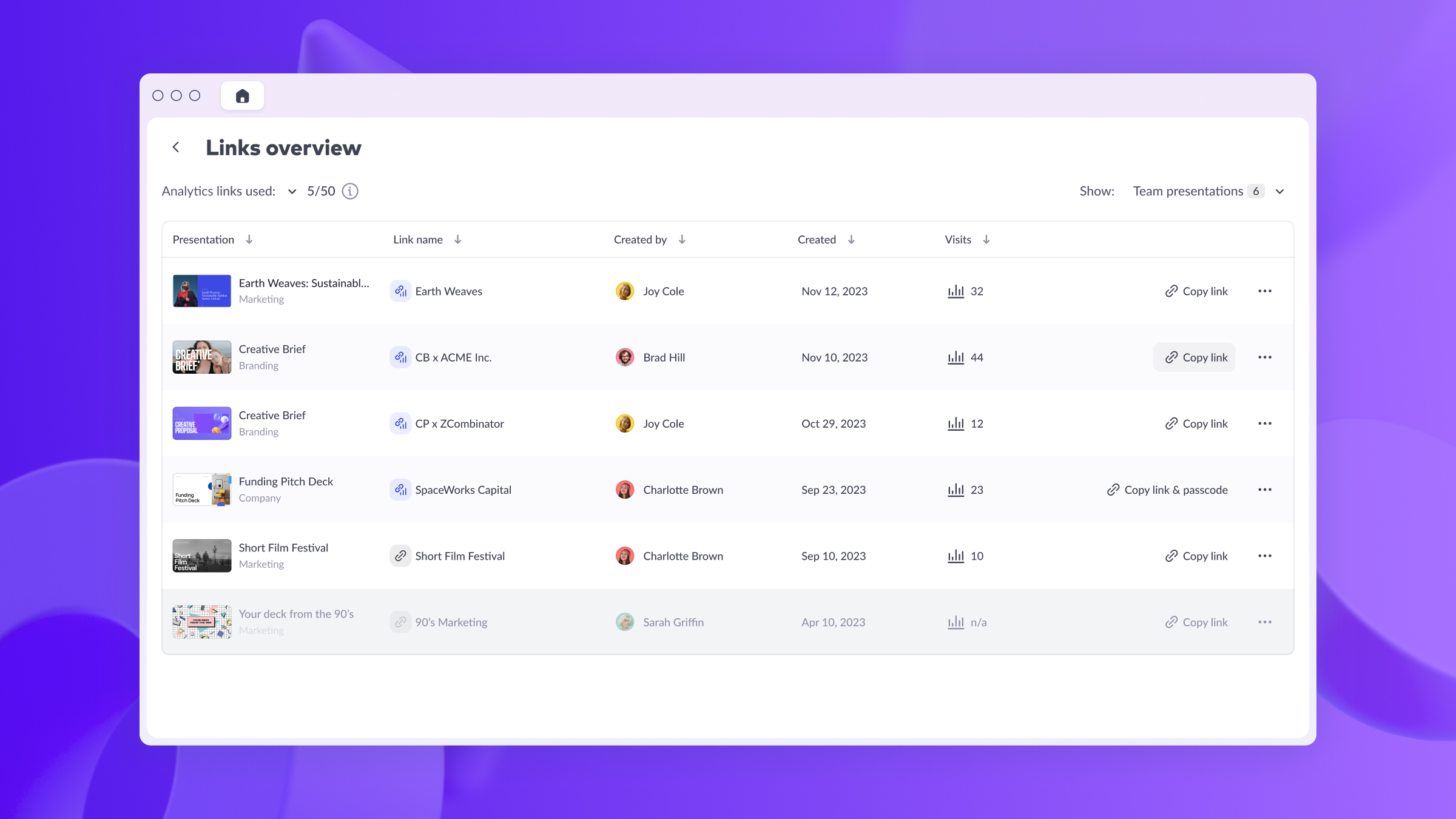
The live link is the hinge. Make a late correction and the audience sees the current version rather than the fossil attached to an email. Advanced links can capture addresses, expire, require a passcode, notify the sender, and report how long visitors spent on each slide. Pitch rooms go wider, gathering presentations, documents, recordings, and scheduling links into one client-facing space. This is less romantic than typography. It is also where sales teams find the money.
“If more than one person on the team is producing decks, the consistency problem just gets worse over time.”Jelle van Schaick, Head of Marketing at Lorum, in a Pitch customer quoteThe AI question
Agent, meet the brand manual
Pitch’s first AI tools could generate a deck, rewrite text, adjust tone, and source imagery. In May 2026, the company introduced Pitch Agent, a more ambitious system that builds with real templates and custom layouts. The distinction matters. A generic generator can produce twelve coherent rectangles quickly; a useful company deck must look like it belongs to the company. Pitch says Agent follows the patterns embedded in a team’s template, leaves the slides editable, and accepts follow-up changes through chat.
By August, Agent could edit the current slide, and Pitch had added an API and MCP integration. The proposed workflow is deliciously specific: ask Claude to pull call notes and CRM data, then build a follow-up deck in the approved template. Or let a CRM event trigger deck creation automatically. That turns presentation making from a destination into an action inside a larger workflow.
The sensible caution is familiar. Generated numbers, claims, and narrative still need an adult in the room. A beautiful falsehood remains false. Pitch Agent is better understood as a quick first designer and tireless production assistant, not the colleague who owns the commercial argument.
Free is generous. The useful gates are deliberate.
As of September 2026, Free covers up to five members, unlimited presentations, unlimited custom templates, basic sharing links, and 100 AI credits that do not renew. It is a credible trial and a workable home for personal decks. Plus costs €10 a month for one seat on annual billing, adding 500 monthly AI credits, custom fonts, video uploads, and unbranded PowerPoint exports.
Team is €15 per seat per month annually for up to 25 people. This is where engagement tracking, 25 advanced links, three teamspaces, two shared pitch rooms, and broader roles appear. Business is €20 per seat per month annually, with unlimited advanced links, pitch rooms, teamspaces, and guests, plus 750 monthly AI credits. Enterprise adds custom terms, SSO and SCIM, a success manager, and onboarding. Monthly billing is available; the site advertises a 17 percent annual discount.
| Choice | Reach for it when | Watch for |
|---|---|---|
| Pitch | Your team cares about brand, live links, pitch rooms, and recipient analytics. | Best commercial features sit on Team and Business; round trips to PPTX can be imperfect. |
| Google Slides | Familiarity, easy collaboration, and Workspace bundling matter most. | Brand governance and post-send sales workflows are lighter. |
| PowerPoint | You need deep formatting, desktop control, or universal enterprise compatibility. | Version sprawl and cross-team production can become a lifestyle. |
| Canva | You make many kinds of visual content and want a huge template ecosystem. | The presentation workflow is part of a broader design suite. |
| Gamma | You value very fast AI-first document and presentation generation. | Traditional slide control and strict brand patterns may be less central. |
No file format leaves the room unscuffed
Pitch can import PPTX and paid plans can export it without Pitch branding. That does not mean a complex deck will commute between engines without losing its hat. A Reddit user praising Pitch for non-designer collaboration warned that PPTX transfer could ruin a deck. A 2025 G2 reviewer described importing a Canva design as awkward. If PowerPoint handoff is contractual rather than occasional, test your ugliest real file before moving a team.
Independent reviews repeat a smaller set of complaints. G2 users mention slow loading on large presentations, lag during PowerPoint imports, limited advanced animations, and a learning curve around more powerful features. TechRadar praised the feature set, ease of use, collaboration, and cross-platform availability in 2023, while flagging storage limits and cost. Some of those plan details have since changed, but the buying question survives: are you paying for slide creation alone, or for the workflow around it?
The company story also contains a sharp turn. After raising more than $130 million, Pitch cut 69 roles in January 2024, roughly two-thirds of its staff, returned to a bootstrapped path, and installed co-founder Adam Renklint as CEO when Christian Reber stepped down. The smaller company did not freeze the product. Pitch rooms arrived later that year, followed by the 2026 Agent, teamspaces, SCIM, API, and MCP releases. Buyers should judge the present cadence, while remembering that venture-sized ambition met ordinary business physics.
Run the Friday-afternoon test
Do not evaluate Pitch with a blank slide and twenty idle minutes. Rebuild the deck your team dreads updating. Import the existing PowerPoint. Give three colleagues access. Ask one to leave comments, one to replace a chart, and one to use the template without supervision. Publish an advanced link, open it from another browser, and inspect the report. Export the result to the format your clients demand. This short rehearsal will expose more than a tour of the toolbar.
Choose Pitch when the deck has many hands, a valuable audience, and a life after “Send.” Stay with PowerPoint when microscopic desktop control and file compatibility rule the job. Keep Google Slides when zero-friction familiarity beats brand control. Consider Canva when presentations are one item in a busy visual-content kitchen. Try Gamma when the first draft is the bottleneck and AI-native composition matters more than a classic slide canvas.
The YesPress verdict
Pitch’s strongest idea is quietly practical: the presentation is a process, not a file. Its editor is handsome enough to invite use, its collaboration tools reduce version archaeology, and its analytics give the sender a reason to return. The paid case is strongest for sales, agency, marketing, and fundraising teams that can act on viewer behavior. For solo makers, the free plan is the honest place to begin.