In the familiar business story, the garage is a waiting room. Two founders work there until success permits them to leave, preferably for an address with better parking and a more expensive coffee machine. Ron Fauquher’s garage in Muncie, Indiana, did produce a software company. But the city surrounding it remained part of the enterprise long after the company outgrew its first room.
Fauquher and Wil Davis started Ontario Systems there in 1980. They had backgrounds in manufacturing, and their young custom software business initially reflected that experience. Collections software was an eventual destination, rather than a founding prophecy. An early collection-agency customer wanted help automating accounts and management, with the application connected to its telephone system. The founders accepted the assignment. One customer’s practical difficulty became a reason to reconsider the business.
The opportunity was repeatable. Other agencies could use the same sort of help, and Ontario moved toward receivables management information systems. It is a pleasingly unceremonious origin: no revelation required, just enough attention to notice that a customer’s problem had relatives. The garage supplied a beginning. The customer supplied a direction.
The name Finvi belongs to a later chapter. Ontario Systems adopted it in October 2021, two years after Fauquher retired as CEO. For much of his working life, the name on the company was Ontario. Remembering that order makes the rest of his career easier to follow: founder first, chief executive later, and eventually an investor working alongside people who had grown up professionally inside the company.
A garage→A customer
A direction→2021
A new name
Thirty-two years before the corner office
Fauquher’s appointment as CEO came in October 2012. By then, he had spent more than three decades helping build the business. His previous responsibilities as senior vice president and chief strategy officer included product direction, partnerships and new business acquisition. The appointment moved someone who knew the machinery of the company into responsibility for the whole of it.
The board elected him unanimously. Ontario was introducing products, including Collect Savvy, alongside established names such as FACS and Artiva. Fauquher’s announcement emphasized continued product investment and the existing direction of the business. Customers were to receive continuity along with the leadership change. For a founder returning to the center of operations, that was a fairly practical promise.
By September 2015, when Arlington Capital Partners acquired Ontario, the company employed more than 315 people. About 270 worked in Delaware County. Those two figures deserve to sit beside one another. A software business can sell beyond its hometown while its payroll remains a very local event. The customers may be scattered across the map; the workday still ends on familiar streets.
Ontario then reported roughly 55,000 licensed users across 500 locations, and its software was used by nine of the ten largest collection agencies. These were tools for the less photogenic portion of commerce: accounts, workflows, telephone contact and payments. There are easier products to explain at a dinner party. There are also fewer businesses that can dispense with getting paid.
A successor with a history of his own
Growth also meant making room for another leader. In December 2017, Jason Harrington became Ontario’s president, taking responsibility for sales, marketing and operations while Fauquher remained CEO. Harrington had already spent 22 years at the company. His relationship with the founders therefore had a history longer than many software firms’ entire existence.
Harrington was a Muncie native who had joined Ontario at 22. Early in his career, when the company sought someone willing to visit customers, he volunteered. The resulting experience in call centers gave him a different professional vantage point from Fauquher’s engineering background. In describing the presidency, Harrington reached for a familial image: “It feels like someone just handed me their baby.” The promotion plainly carried more than a new business card.
In August 2019, Harrington succeeded Fauquher as CEO. Fauquher retired after 39 years with Ontario, with plans to advise its board and management and help on special projects. The handover followed New Mountain Capital’s agreement to become the majority owner. During Arlington’s ownership, Ontario had doubled revenue. By that summer, the business had nearly 500 employees in 28 states.
The continuity mattered. A founder can leave a company behind in several senses of the phrase. Here, the next chief executive had spent decades learning its customers, and the departing one remained available. The arrangement gave a large institutional change a familiar human face. It also left Fauquher with experience that could travel beyond one executive office.
“It feels like someone just handed me their baby.”Jason Harrington, on becoming Ontario’s president in 2017
The useful glamour of a cash reserve
Some of that experience had already been going elsewhere. In 2014, Fauquher received the David Sursa Leadership Award for nonprofit board service. His work with Ivy Tech prompted the nomination, and the award brought a $1,000 grant to the college. Fauquher had known Sursa and spoke about the responsibility businesspeople carry toward the places where they live and work. Education belonged in that account of a successful business career. The grant made the recognition tangible for the institution that nominated him, connecting an individual honor to the college’s ongoing work with students.
At the Innovation Connector, which supports entrepreneurs in Muncie and East Central Indiana, the work included an especially consequential administrative achievement. Fauquher helped the organization become an Indiana Certified Technology Park in 2004, generating $5 million in state funding. A designation can sound like paperwork wearing a tie. In this case, it brought money into the work of helping businesses begin.
By 2020, he had served on the Connector’s board for 17 years and was its chair. His nomination for the Fisher Governance Award described a leader who kept discussions anchored to the organization’s purpose. It also credited his insistence on adequate cash reserves and his encouragement of candid, constructive communication. Financial caution rarely receives the applause reserved for a launch. It does help keep the lights on.
The award, presented that October, brought $10,000 to Innovation Connector for operations or board training. Fauquher also received a glass award made by Ball State artist Brent Cole. Together, the grant and the object make a rather good pair: something to display, and something to put to work. The recognition attached to the patient business of governing an organization, including decisions whose usefulness becomes visible much later.
Retirement, with familiar colleagues
In July 2021, Fauquher appeared in another software transaction. A Muncie investment group announced an agreement to buy Boyce Systems, with Fauquher joining its board. The operating leaders were familiar: former Ontario executives Jason Harrington, Casey Stanley and Jay Moorman. Their announced roles were CEO, president and chief customer officer. Ontario’s working relationships had become the basis for another undertaking.
Boyce brought a very different clock to the meeting. Its history reached back to 1899 and included printing, bookbinding, forms and accounting services. By the acquisition announcement, it supplied financial software and forms to more than 1,200 municipalities, schools, libraries and utilities. Fauquher’s next investment connected a team formed in twentieth-century software with a business that had begun in the nineteenth.
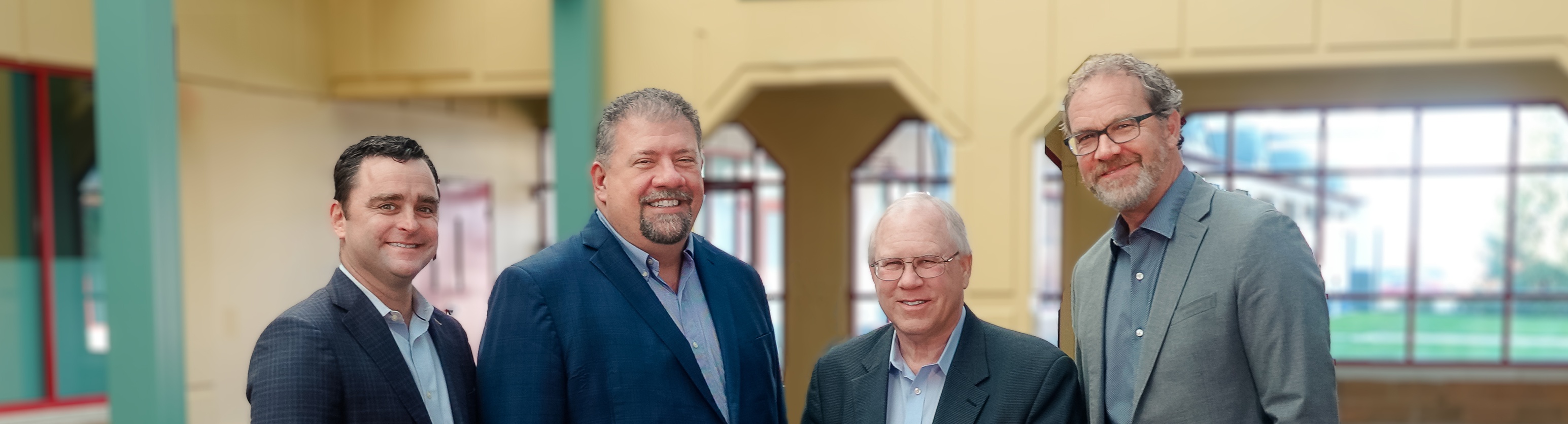
The shared territory was practical information: the records and financial processes that let institutions function. The business was already releasing new software, and the incoming group planned investment in growth and innovation. In May 2024, Boyce announced that more than 150 Indiana public school systems had implemented its cloud software. Its ownership photograph identified Fauquher as a board member, standing beside the three former Ontario colleagues.
For a retired founder, there is a certain economy in working with people whose judgment you have watched develop over years. The Boyce announcement supplies the concrete version of that idea. The colleagues had changed companies, acquired new responsibilities and returned to the work of improving software used by organizations across Indiana.
A name that keeps going to work
Back in November 2019, Ontario had gathered past and present employees and community leaders to mark its approaching fortieth year. During the celebration, the company announced an unrestricted community fund honoring Davis and Fauquher. The founders were among those surprised by the announcement. Ontario’s opening donation would receive a matching contribution from the Community Foundation of Muncie and Delaware County.
An unrestricted fund has an appealing humility about the future. Its creators do not have to pretend they can predict every need that will arise. The foundation can direct support as circumstances change. Fauquher described the founders’ original ambition as creating a caring workplace where people and families could build meaningful careers in Muncie. The fund gave that local commitment another way to continue.
The honors continued, too. Innovation Connector’s November 2025 business showcase included the Ronald K. Fauquher Legacy Award, recognizing his leadership as board chair and support for the local business community. Ball State selected him for its 2025 Distinguished Alumni Award; a March 2026 account described the recognition at the previous fall’s Homecoming celebration. He had earned his master’s degree there in 1978.
Fauquher’s response to the university honor returned to “serving this community and helping others succeed.” It is a modest description for a career with acquisitions, executive appointments and hundreds of jobs in it. It also fits the sequence. A garage became a company. Colleagues became successors and investment partners. Experience became board service, and a company celebration became a fund. Muncie remained the place where those consequences could be seen.