At GetixHealth, the problem was partly a problem of sight. More than 250 accounts-receivable agents worked across the globe, but the company struggled to see what was happening to insurance claims, follow-up, denials, and the hours its representatives spent on them. Finvi’s published case study reports that, after adopting the Artiva suite, average accounts worked per hour rose from five to eight. The extra three accounts are a useful place to begin. An unpaid bill can consume a surprising amount of paid labor.
- Finvi sells the software behind collections, insurance follow-up, and payment recovery.
- Its buyers include hospitals, healthcare outsourcers, banks, lenders, and collection agencies.
- Its cloud strategy joins configurable workflows with payments and outside services.
- The useful measure is what gets resolved for the effort spent, with errors counted too.
Accounts receivable sounds like a stationery cupboard. In practice, it is a sequence of decisions: which account to work, what information is missing, whether to contact someone, how to record the conversation, and how to complete a payment. Finvi builds software around those decisions. The interest lies in the space between them, where an employee can be busy all day without moving an account very far.
01 / The three extra accounts
GetixHealth’s reported 60% efficiency improvement is a customer example published by its vendor, rather than a promise for every buyer. Still, the underlying arithmetic is refreshingly plain. Five became eight. The lesson is that performance depends on the work surrounding the claim, as well as the person handling it. If managers cannot see the queue or understand how time is spent, exhortations to work faster have rather limited charm.
There is a related distinction in healthcare: resolving a claim with an insurer and collecting a patient balance require different work. Artiva HCx gives providers and outsourced revenue-cycle teams a centralized place to manage those activities. The buyer wants visibility into accounts, productive staff, and fewer avoidable delays. The patient wants a comprehensible experience. Both are affected by how the back office behaves.
02 / A new name for an old acquaintance
Finvi began in 1980 as Ontario Systems, founded by Wil Davis and Ron Fauquher in Muncie, Indiana. Its roots are unusually durable for a business now discussing machine learning and cloud delivery. In 2019, the company honored its founders with a community fund bearing their names, supported by the Community Foundation of Muncie and Delaware County. The business had grown; the hometown still mattered.
That year, New Mountain Capital announced a majority investment, replacing Arlington Capital Partners as the largest investor. The price was undisclosed. Today the investor lists Finvi as a current control investment headquartered in Burlington, Massachusetts. This is an established business being rebuilt around newer technology, with private equity behind it.
The October 2021 rebrand gave that effort a name: Finvi, pronounced fin-vye. CEO Tim O’Brien described integrating acquisitions, refreshing product roadmaps around customer feedback, and becoming a product-led organization. The strategic change had begun before the lettering did. A company accustomed to selling collections systems was broadening the machinery around repayment.
03 / Buy the last step, then rebuild the route
In May 2020, Ontario Systems acquired SwervePay, a payment facilitator. The announcement explicitly connected the purchase to transforming legacy on-premises products into an end-to-end SaaS offering. SwervePay brought capabilities including text-to-pay and payments without an app download or portal sign-in. The point was to simplify the moment when a willing payer actually pays.
That is a revealing product decision. Collections software can identify an account, prepare outreach, and record a promise. A separate payment process can still leave another handoff to manage. Bringing capture closer to the workflow addresses the final stretch of the journey. A beautifully organized queue earns little gratitude if the person at its end cannot finish the transaction.

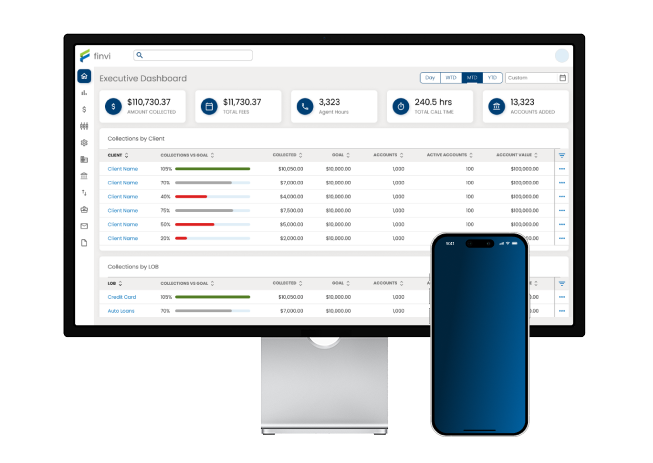
Velosidy, its SaaS collections and payments platform for third-party agencies, reached general availability in September 2024 after an early-adopter program. It combines configurable workflows, payment processing, AI-assisted segmentation, and a multi-tenant cloud design. Finvi reported early-adopter improvements, but those figures describe a selected launch group. The more useful question for a prospective buyer is whether its own accounts can move through the system with fewer delays.
Finvi says it interviewed more than 100 clients during Velosidy’s development. By February 2025, it reported nearly a dozen signed customers. National Business Factors valued configuration changes “without complex coding”; The SOS Group highlighted automated data loading and reporting. Those are practical reasons to change software. A modest adjustment should not always require an elaborate technical production.
04 / One denied claim deserves the next hour
In July 2025, Finvi introduced the Denial Intelligence Engine inside Artiva HCx. Its job is to help prioritize denied insurance claims for human follow-up. It combines industry-wide data with client-specific insights, then applies scoring alongside payer contract logic. That brings two questions together: how likely is this claim to yield a recovery, and what might the reimbursement be worth?
This is a more concrete use of AI than the familiar promise that everything will become effortless. Someone still has to act. The software attempts to make the choice of action better. A queue ordered only by age or balance may send attention somewhere different from a queue informed by recovery prospects and contractual value. That distinction is the product’s premise, rather than proof that any particular claim will be paid.
“We saw huge efficiency gains in the first hour.”Kimberlee Smallwood / GetixHealth
Testimonial published on Finvi’s Artiva HCx page
Finvi’s June 2026 Office Ally partnership announcement follows the same logic further upstream. It proposes real-time eligibility checks, claim-status checks, and discovery of unknown insurance directly within Artiva HCx. Keeping those steps where the follow-up work happens could reduce manual switching between systems. The announcement describes the integration’s intended capabilities; it does not supply a measured post-rollout result.
05 / Four products, four kinds of working day
The portfolio makes more sense when viewed through the customer’s desk. Velosidy serves third-party agencies. Artiva HCx addresses healthcare revenue-cycle work. Katabat serves first-party lenders, which are trying to resolve accounts with their own customers. Simplicity Collect offers a web-based platform for smaller agencies and businesses. Each buyer has a different relationship with the person who owes money.
Katabat joined the company through an August 2021 acquisition. Its current positioning is an orchestration layer above a lender’s servicing platform. It offers configurable strategies, digital self-service, and connected account activity. That appeals to an institution wanting to change collections treatments while keeping its core servicing system. The attractive promise is operational control: let the people running collections adjust the journey.
For smaller operations, Simplicity provides the clearest published price. Its Essential plan lists $399 monthly, three included users, 50,000 accounts, and a $699 startup charge. Higher tiers increase capacity; additional users carry fees. Twelve months at the Essential rate plus setup comes to $5,487 before any extras. That arithmetic is a planning example, not the total cost of running an agency.
+ $699 startup charge
Finvi earns its place in the market through domain-specific software, subscriptions, implementation and support, and payments services. Its enterprise products require a sales conversation. Buyers evaluating alternatives such as C&R Software’s Debt Manager should compare the operation they need to run: account types, existing integrations, controls, migration work, and the full commercial proposal. A company serving a hospital outsourcer and a lender has several competitive conversations to manage.
06 / The queue must survive the office
Finvi’s Methodist Health System story supplies a particularly well-timed example. The A/R team implemented its cloud voice solution three weeks before COVID-19 restrictions forced remote work. According to the published account, the team moved home within two weeks. Automatic quality assurance and coaching from real-time data accompanied the change; the average representative monthly promise-to-pay rate rose 35% in the first year. A promise is still distinct from a completed payment.
What gave way first was the workplace arrangement. The new software helped preserve the work. That is a lesson an operator can copy without buying the same product: test whether people can access the account, communicate, receive coaching, and record outcomes when their surroundings change. Continuity depends on the ordinary steps holding together.
Finvi’s partnership network extends those steps. TCN became its preferred contact-center partner in 2024; Divinity Software added portal capabilities, and Applied Innovation joined the Velosidy marketplace in November 2025. The company is selling a connected operating environment. Connections also create dependencies, which belong in the buyer’s evaluation.
07 / Count the errors with the dollars
The most useful restraint comes from Finvi itself. In September 2026, risk and compliance leader Angela Erwin’s Brainstorm conference recap emphasized oversight, accountability, and measuring risk alongside business outcomes. She recommended baseline measurements, a few performance indicators, and at least one guardrail metric. More automated activity can still be a poor result if accuracy deteriorates.
For a buyer, that suggests a disciplined pilot: choose a defined queue, record present effort and outcomes, then measure what changes. Follow recovered revenue and staff time alongside complaints, errors, and exceptions. This is an editorial inference from the operating problems and governance guidance, not a claim that every Finvi customer follows that procedure.
The conditions matter. Configurable software requires people who understand the process they are configuring. Recovery scoring needs relevant information and monitoring. An integrated payment option cannot make a disputed balance correct or an unaffordable bill affordable. Finvi’s own materials leave responsibility for compliance with the organization using the tools. Software can improve the route to resolution; the judgment at either end remains consequential.
Finvi website ↗ · Velosidy video demos ↗ · Artiva HCx ↗ · Katabat ↗ · Simplicity plans ↗
Company news ↗ · Blog ↗ · Compliance videos ↗
LinkedIn ↗ · X ↗ · Facebook ↗