Six weeks is an awkward amount of time. Long enough for a software project to acquire a committee. Short enough for that committee to still be discussing the migration plan. In December 2023, JonesTrading Canada and TRAFiX announced that the broker’s institutional equity and options electronic trading business had moved onto TRAFiX’s order management system in precisely that interval.
- TRAFiX connects institutional orders, execution and the work that follows.
- JonesTrading Canada reported a six-week implementation.
- Trading Technologies bought the company in September 2026.
JonesTrading’s chief technology officer, Jack Garceau, described the transition as ahead of schedule and free of complications. That is a modest-sounding endorsement for software that sits between a trader’s intention and an actual transaction. The customer announcement gives TRAFiX something more useful than a claim about speed: a named firm, a defined migration and a clock.
“The transition was executed ahead of schedule and without complications.”
Jack Garceau · CTO, JonesTrading · December 2023
Six weeks does not establish a universal delivery time. It does suggest where to look for the company’s appeal. Trading software is bought for what it does during the trading day. It is also judged by what happens while a desk is trying to change it.
The trade has a long tail
To understand TRAFiX, follow an order rather than a stock price. An institution wants to buy or sell. Someone must record the instruction, choose an execution route, track what fills, enforce limits and pass the resulting information onward. The screen is the visible part of a much longer chain.
TRAFiX supplies the order management system, or OMS, and execution management system, or EMS, together with connectivity and related controls. Its core territory is global equities, options and complex options. Its product catalogue includes pre-trade risk limits, allocation tools and interfaces to clearing systems. Institutions can also use its managed FIX connectivity separately. FIX is the messaging language that lets trading systems exchange instructions and updates.
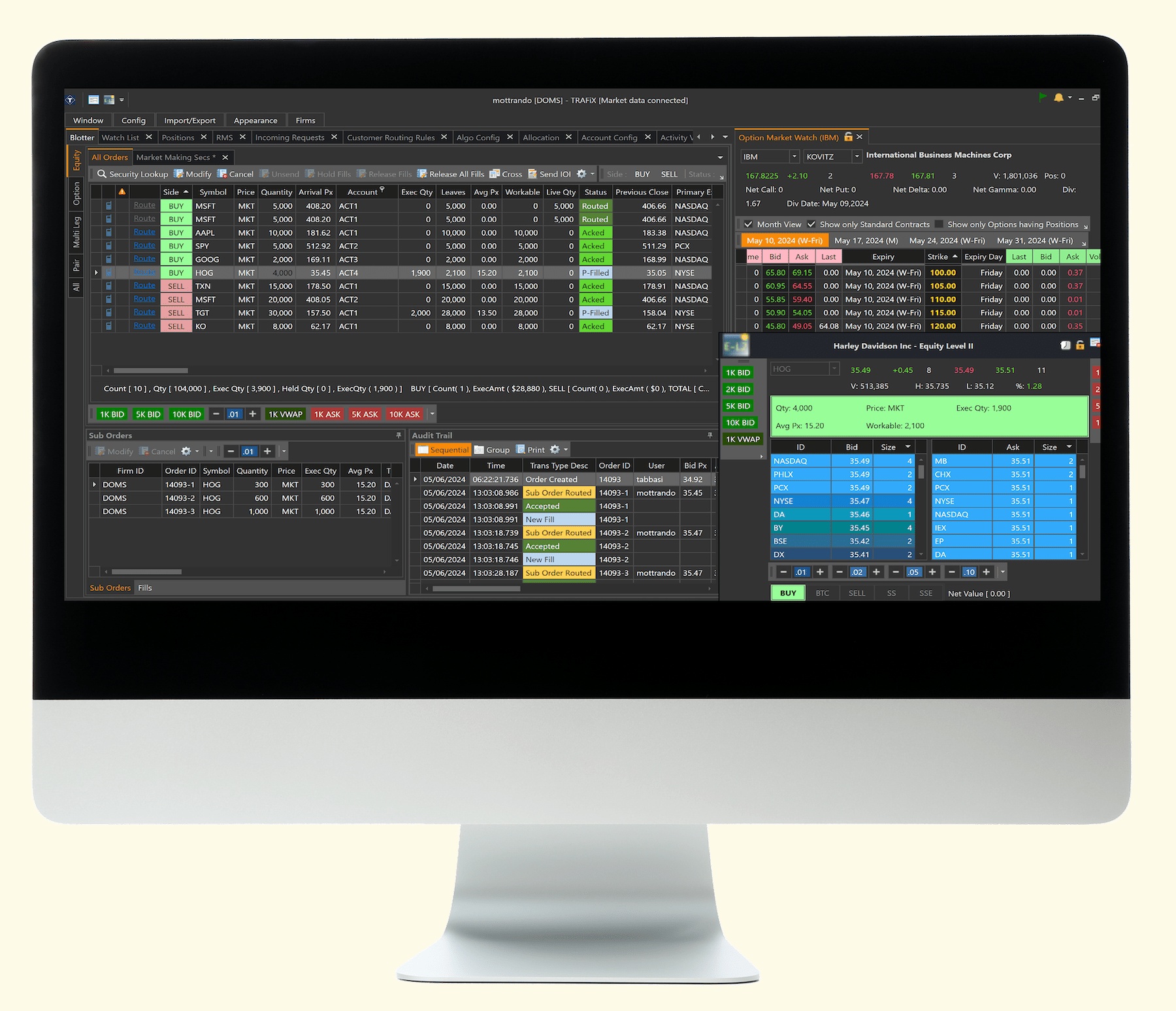
The customer is a broker-dealer, asset manager or proprietary trading firm. A broker-neutral platform lets the institution work across counterparties instead of organizing its technology around one executing broker. The practical attraction is choice, provided the necessary connections and workflows are in place.
- 01ManageOrders + limits
- 02ExecuteRoutes + fills
- 03Hand offAllocations + clearing
The expensive part is often between the boxes
TRAFiX’s account of its origins begins with aging trading infrastructure. Existing providers, it argues, faced difficult choices about replacing old systems or withdrawing from markets. Customers could inherit the expense and delay. This is the company’s diagnosis of its opening, rather than a documented failure of every competing product.
There are plenty of alternatives. A Cboe submission published by the SEC places TRAFiX alongside providers including FlexTrade, SS&C Eze, Bloomberg and TS Imagine. A feature checklist alone will struggle to settle that contest. TRAFiX’s position combines a newer architecture, modular connectivity and a service model intended to reduce the effort of adopting and running the system.
Its hosted model moves responsibility for servers, updates and connectivity toward the vendor. The economic argument is that infrastructure costs can be spread across customers while individual firms carry less operational work. That is a business rationale, not a measured savings figure. A buyer still needs to price the complete arrangement and decide how much infrastructure control to retain.
This is an enterprise sale: the institution buys software and connectivity services for its trading operation. The hosted offering adds continuing operational responsibility to that relationship. Evaluating it therefore means looking beyond the interface to the work the vendor will perform after launch.
A person comes with the software
TRAFiX describes dedicated implementation managers, continuing relationship managers and 24/6 technical support in its service commitment. Those people are part of the proposition. A routing change or unfamiliar workflow needs someone who understands what the desk is trying to accomplish.
ICAP provides an earlier example of the business traveling beyond its initial deployment. In 2020, the firms announced an expansion from their existing US relationship into equities desks in EMEA and APAC. By August 2026, Sigma Capital Partners MENA had selected TRAFiX to support its institutional brokerage expansion. Sigma’s announcement emphasized global access and a responsive relationship as well as execution capabilities.
The useful lesson for another enterprise software company is fairly concrete: implementation expertise can belong inside the product promise. The useful lesson for a buyer is to ask who will do the integration work, which systems must exchange information and how success will be measured. TRAFiX’s own buyer guidance starts with questions like these.
Connectivity also grows through other people’s networks. In 2017, IPC added TRAFiX to its Financial Markets Network, giving participating firms another way to reach its trading and routing services. That same year, Bats announced access to its BAM options auction through TRAFiX. Each connection makes the software useful in a specific place. A global platform is assembled through such practical arrangements, one destination at a time.
Canada came with local knowledge
In February 2023, TRAFiX announced its acquisition of ITS, the Canadian trading applications, connectivity and smart-routing provider. ITS brought a history dating to 1998 and local infrastructure expertise. Its existing products and customers were to remain supported as integration proceeded.
That detail matters. Selling into another market involves more than translating a screen. Connections, execution practices and operational requirements travel less neatly. Buying an established specialist gave TRAFiX a route into Canada with knowledge attached. The JonesTrading deployment followed later that year. Also in 2023, Marlin Equity Partners invested in TRAFiX, its first institutional capital, to support development, expansion and hiring.
Then customers asked for another asset class
On September 30, 2026, Trading Technologies acquired TRAFiX. TT reported more than 200 TRAFiX customers and connections to more than 100 trading venues. The strategic fit was straightforward: TRAFiX brought equities and equity options to a business with established strength in futures and an expanding asset menu.
Fitzgerald told The TRADE that customers wanted futures at TRAFiX and equities at TT. Building the missing capabilities separately would have taken years. The combination changed the build-versus-buy calculation. Financial terms were undisclosed.
The wider platform remains an integration project, with its benefits dependent on delivery. The six-week Canadian switch supplies a useful standard for judging that next chapter: watch a real customer’s workflow change, count the handoffs, and start the clock.