Consider the distance between a price on a screen and an order at an exchange. To the person clicking, it looks almost trivial. A number changes. A button is pressed. Somewhere else, a trade happens. Yet the journey involves market data, account permissions, risk checks, routing and an exchange willing to accept the instruction. The screen is the part you see. CQG has built a business around the rest of the journey, too.
- Two businesses in one: trading software for users, infrastructure for firms.
- Different kinds of reach: 85-plus data sources and direct access to 45-plus exchanges.
- A visible example: CQG powers futures infrastructure for three Webull APAC entities.
- A new owner: Broadridge completed its acquisition in April 2026.
A price is the beginning
CQG makes software for financial markets, with particular depth in futures and options. Its customers include traders, brokers, commercial hedgers, institutional firms and exchanges. These customers do not all want the same thing. A trader wants useful analysis and responsive order entry. A broker needs to administer accounts and control exposure. An exchange needs participants connected to its market. CQG occupies several positions along that chain.
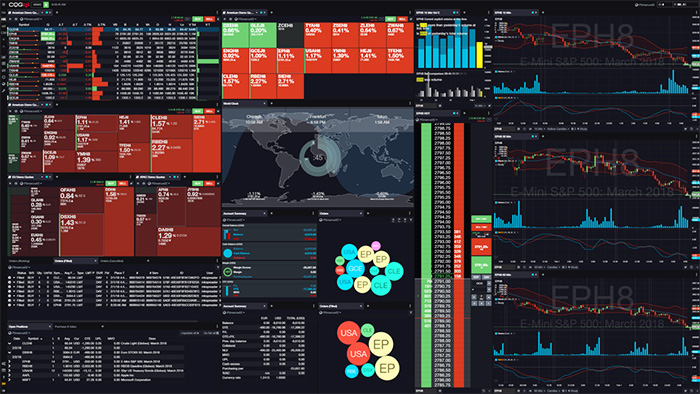
This helps explain why calling it a charting company is accurate but incomplete. CQG Integrated Client brings data, studies, charting and routing into one installed application. Users can develop and test trading systems; optional tools add automated execution and options analysis. QTrader offers a narrower subset of that functionality. The distinction matters because a desk should buy the tools its work requires, rather than a collection it merely admires.
Then there is CQG One, a professional platform built with HTML5, Protocol Buffers and WebSockets. It combines charts with order-entry tools, market-by-order depth, server-side smart orders and execution algorithms. Desktop and Mobile supply other ways into the ecosystem. The names can make the product family look like a software cupboard. Its organising principle is more practical: different users need different combinations of analysis, access and execution.
The screen is optional
The more revealing customer may be the one whose users never open a CQG-branded window. In November 2025, Webull Singapore announced that CQG would support its futures offering with trading infrastructure and global order routing. CQG’s relationships with Webull entities in Hong Kong and Malaysia had preceded it. Across those three markets, the work included routing, pre-trade risk management and access to a broker network.
Webull’s example makes the division of labour unusually clear. The broker can keep the interface its customers recognise while bringing in technology for the market connections underneath. A futures button may be new to the customer. It need not require the broker to invent every component behind it. CQG can therefore sell a finished workspace to one customer and ingredients for a workspace to another.
Those ingredients include APIs. CQG distinguishes individual client APIs, which run with Integrated Client on the same machine, from enterprise interfaces intended for systems serving multiple users. Its WebAPI delivers streaming market data, historical data and access to execution gateways. Public Python and JavaScript samples make the interface inspectable. Production access requires a formal conformance test. The jump from a working demo to an approved trading application is a real step.
- 01ObserveMarket data + charts
- 02DecideTrader or algorithm
- 03CheckAccount + broker limits
- 04RouteGateway to exchange
Distance has a price
CQG’s published network figures deserve careful reading. Market data from more than 85 sources is different from direct market access to more than 45 exchanges. One describes information arriving. The other describes places an order can go. A trader may be able to watch a market without being authorised to trade it. The broker, product, exchange and account permissions still matter.
For certain strategies, location matters as well. CQG manages spread orders, aggregated-market orders and smart orders on servers co-located with exchange matching engines. A spread links several legs, potentially across markets. Managing those legs close to the exchange reduces the geographic delay involved in responding to a changing order book. It does not turn every leg into a guaranteed fill.
This is professional execution infrastructure, and it has professional competition. Trading Technologies also offers charts, algorithms, spread tools, APIs and a co-located network. CQG’s useful distinction is the combination of its analysis products, data services and infrastructure distributed through brokers and other applications. Buyers should compare actual broker support and workflow requirements. A claim that one supplier is universally faster would tell them rather less than an answer about their particular contract.
The bill beneath the button
CQG charges for software, additional capabilities and trading activity. Its published basic monthly package for Integrated Client is $595, with CQG Trading listed separately at $250. QTrader and One each start at $100 plus per-fill charges. Desktop starts at $25 plus per-fill charges. Optional analytics, data entitlements and exchange fees make the eventual invoice more complicated than any of those opening numbers.
Base platform fees only. Trading, per-fill charges, exchange data, optional tools and broker costs can add to the total. Pricing checked October 2, 2026.
That pricing structure is also a map of the business model. CQG earns recurring software revenue and sells access to additional tools and infrastructure; transaction charges can tie parts of the bill to use. Distribution through futures commission merchants puts broker relationships inside the buying process. A platform subscription alone does not supply a funded account, a clearing relationship or permission to trade every instrument.
For someone evaluating the software, the useful first experiment is a defined workflow in a demo environment. CQG publishes trial details and training material. Test the symbols, order types, displays and account tools needed for the actual job. An attractive chart is easy to admire. Discovering that a required order type is unavailable on your intended route is a much more consequential observation.
From partnership to ownership
CQG’s history stretches back to Tim Mather’s founding of the company in 1980. It expanded into Europe in 1988 and Asia in 1998; in 2010 it launched Continuum for enterprise API solutions. Those milestones describe a steady widening of the business, from serving traders to supplying technology other firms could build upon.
In March 2023, CQG and Broadridge announced a partnership to connect CQG’s execution management system with Broadridge’s order management system. The distinction is significant. Execution management concerns getting trades done. Order management organises orders and related desk workflows. The announcement described clients having to piece together technology from several vendors, then bear the effort and cost of making the pieces cooperate. A FIX connection into Broadridge was already completed, with further development underway.
Later that year, a group of CQG senior executives bought the company from Mather. In a January 2024 interview, CEO Ryan Moroney presented the November buyout as a way to preserve leadership continuity and keep developing the business. In February 2026, Broadridge announced an acquisition agreement. Its earnings release records completion on April 30 and an approximate purchase price of $173 million plus contingent consideration. The completion announcement followed on May 1.
“For our clients, it remains business as usual.”
Ryan Moroney / CQG’s acquisition message
The partnership gives the acquisition a concrete rationale: combine execution, analytics and connectivity with a broader order-management offering. CQG’s client message describes a planned cohesive front-to-back platform and continued contact with existing teams. That is a stated direction, not a reason to assume every integration is finished. For customers, the useful test will be whether more of the trading workflow runs together with less intervention.
Borrow the sequence
The lesson for other companies is an editorial inference from CQG’s partnerships: separate the customer experience you need to own from the infrastructure you can sensibly obtain elsewhere. Specify permissions, data and execution needs before choosing the screen. Test the whole sequence. Price the whole sequence. A reusable connection can save work, but only if it supports the market and account you actually need.
That approach has limits. An unsupported broker, instrument or algorithm can rule it out. Developer teams still have to satisfy production requirements. For a user who needs only occasional chart inspection, the recurring costs and operational detail may be unnecessary. A well-connected trading tool also cannot rescue an unsound trading decision. The responsibilities of the software and its user remain distinct.
CQG’s September 28, 2026 release notes offer a suitably modest closing detail: equities short-sale controls, Order Ticket 2.0 and the ability to reorder chart panes. These are small changes to the workbench. After decades of expansion and a change of owner, the business still has to make the next order easier to handle. Financial technology earns its place one usable control at a time.
Explore CQG’s website, the product comparison, news and workspaces, the training library and API examples on GitHub.
Watch Setting up CQG One & Desktop or browse CQG’s YouTube channel. Follow LinkedIn, X and Facebook.