In 2005, First Merchants was forty-third in the Indianapolis banking market. Its share of local deposits was 0.11 percent. There are discreet entrances, and then there is arriving with approximately one dollar in every nine hundred. Mike Rechin joined that year as chief operating officer. He had spent a decade running National City’s Indiana commercial banking operations, and he thought the smaller institution had room to matter.
By June 2014, First Merchants had reached tenth place in Indianapolis, with $958 million in area deposits and 27 offices. Its local deposit share had risen to 2.5 percent. The progress gave substance to the opportunity Rechin had seen in 2005. First Merchants could compete in Indianapolis with a much smaller presence than the national banks.
There would be a much larger number by the time he retired as chief executive. Across his tenure, First Merchants grew from roughly $3 billion to $13 billion in assets. Yet the interesting part of his career lies in the decisions underneath that expansion: which markets to enter, which people to bring along, and how to leave the institution in their hands.
An English major enters the bank
Rechin grew up in Cleveland and studied at Miami University in Ohio, earning a bachelor’s degree in English and an MBA in finance. The combination offers a pleasing departure from the usual banker’s biography. Before the career devoted to balance sheets, there was a degree concerned with words.
His early professional training was thoroughly practical. In 1983, he entered BancOhio National Bank in Columbus as a corporate banking trainee. National City acquired BancOhio in 1984. Rechin subsequently worked in multinational and metropolitan Ohio commercial banking before taking on the Indianapolis assignment in 1995.
His responsibilities eventually stretched across commercial lending, treasury management, investment real estate and international banking. That breadth matters. A commercial banker encounters businesses through several doors: the loan that funds expansion, the systems that move cash, the property that houses operations. Rechin arrived at First Merchants with experience across those activities and a decade of working in Indiana.
The November 2005 announcement of his appointment described First Merchants as a $3.2 billion financial holding company. Its annual report singled out his Indianapolis experience as an advantage. He was joining a Muncie institution with an interest in the larger city down the road, bringing knowledge of the market it wanted to reach.
Columbus, Ohio
National City
First Merchants
First Merchants
Forty-third place leaves room to move
First Merchants had entered Indianapolis in 1998 with a Noblesville branch. When Rechin arrived, it had five area branches. The challenge was substantial, though he described the opportunity with little ceremony: the board wanted a more meaningful Indianapolis presence, the business logic appealed to him, and he believed he could contribute.
“You don’t have to be Fifth Third-sized or JPMorgan Chase-sized to be relevant.”
Mike Rechin, 2015
That observation sets the terms of the contest. National competitors had extensive branch networks. Trying to match them office for office would consume resources without necessarily giving First Merchants a useful identity. Rechin’s proposition allowed for a smaller footprint, provided the bank could win enough business within it.
The expansion combined local hiring with acquisitions. Michael Stewart, who became chief banking officer, was among the bankers who joined from National City’s Indianapolis operation. First Merchants also bought Plainfield-based Lincoln Bancorp in 2008 and Noblesville-based Community Bancshares in 2014. People and geography arrived together.
This was an expansion built around a particular place. Indianapolis offered a larger deposit market and opportunities beyond the bank’s established hometown base. Rechin’s earlier career gave him familiarity with that territory. The move from forty-third to tenth place was the visible result of years spent adding relationships, offices and businesses.
Growth has an address
Acquisitions can make a bank’s story read like a list of changing names. Rechin’s deals become easier to understand when put on a map. In 2013, First Merchants agreed to acquire CFS Bancorp, parent of Citizens Financial Bank in Munster. Northwest Indiana and northeastern Illinois extended the bank into neighboring territory.
When that merger closed in November, the combined bank had 95 banking centers and approximately $5.5 billion in assets. Customers of Citizens would gain access to additional services, including trust and wealth management. Rechin emphasized the capital and lending capacity available to the expanded operation.
Six years later came Monroe Bank & Trust. The Michigan institution brought 20 banking centers in the southeastern part of the state and about $1.3 billion in assets as of June 2019. The transaction closed effective September 1. The company planned to complete the integration that autumn.
These were specific additions to a regional footprint. Munster and Monroe were places with existing bankers, customers and institutional histories. Monroe Bank & Trust dated to 1858. Each acquisition brought an established organization into First Merchants, with the accompanying work of helping customers and employees through a change of ownership.
First Merchants assets · Rounded figures from the September 2020 retirement announcement. Two comparison points, not an annual growth series.
The work between signing and belonging
One revealing artifact of the Citizens acquisition is the customer welcome booklet. Signed by Rechin and regional president Daryl Pomranke, it set out the February 2014 transition weekend, explained the additional services, and directed customers to their local banker for assistance.
It is easy to pass over such a document. It contains the kind of practical information people need when somebody changes the name on their bank. But it also shows where a regional growth strategy meets ordinary life: customers want to know what will happen to their accounts and whom to ask about it.
By early 2020, Rechin’s stated priorities included establishing the First Merchants brand in Michigan, developing relationships, expanding community lending in metropolitan markets, maintaining pricing discipline and investing in digital delivery. The agenda covered both the newly acquired territory and the continuing business of serving customers.
That mixture gives the growth figures some texture. Acquiring a bank adds assets at a stroke. Making the combination useful calls for decisions about lending, technology and service long after the announcement. Rechin’s priorities acknowledged that continuing work rather than treating the transaction itself as the finish.
A life with more than one boardroom
Indiana became home. A 2011 profile placed Rechin and his wife, Debbie, in Carmel with their three children. It also described an avid golfer and a sports fan whose loyalties included Indiana and Cleveland teams. Geography, evidently, did not require an exclusive contract.
His civic commitments reached into cultural and educational organizations. Over his career, he served on boards associated with the Arts Council of Indianapolis, Minnetrista, Conner Prairie and The Center for the Performing Arts. Those positions put museums, the arts and regional civic life alongside his banking responsibilities.
There is a concrete example of how those connections continued through colleagues. In 2025, former First Merchants regional president David Greene recalled getting involved with the performing arts center after Rechin joined its board. Greene described the bank’s sponsorship of the gala’s cocktail reception and his own subsequent years helping the event.
The connection is modest enough to be instructive. A board appointment led to a bank sponsorship and another colleague’s sustained involvement. Community participation, in this instance, had names, an event and people willing to keep turning up.
Three promotions, one departure
Rechin’s retirement announcement in September 2020 named three successors to new responsibilities. Mark Hardwick would become CEO, Stewart would become president, and Michele Kawiecki would become chief financial officer. The changes would take effect on January 1, 2021, after Rechin’s final day as CEO on December 31.
The trio came from inside the institution. Hardwick had joined in 1997, Stewart in 2008 and Kawiecki in 2015. The board described their promotions as the result of a succession process developed over time with Rechin. His departure therefore carried a second message: the management team was ready to move.
His own plans included remaining on the board and helping the next leadership team. A two-year consulting agreement provided for part-time assistance, when requested, with matters including acquisitions, investor relations and customer relationships. It gave the transition a defined practical arrangement.
He also made a personal declaration that was refreshingly free of strategic vocabulary: “My wife Debbie and I consider Indiana home.” After years spent expanding a Muncie bank’s reach, he intended to stay in the state where he had built much of his working life.
The next handoff is already on the calendar
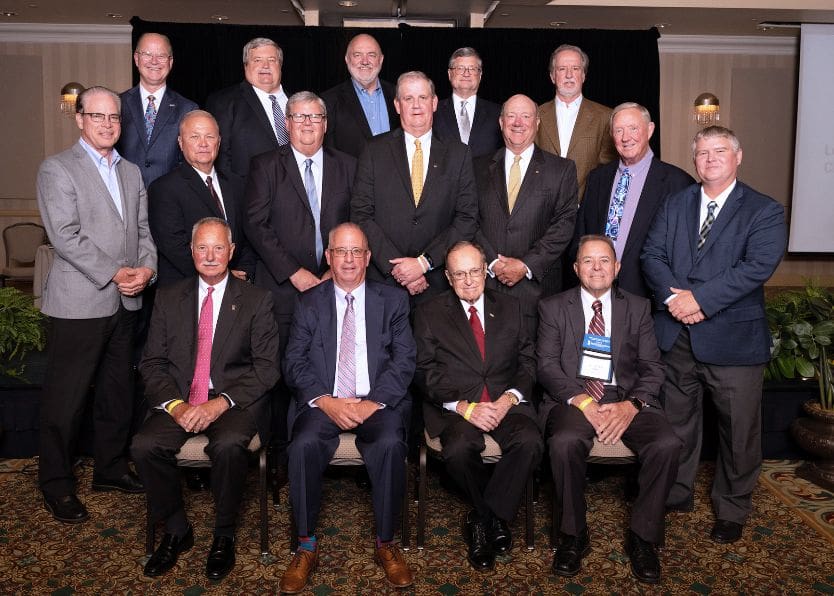
In August 2021, Rechin joined the Indiana Bankers Association’s class of Leaders in Banking Excellence. The ceremony in French Lick recognized current and retired bankers for their contributions to their institutions and communities. Each honoree received a keepsake plaque; a permanent Wall of Excellence stands in Indianapolis.
Today, Rechin serves as First Merchants’ board vice-chair, with membership on its Risk and Credit Policy and Trust Oversight committees. His executive tenure has ended, while his connection to the institution continues through board oversight.
On October 1, 2026, First Merchants announced another transition: Hardwick would retire at year-end, and Stewart would become president and CEO at the start of 2027. The two colleagues promoted when Rechin stepped down were again central to the bank’s succession.
That brings the story back to his early Indianapolis ambition. Rechin joined a bank with a small local presence and helped it grow into a larger regional institution. Six years after his departure as CEO, people who worked alongside him are preparing its next handoff. The career can be measured in assets. It can also be followed through the colleagues still carrying the work forward.