The most revealing number in Rohit Arora's business may be the one that arrives when nobody is supposed to be working. At Biz2Credit, 47 percent of applicants apply after normal business hours or during weekends. It is easy to read that as a web-traffic fact. It is really a portrait of the customer: the restaurateur closing the register, the contractor back from a site, the shopkeeper finally alone with the books. The loan application begins after the business day has spent everything else.
Arora has been studying that collision between the lender's process and the owner's life for almost two decades. His career has moved through private investment, consulting, an online credit marketplace, direct financing, bank software, data analytics, and now AI. The vocabulary became more technical. The problem stayed almost stubbornly ordinary. A viable small business needs capital, and the person running it has neither a finance department nor an afternoon to waste.
The application after closing time
47% apply after hours or on weekends. The remaining 53% apply during business hours. A digital journey is not cosmetic when the borrower works a different clock.
01A profitable contradiction
Arora came to New York from Delhi in 2003. Before that, he had worked for GIC in Singapore. He arrived with an engineering degree, studied international business at Columbia, and then joined Deloitte Consulting in business strategy. In 2006, while researching the profitability of bank portfolios, he found a contradiction with excellent manners. Small-business loans could be profitable for banks. Small-business owners still described getting one as a slog.
The contradiction sharpened on New York's streets. The city was full of immigrant-run groceries, restaurants, professional practices, and neighborhood shops. Arora spoke with owners who could obtain a mortgage more easily than financing for the enterprise that paid the mortgage. Many had limited familiarity with the American credit system. Some felt intimidated walking into a bank. Few had a CFO to translate their ambitions into a file a lender would welcome.
Rohit and his brother Ramit began by helping members of the South Asian community navigate business-loan applications. This was not yet the sleek origin scene startup folklore prefers. It was paperwork, explanation, document gathering, and the patient decoding of institutional expectations. Precisely because it was manual, it taught them where the friction lived.
“Small business owners are very busy people, they don't have much time, and don't have CFOs.”Rohit Arora, describing the original customer problem
02The first interface was human
Biz2Credit emerged in late 2007 as an online financing marketplace. An owner could bring information to one place, see possible financing routes, and avoid repeating the same pilgrimage from lender to lender. The timing was severe. The financial crisis arrived almost immediately, credit tightened, and the young company had to survive while its chosen industry was recoiling from risk.
Yet the downturn also clarified the value of an alternative route. Banks became more cautious. Owners still needed inventory, equipment, real estate, and working capital. An online process could offer less paperwork and a clearer sense of whether money, terms, and timing were plausible. Arora later said customers valued certainty and transparency as much as speed. Suspense is charming in a novel. It is expensive in payroll week.
One borrower has stayed in Arora's repertoire of stories: a New York entrepreneur whose specialty was macaroni and cheese. Biz2Credit helped fund her first stall in Manhattan. She later opened additional locations. It is a wonderfully un-Financial-District example. Capital did not disappear into an abstract portfolio. It became ovens, counters, shifts, and several more places to sell an emphatically specific lunch.
03A bank branch inside the pocket
Arora also remembers the first iPhone as an “aha moment.” In 2007, the internet was breaking its leash to the desk. A business owner would no longer need to be seated at a desktop, much less standing at a branch, to begin a financial task. The device did not solve underwriting. It changed what customers would soon consider reasonable.
This distinction matters. Fintech is often narrated as technology arriving with a trumpet and scattering old institutions. Arora's version is more practical. Technology removes repetitive steps. It gathers documents, connects accounts, and analyzes a larger set of signals. The consequential work is not making money feel modern. It is shortening the distance between a working business and an informed decision.
04Turning the platform around
The original Biz2Credit proposition faced the borrower. Over time, the Aroras learned the lender's side with equal intimacy: credit rules, document review, fraud checks, compliance, risk appetite, and the ancient institutional sport of persuading one system to speak to another. In 2019 the company launched Biz2X, a software platform that lets financial institutions build digital small-business lending experiences of their own.
This turn created a two-sided education. Biz2Credit could see what owners submitted and how their businesses performed. Biz2X could package those lessons into workflows for institutions. The company says its financing platform has served more than 200,000 small and midsize businesses and facilitated more than $8 billion. Those figures describe scale, but the more interesting asset may be the accumulated pattern recognition: what a healthy business looks like before the paperwork becomes stale.
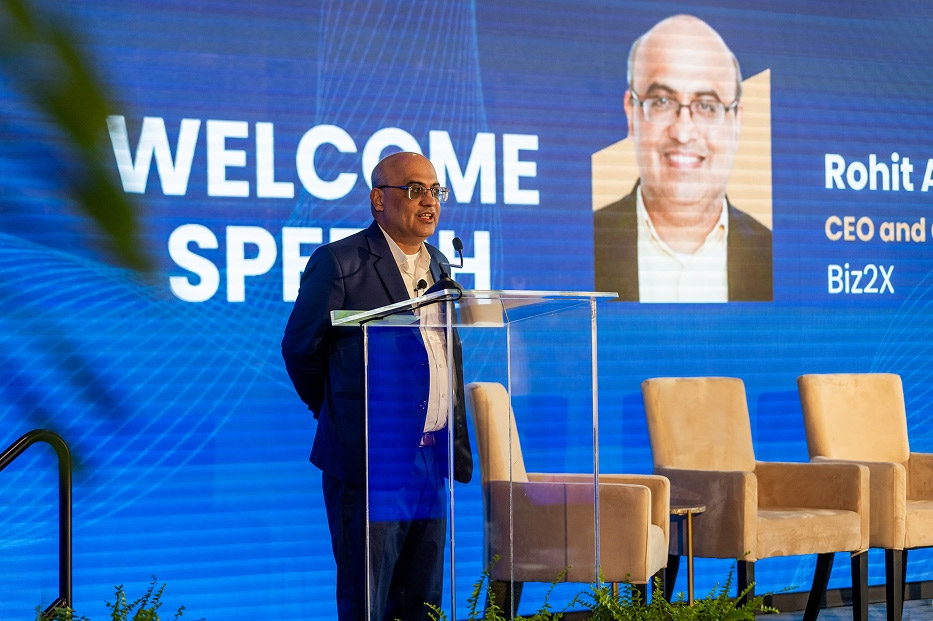
Arora's public work grew alongside the platforms. He has written extensively about lending and small-business economics, overseen recurring credit reports, and spoken with policy and finance leaders. In 2011, Crain's New York Business named him an Entrepreneur of the Year. By 2026, his stage had widened to a World Bank Group-IMF Spring Meetings session on new approaches to financing small and midsize enterprises. The subject was global. The basic question would have sounded familiar in a New York shop in 2007.
05Read the business while it is moving
Arora's current argument is that traditional credit evaluation spends too much time looking in the rearview mirror. Tax returns arrive months after the period they describe. Static credit scores compress a complicated enterprise into a tidy judgment. Meanwhile, bank feeds show cash entering and leaving now. Payment systems, payroll, and accounting data can offer a more current view of the operation.
This does not make lending simple. A restaurant's cash flow differs from a dental practice's; a seasonal retailer can look sick in February and perfectly ordinary in November. The point of richer data is context. A useful system should compare a company with relevant peers, notice changes over time, and help distinguish a temporary wobble from a structural problem.
“You have to solve problems and you have to play that long term.”Rohit Arora on building through cycles
The long term has included several abrupt short terms. During the pandemic, Arora says his team reengineered its platform around special government-loan rules in roughly two to three weeks. He also recalls an early self-taught machine-learning model turning a four-to-six-week development problem into work completed in a few days. These stories appeal because the clock moves dramatically. Their sober lesson is about preparedness: years spent structuring messy financial data make speed available when a new rulebook lands.
Arora describes AI as a way to automate repetitive work, analyze more data, detect patterns, and inform risk. He has also stressed that a human still reviews lending applications and analysis.
06The person still in the room
Arora is bullish about AI without pretending the loan can float free of responsibility. He has called job replacement a common misperception and emphasizes automation of repetitive functions. In lending, he says, people still review the application and analysis. It is a sensible boundary in a field where a fast mistake can be both efficient and ruinous.
His own habits sound less robotic. He says he reads technology news every morning. Around 2015 or 2016, an article about machine learning in manufacturing pipelines prompted him to wonder whether similar methods could improve underwriting. Curiosity here is not a decorative founder trait. It is the practice of carrying a useful pattern from one industry into another, then asking engineers to test it against reality.
There is also a family structure beneath the technology. Rohit remains the strategist and CEO; Ramit, Biz2Credit's president and co-founder, has led credit and sales operations. Their partnership began before the company, with a shared intention to build something of their own. Almost two decades later, the division of labor still mirrors the two truths a lender must hold at once: somebody has to imagine a different system, and somebody has to make the credit work.
07The business behind the number
In 2026, Arora is talking about embedded finance, connected tax and payment systems, agentic AI, and more competitive capital markets. He convenes executives and policymakers at Biz2X Frontiers and publishes readings of the small-business economy. The language belongs to institutions. His sharpest evidence still comes from owner behavior.
Someone applies on Sunday because Monday is already spoken for. Someone needs a decision quickly because an equipment bargain, a lease, or a contract has an expiration date. Someone with a good business looks mediocre in an old document. Each inconvenience is a clue about the system that produced it.
Arora's career can be read as a long exercise in taking those clues seriously. He began close enough to borrowers to see the intimidation in a form. He built a marketplace to reduce the wandering, a financing operation to make decisions, and software to help institutions change their own machinery. Now he wants AI to read the signals faster without removing the accountable person from the room.
The grand aspiration is to narrow the small-business financing gap around the world. The memorable image is smaller: a shop is dark, the day's receipts are counted, and an owner opens a loan application after everyone else has gone home. For Rohit Arora, that late hour is not an edge case. It is where the design begins.