The modern business loan has a peculiar front and back. The front is a calm browser window asking for revenue, ownership and a few documents. The back is a cupboard after an earthquake: identity vendors, tax returns, credit bureaus, policy rules, pricing grids, exceptions, signatures, servicing records and compliance logs. Biz2X is in the cupboard business.
The New York company sells cloud software to banks, credit unions, nonbank lenders and companies that want to embed financing inside another commercial experience. A lender can use it to collect an application, analyze cash flow, apply its own credit rules, produce a decision or counteroffer, close the loan, service it and watch the portfolio for trouble. The borrower gets speed. The banker gets fewer swivel-chair handoffs. The risk team keeps an audit trail.
That distinction matters. Plenty of fintech products digitize the form. Biz2X is trying to digitize the institution around the form.

The product came after the scar tissue
Rohit and Ramit Arora started Biz2Credit in 2007, just as the credit system was about to demonstrate how abruptly it could stop. Their original business connected small companies with financing. The operation later lent more directly, accumulating the kind of knowledge that rarely appears in a product requirements document: which fields borrowers misunderstand, where underwriters pause, what changing rules do to throughput and which warning signs arrive before a missed payment.
Biz2X, launched as a separate SaaS platform in 2019, is the productized version of those observations. The founders did not begin with a blank whiteboard labeled “banking transformation.” They began with a working lending operation and extracted repeatable machinery from it. That is the part another founder can copy. Run the painful service. Mark every repeated judgment, handoff and reconciliation. Build software only where the pattern is stable enough to deserve it.
“The lending app is the visible inch. The product is the mile of decisions behind it.”YesPress analysis
The first thing that failed was not a Biz2X product. It was the broader assumption, exposed in the financial crisis and again during pandemic-era emergency lending, that branch visits and paper-heavy processes were reliable infrastructure. Credit policy could change in days while old systems expected years of calm. Biz2X's answer was configurability: give a lender tools to change workflows, rules, products and data connections without rebuilding the whole stack.
One loan, fewer handoffs
and verify
cash flow
counteroffer
service
risk
What the bank is actually buying
The catalog runs across the credit lifecycle. The loan origination system handles applications, document uploads, underwriting workflows, e-signatures and integrations. Risk Analytics adds financial analysis, scorecards and a decision engine. The loan management system takes over after disbursement. Portfolio Monitoring watches exposure, covenants, cash flow and early-warning signals. Collections tools manage what happens when repayment goes sideways. An SBA edition adds program-specific checks and reporting.
In India, DigiKred packages CRM, origination, a business-rules engine, loan management, monitoring and collections into one suite. Maadhyam, launched in 2022, connects lenders with aggregators, anchors and SME borrowers. Embedded Finance moves the same capability into a partner's environment, so financing can appear beside a purchase or inside a merchant platform.
The customer list explains the market position better than a quadrant ever could. Public case studies name HSBC, Popular Bank, BayFirst and Australian Finance Group. Newer partnerships include regional banks, digital lenders and commerce platforms. They do not all need the same thing. A community bank may want an SBA workflow without hiring a software department. An international bank may need a controlled route into a new small-business segment. A marketplace may want financing to appear at checkout without becoming a lender itself. Biz2X sells the configurable layer beneath those different ambitions.
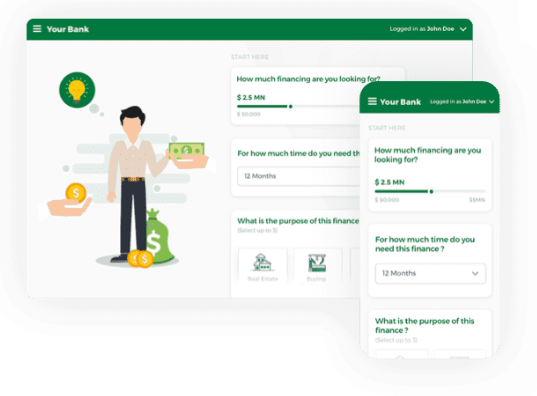
Biz2X says its technology has processed more than $32 billion in originations globally. Product pages advertise outcomes such as 40 percent faster decisions, twice the portfolio growth and roughly 10 percent fewer defaults. Those are company claims, not universal laws. They describe the intended ceiling, not what appears simply because a contract was signed.
The commercial model follows enterprise convention. There is no public checkout button and no $49 monthly tier. Buyers request a demo; pricing changes with organization size, loan products and functionality. Revenue has been externally estimated at about $18.8 million a year, but Biz2X does not publish standalone accounts, funding history or valuation. The supplied company record puts headcount near 350, consistent with LinkedIn's 201-500 range and a Great Place to Work listing of 324 India-based employees. The picture is of a private, service-intensive SaaS company with a substantial delivery organization, not a tiny team shipping a generic API.
The counteroffer tells the whole story
Approval gets the confetti, but the counteroffer is the more revealing feature. Real commercial lending is not a binary parade of yes and no. A borrower may qualify for a smaller amount, a different term or another product. Software that can automate that response is encoding how a bank actually conducts business, not merely how a demo proceeds.
Central Pacific Bank offers a useful example. It first used Biz2X for SBA lending, then expanded the relationship in 2026 to non-SBA small-business products. The wider implementation brought automated decisioning and counteroffers, tax-return spreading, digital forms and connections to systems including LaserPro and FICO LiquidCredit. The change of mind was empirical: a narrow deployment showed enough flexibility and efficiency to justify a broader one.
Elsewhere, TAB Bank adopted the platform to streamline SMB decisioning. Deem Finance announced a UAE program that uses point-of-sale sales data rather than relying only on static balance sheets. Watermelon Ecosystem brought embedded lending and invoice financing to food-and-beverage merchants in the Middle East. TruBoard added collections capability to Maadhyam in India. The pattern is consistent: Biz2X enters where lending collides with a specific operating context.
That geographic spread adds another constraint. Credit is local even when software is global. Data sources, identity checks, disclosures, loan products and collections practices change across the United States, India and the Gulf. A platform earns its keep by holding a common architecture underneath those differences without pretending the differences have vanished. Biz2X's India team gives the company engineering scale and local product depth; its India operation marked a fifth consecutive Great Place to Work certification in 2025. Culture claims are easy to print, but five repeated certifications at least indicate that the organization measures the employee experience consistently.
The price is more than the invoice
Biz2X does not publish a price card. The company says cost varies by institution size, lending products and required functionality. That usually means enterprise licensing plus configuration, integrations and implementation work, but exact contract terms are private. The honest budget includes a second column: people who must clean data, map policy, test models, redesign approvals, train staff and govern exceptions.
This is where transformation projects become expensive even when software works. Automating a confused process produces faster confusion. A risk team that cannot articulate its rules will struggle to configure them. A bank whose customer records disagree across systems will carry that disagreement into the new platform. And machine-learning scores do not eliminate accountability. In regulated lending, an institution still needs explainable policy, monitoring and humans who know when to challenge the machine.
What to steal - and what to leave alone
The copyable strategy has five moves. First, begin in an operational niche where the pain is frequent and expensive. Second, collect structured evidence about where time disappears. Third, automate the repeatable judgment while preserving a route for exceptions. Fourth, make policy configurable so the product can cross customers and markets. Fifth, expand along the lifecycle, because the output of one workflow becomes the input of the next.
What should not be copied blindly is the breadth. Origination, servicing, risk, monitoring and collections make sense together after a company has earned domain depth. A young startup attempting all of them at once would be building six products before learning why one buyer says no. Biz2X could widen because Biz2Credit supplied years of cases, data and institutional memory.
That background is also its clearest difference from large core-banking suites and young point solutions. Compared with a broad vendor, Biz2X is more tightly centered on small-business credit. Compared with a single-purpose tool, it offers continuity after the application is approved. Compared with an internal build, it brings patterns already tested across lenders and geographies. The tradeoff is predictable: more coverage asks for more implementation discipline.
The competitive field is crowded. nCino, Finastra, Temenos and Mambu approach from banking platforms; Amount and Numerated come from digital origination; LoanPro emphasizes servicing; specialist data companies attack individual underwriting tasks. The stubborn competitor is the bank's own spreadsheet, wrapped in habit and institutional knowledge. Biz2X does not win merely by having more modules. It wins when a lender believes one connected system will be easier to govern than the collection of tools and manual work already paid for.
There is nothing mystical here, which is precisely the appeal. Small businesses want answers. Banks want control. Regulators want evidence. Biz2X tries to let all three coexist inside one configurable chain of work. Its best idea is not “AI-powered lending.” It is that software becomes valuable when it remembers every unglamorous place a loan can get stuck.
Keep digging