Six weeks is a useful unit of time for a banking software company. It is short enough to get attention and long enough to invite questions. In January 2024, Fimple announced that it had deployed its core banking platform at Türkiye’s Dünya Katılım in a month and a half. The installation went into the bank’s own data center. A cloud-native product had found a home on the customer’s premises.
That episode captures Fimple’s proposition better than its long menu of technical terms. The company wants banks to assemble financial services from reusable software components, with room to choose how those services run. Its pitch is about the distance between a product meeting and a working product: how much software must change, how many systems must connect, and how often the bank must start again.
The six-week account is a vendor-reported deployment milestone, not a universal timetable for opening a bank. Still, it supplies something more concrete than a promise of speed. Fimple had a named institution, a working installation and a story it could take into the next sales meeting.
Reported core platform deployment at Dünya Katılım. A specific implementation, not a standard launch guarantee.
The founders had already worked inside the bank
Fimple began in January 2022. Co-founders Mücahit Gündebahar and Abdurrahman Çınar brought experience from Kuveyt Türk Participation Bank. Gündebahar had served as its chief information officer; Çınar’s roles included enterprise architecture and IT service management. Their background matters because core banking requires knowledge of what an institution does after the customer taps a button.
A 2024 company press release described their ambition to build an independent software business that could serve different banks. The founders put it this way: “We established Fimple to break free from the limitations imposed by traditional banking systems.” The ambition was to turn banking experience into a repeatable product business, serving institutions with different requirements.

The firm’s employment pitch is similarly practical: customer feedback, simple solutions, collaboration and knowledge sharing. Its careers page advertises flexible hours, home-office work and, with pleasing specificity, office snacks. Those are the employer’s stated priorities. The more consequential cultural test is whether a growing team can keep incorporating customer requests without turning a shared platform into a collection of unrelated projects.
A loan is a chain of jobs
Fimple sells the software underneath financial services. Its customers are institutions: banks, lenders, fintechs and businesses building financial offerings. An individual borrower might encounter its technology through a lender’s application, without ever seeing the Fimple name.
Consider a loan. The institution needs a customer record, an application, a decision process, limits, perhaps collateral, a disbursement and a way to manage the debt afterward. Fimple’s lending offering covers origination and lifecycle management; its broader suite supplies related banking functions. That breadth is part of the sales argument. A lender is buying connected operational capabilities, not merely a screen that accepts an application.
Deposit management handles another set of everyday jobs: opening accounts, calculating interest, withdrawals and statements. Elsewhere in the catalog are treasury, accounting, payments, transfers and collection management. The business value depends on how well those functions fit the institution’s products and existing systems. A long feature list helps only when its pieces work together.
Illustrative sequence using capabilities in Fimple’s catalog. The institution chooses its own process.
Fimple calls its approach Financial Function as a Service. The label describes banking capabilities delivered as components that institutions can combine. For a buyer, the interesting question is which parts of its own product plan can be assembled from those existing components.
Two composers, different jobs
Transaction Composer is Fimple’s tool for developing and reconfiguring financial products. Magic Process Designer addresses the workflow around them. The distinction is useful: defining a product and arranging the sequence of actions that delivers it are related tasks, but they are not identical.
The process designer offers a visual low-code or no-code environment, prebuilt connectors and API-based data exchange. Fimple also describes debugging, monitoring and retry mechanisms. These are less photogenic than a mobile app, but they matter when a process encounters an exception. An integration needs a response when the next system does not answer as expected.
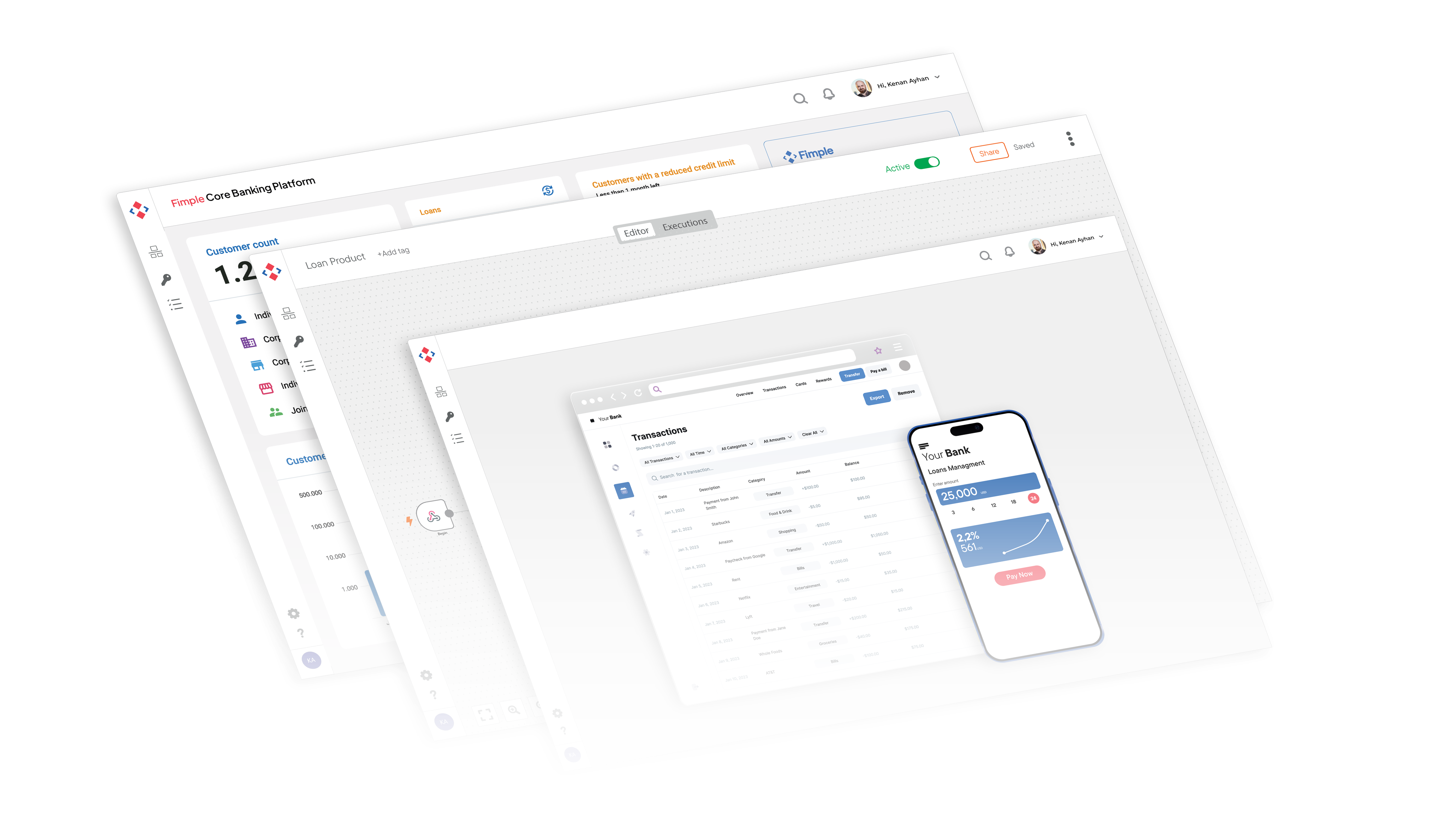
The company also offers a marketplace of technology partners and a common core banking interface. The intended benefit is less repeated integration work and a more coherent operating experience. For an institution with specialist providers already in place, the practical attraction is the chance to connect those services to the core and describe how work should move between them.
Islamic finance gives the pitch an address
Fimple’s participation banking experience is visible in its product range. Its Islamic banking offering includes support for Murabaha, Ijara, Mudaraba and Musharaka, together with tools for Sukuk and integration with Takaful services. These are specific financial structures and operational requirements that a platform must accommodate.
In August 2025, Fimple made the combination of Islamic and conventional services central to its Gulf expansion announcement. It presented a dedicated Islamic Banking Suite within the same architecture as its broader banking capabilities. That positioning connects the founders’ experience to a regional commercial strategy.
The distinction is more useful than treating “cloud-native” as a unique invention. Thought Machine’s Vault Core also separates product logic from underlying banking capabilities, using programmable smart contracts. Mambu, Tuum and Temenos occupy the wider field of alternatives. Fimple’s case rests on the particular combination it can deliver: configurable products, operational workflows, participation banking knowledge and deployment choices. Which combination wins depends on the buyer’s actual requirements.
The cloud still needs somewhere to live
Fimple’s August 2026 partnership with Bulutistan in Uzbekistan makes that last point tangible. Fimple supplies the banking platform; Bulutistan supplies local cloud infrastructure. The arrangement is designed to let institutions use the software with infrastructure and data inside the country.
The lesson is geographical as much as technical. A software architecture may travel well while its hosting arrangement needs a local answer. Fimple’s account of the partnership identifies data location as a barrier to adoption and presents in-country infrastructure as the response. The agreement turns deployment flexibility into a concrete route to a market where the location of infrastructure matters.
The September 1 TulipTech agreement addresses a different need: access to buyers in Bangladesh. TulipTech will introduce Fimple to financial institutions and support joint market activity. Fimple calls this its first formal step into South Asia. A distribution partnership opens conversations; it should not be confused with an installed customer base.
$27.5 million buys a longer itinerary
Fimple’s disclosed financing tells an expansion story. A $2 million pre-seed investment in May 2022 was followed by a $3.5 million bridge round announced in December 2023. APY Ventures led the bridge, alongside KT Portfolio, Tera Portfolio and angel investors.
In February 2025, DN Capital and Smartfin led a $12 million Series A, with existing investors participating. The company named Aytemiz Investment Bank, Misyon Bank, Hedef Investment Bank and Q Investment Bank among its customers, and earmarked capital for product development and international growth.
Four announced rounds. $27.5m total. Financing raised, not revenue or customer implementation cost.
Another $10 million followed in January 2026, led by Ak Asset Management VC Fund with DN Capital, Smartfin and APY Ventures participating. This announcement emphasized the GCC and recently launched commercial offices in Dubai and Riyadh. By September, Fimple reported working with more than 35 financial institutions across 10 countries.
For customers, the commercial model is B2B software, with usage-based pricing advertised on the website. The economic proposition is to reuse banking capabilities and integration work across products. The buying calculation must therefore connect usage, implementation scope and ongoing changes. Funding measures the vendor’s financing; it does not tell a bank what its own project will cost.
Ask for the change nobody rehearsed
Fimple’s own August 2026 essay on moving from licence to launch offers a useful way to examine its pitch. Co-founder Çınar recommends testing a platform against the buyer’s products and difficult scenarios, and asking how much is configuration versus development. The essay also acknowledges that some requirements need integration.
That suggests a practical exercise: bring one real product to a demonstration, then change a meaningful requirement. Watch who can make the change, what must be retested and which external systems become involved. Compare the result with the institution’s own operating constraints. A rehearsed path through a demonstration cannot settle those questions.
Bring the product. Then change the brief.
An editorial takeaway from Fimple’s approach to platform evaluation
The approach is most persuasive when a bank’s requirements map well to available functions and its team can manage the surrounding integrations. Heavy customization or unresolved operating dependencies would weaken the speed argument. Fimple’s creation of a services business in 2022 is a reminder that banking software still arrives with implementation work attached.
The next persuasive evidence will be more specific deployments: what went live, how much was configured and what happened when the customer wanted something different. Six weeks made a useful calling card. The enduring product is the ability to keep changing after the first launch.
Follow the product, and the people
Explore Fimple’s platform, API documentation and video tutorials. Read its company news and licence-to-launch essay.