A restaurant owner does not need “capital efficiency.” She needs two ovens before the holiday rush. A contractor does not dream about a credit facility. He needs to cover payroll while three customers take their sweet time paying invoices. Biz2Credit built its business around this translation problem: turn the untidy life of a small company into a file that somebody is willing to finance.
Brothers Rohit and Ramit Arora started the New York company in 2007 after seeing immigrant entrepreneurs and other small-business owners struggle to obtain credit. Rohit had worked in investing and consulting; Ramit came from banking and corporate finance. The pair noticed that consumer finance was moving online while business credit remained a paper chase. Their first important decision was negative. “We will not be lead generators,” Rohit later recalled. They wanted to underwrite, match and service financing, not simply collect an owner’s phone number and auction it to lenders.
One company, two customers
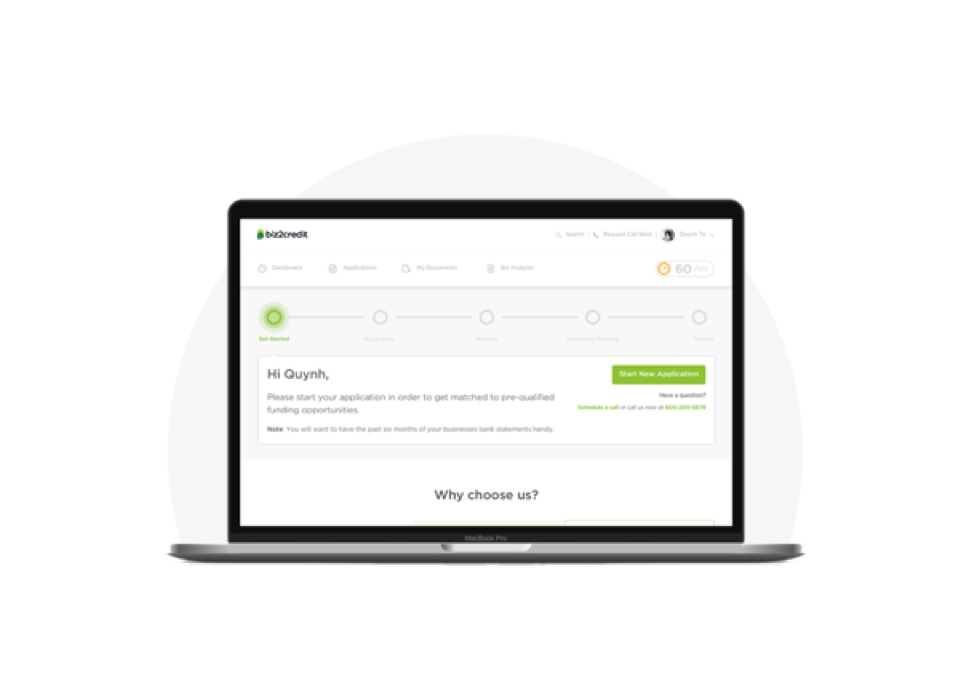
Today, Biz2Credit has two faces. The first is the website an owner sees: create an account, connect business information and bank statements, get prequalified, finish an application, wait for a decision. The current menu emphasizes fixed-rate term loans from $25,000 to $2 million, revenue-based financing from $25,000 to $2 million or more, and a line of credit up to $500,000. Published guideposts include a year in business, $100,000 in annual revenue and a 650 FICO score for term-loan eligibility. Approval is not guaranteed, and availability varies.
The second face is Biz2X, the software sold to banks and financial institutions. It handles digital applications, origination, underwriting, servicing, monitoring, risk and analytics. That is the clever bit. Biz2Credit did not invent lending software in a quiet lab. It learned from actual applications, payments, missing documents and declining cash flow, then packaged the machinery. Institutions including HSBC, Oriental Bank and Tata Capital have been named as customers or deployment partners. A separate portal built with CPA.com lets accountants shepherd client applications from one dashboard.
The operating-data flywheel
The economic model is correspondingly mixed. Applications are free. Biz2Credit and its wholly owned Itria Ventures subsidiary earn revenue when financing closes and through origination and servicing activity; partner lenders fund some products. Biz2X adds software and implementation revenue. Referral partners can earn a percentage of funded transactions. This is not the airy margin profile of a pure SaaS company. It is a capital, compliance, service and software business sharing a trench coat.
What it costs - and what you are buying
Biz2Credit does not publish one universal annual percentage rate or fee schedule because pricing depends on the applicant and product. It says there is no application fee; closing costs and material terms appear in the financing agreement. That makes the first-page disclosure the most important screen in the product. Owners should compare total dollars received, total dollars repaid, payment frequency, collateral or liens, guaranties, prepayment treatment and what happens when revenue falls.
A conventional fixed-rate structure with a defined term, currently advertised at 12 to 36 months and $25,000 to $2 million. Better suited to a planned investment with predictable repayment capacity.
A purchase of future receipts, not described as a loan. Remittances track receipts until the purchased amount is delivered. It commonly includes a UCC lien and personal performance guaranty.
The distinction is not wordplay. A business with lumpy but healthy sales may value repayment that adjusts with receipts. A thin-margin company can discover that frequent withdrawals consume the oxygen the financing was supposed to provide. A line of credit can be cleaner for repeat, short gaps because the business pays on what it draws. A bank or SBA loan may be cheaper for owners who can tolerate paperwork and time. Fast money is a feature, not proof of fit.
“The original advantage was not speed alone. It was seeing the business as a living cash-flow system instead of a frozen credit score.”YesPress analysis of the BizAnalyzer and Biz2X model
The first thing that broke was the promise
Pandemic relief delivered the stress test no product manager would request. Biz2Credit’s Itria Ventures became the seventh-largest Paycheck Protection Program lender in 2021, according to the company. Volume was enormous, documents were inconsistent and frightened owners treated every silent day as an alarm. Biz2Credit advertised average processing of 10 to 14 business days. According to the Federal Trade Commission, actual average processing took well over a month, and tens of thousands of applicants waited more than two months for a final determination.
In March 2024, Biz2Credit and Itria agreed to a $33 million monetary judgment and a permanent injunction to settle the FTC’s charges. The failure was not that software occasionally encountered an exception. Lending is an exception factory. The failure was continuing to put a precise stopwatch in advertising after internal reality had changed. Scale turned a conversion claim into a liability.
PPP processing-time mismatch
The episode changed the useful reading of Biz2Credit. Automation is not the removal of people; it is deciding which cases machines can clear and getting every other case to the right person with context. A glossy application flow means little if verification, customer support or funding operations become an invisible queue. The company still sells speed, but current pages pair product ranges with eligibility notes, state limitations and links to detailed terms. Marketing restraint is now part of the product.
What builders can steal
The copyable sequence
- Begin with an ugly transaction. The Aroras chose a workflow with forms, phone calls and scattered decision-makers, where reducing friction created obvious value.
- Own the outcome, not the lead. Underwriting and servicing produced better learning than selling contact details ever could.
- Turn internal judgment into product. BizAnalyzer and Biz2X encoded the patterns loan specialists were already using.
- Add trusted distribution. Accountants, payroll companies and banks already sit near the moment a business needs money.
- Make capacity constrain copy. Publish service promises from measured queue performance, with an automatic brake when conditions change.

This playbook does not travel everywhere. It works when the operator sees enough repeated transactions to learn something proprietary, the data has permission and quality, and customers will trust the same company with workflow and decisioning. It breaks when a startup is merely wrapping commodity data, when losses arrive too slowly to improve the model, or when regulation differs so much across markets that “one platform” becomes dozens of bespoke deployments.
It is also a poor customer fit when a business has no stable revenue, needs the cheapest long-term capital, cannot absorb frequent remittances or does not understand the lien and guaranty. A two-minute application cannot compress the economics of repayment. Business owners should treat fast prequalification as the beginning of comparison, not its conclusion.
Where Biz2Credit fits
Biz2Credit sits between slow, lower-cost bank lending and fast, expensive alternative capital, while Biz2X competes in the enterprise software layer that banks use to modernize lending. Its advantage is operating memory: years of applications, servicing and repayment behavior. Its burden is the same thing in reverse: the company cannot behave like a neutral software vendor when its own financing promises, affiliates and customer outcomes are part of the system.
For an owner, the alternatives divide by patience and profile. A community bank or SBA lender can offer longer terms and lower pricing, but the file may take more work. OnDeck, Funding Circle, Lendio, Fundbox and Bluevine compete for the owner who values digital access and speed. Biz2Credit’s range and live funding specialists make it closer to a financing desk than a self-serve calculator. The useful comparison is never just the headline amount. It is cost, cash-flow timing, certainty of close and the owner’s ability to survive the repayment schedule.
For a bank, the competitive set changes to nCino, Amount, Numerated, Q2, MeridianLink, Temenos and Finastra. Here Biz2X sells the uncomfortable knowledge earned in the first business: which documents arrive sideways, where applicants abandon a form, how risk changes after funding and which cases demand a human. That experience can shorten a bank’s build. It can also make implementation heavier than the word “platform” suggests. Legacy cores, policy rules, data residency and model governance do not disappear when the interface gets nicer.
The company’s own culture reflects the split. Its public materials describe a team stretching from New York to New Delhi, mixing engineers and data scientists with marketers, underwriters and funding specialists. That combination is not decoration. Lending software built without credit operators tends to automate the happy path; credit operations without engineers tend to scale by adding inboxes. Biz2Credit’s best product decisions live where those groups disagree productively.
The company’s latest direction follows the same logic on a wider map. Biz2X announced 2026 partnerships with Central Pacific Bank in the United States and Deem Finance in the United Arab Emirates, while its research increasingly emphasizes real-time cash-flow signals and AI-assisted decisions. AI may reduce document work and surface risk earlier. It will not decide whether a promise is fair, whether an owner understood the price, or whether support has enough people on Monday morning.
That is the durable Biz2Credit story. Two brothers found a credit gap, built an operating company inside it and sold the resulting machinery. The model has financed many businesses and given banks a faster route online. Its roughest chapter supplied the better lesson: the front end can move at software speed only when underwriting, compliance and service move with it.