The first QuillBot was a single page, a demonstration with very little ceremony. Rohan Gupta’s assessment of its finish was affectionate and concise: “The first version of QuillBot was quite janky.” Then people began using it. A rough application could apparently be useful enough to share with someone else, especially when it helped a writer working in a second language. The founders had put it on Reddit. The internet, for once, supplied encouragement.
That reception produced a less romantic problem: paying the bills. Gupta and his colleagues introduced a premium subscription and kept building. Before they raised venture capital, the business had passed a million monthly active users. There is something pleasing about this order of events. The customers got a vote before the pitch deck acquired its supporting cast.
The pillowcase business had no algorithm
Gupta had been selling things long before there was a paraphrasing model to explain. At ten, he helped his mother sell silk pillowcases she brought from India. In his early high school years, he programmed software utilities and sold them online. The merchandise changed; the interest in making something that someone would pay for persisted.
At the University of Illinois Urbana-Champaign, he studied finance. Artificial intelligence began taking up more of his attention, inside class and outside it. He completed a bachelor’s in finance, followed by a master’s in computer science. Business and computing ended up sharing the same education, an arrangement that would soon have practical consequences.
The combination makes sense in retrospect without requiring a childhood prophecy. A person selling a utility has to think about what it does and why anyone wants it. At QuillBot, those questions would become inseparable.
A quiz machine takes a detour
The project that led to QuillBot was initially concerned with questions. Anil Jason was developing a system that could read material and generate quiz questions from it. Varying those questions required the machine to express the same meaning in different language. That capability had uses beyond the quiz.
Gupta joined Jason and David Silin in building the business. The University of Illinois’s early account identifies Gupta as chief operating officer when the team shifted toward paraphrasing. The iVenture Accelerator provided a setting for the work, including early support and an insistence on finding out what customers actually needed.
A question generator had become a way to offer alternative sentences. It was a change in the product’s center of gravity: the machinery built for one task could serve people doing another. The founding team’s work was to recognize that opening and make something people could use without understanding the research underneath.
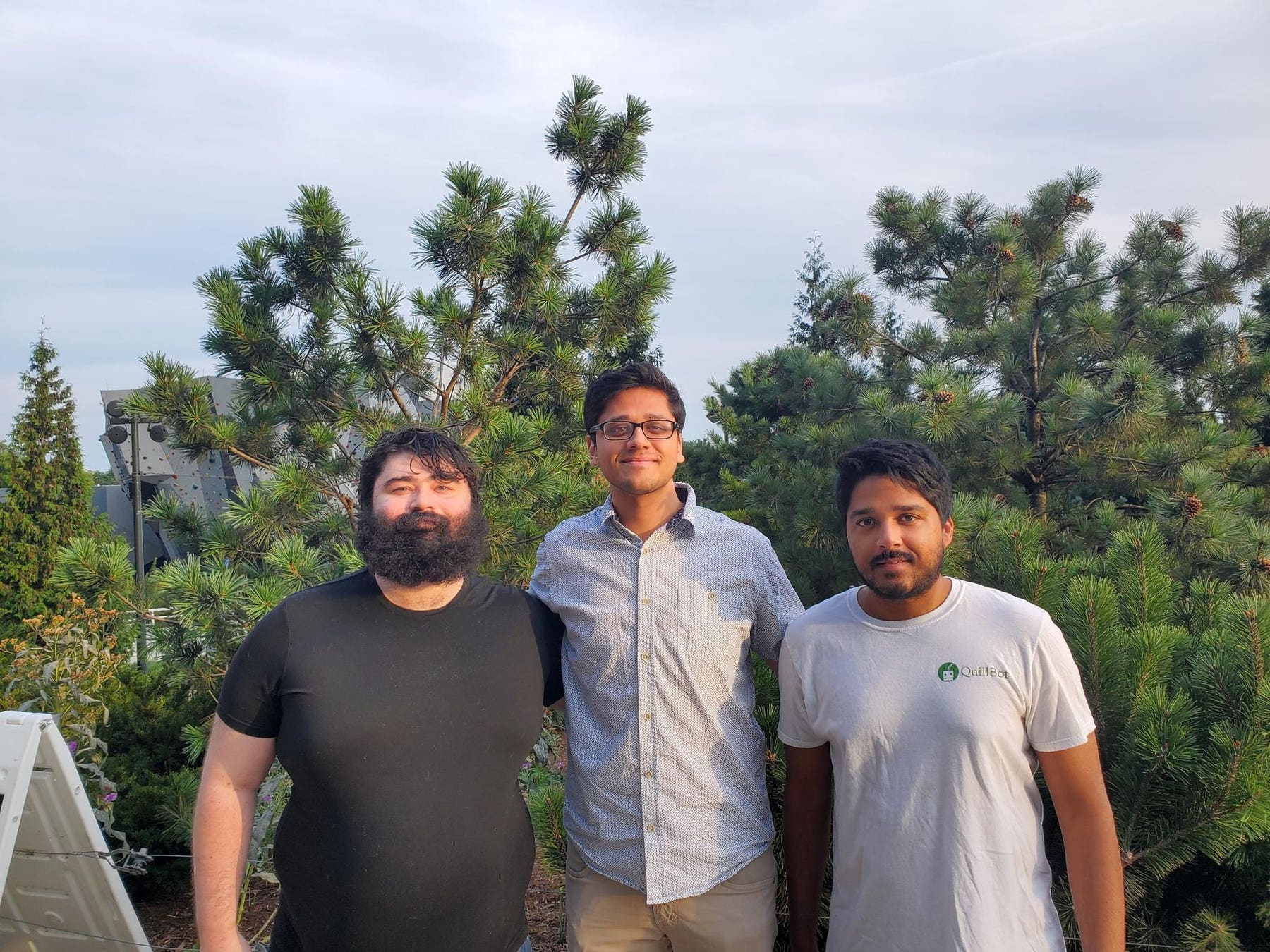
By July 2019, the operation had moved to Lombard, a Chicago suburb. About 330,000 people were visiting the site each month, with roughly 30,000 daily active users. The early audience was already international. A tool made by students had found its way into other students’ routines with very little advertising.
The audience arrives before the investors
In April 2020, QuillBot announced a $4.25 million seed round led by GSV Ventures and Sierra Ventures, with Service Provider Capital participating. Its audience already exceeded a million people worldwide. The money would support a broader writing companion, including summarization and suggestions for completing sentences.
The linguistic need was already visible. More than 60 percent of users were non-native English speakers. For them, revising a sentence could be part of preparing coursework or communicating professionally in a language they were still learning. The product sat close to work that had to get done.
Sierra’s investment argument distinguished correct writing from better expression. Grammar tools had demonstrated willingness to pay for corrections. QuillBot offered help with construction, tone and fluency. A sentence can be grammatically immaculate and still wear the wrong clothes to the meeting.
That distinction gave the company room to develop. A writer might want a shorter sentence, a more formal one, or simply another attempt at a thought that kept coming out awkwardly. Offering alternatives made the product useful across different tasks without pretending that every task wanted the same voice.
A calculator for the sentence
Gupta described the paraphraser as a full-sentence thesaurus. The comparison gave people a familiar place to start: keep the underlying thought, consider other ways to express it. Formality, length and tone became choices the writer could examine rather than rules the software silently imposed.
He also compared the tool to a calculator. The argument was that less time spent wrestling with the mechanics could leave more attention for constructing an argument or telling a story. That analogy carries a responsibility as well as a sales pitch. A calculator cannot decide which problem deserves solving.
Gupta’s customer stories were often smaller and more revealing than the company’s market. One teacher wanted recommendation letters that sounded distinct for each student. QuillBot helped her vary the wording. The task was personal: a student was relying on an adult to describe them with care.
Other uses surprised him. People reported editing novels with the software. English learners found value in seeing one meaning expressed through different structures and vocabularies. The alternatives could become examples to learn from. Gupta spoke about reaching the “marginal writer”: someone with ideas who might otherwise leave them unshared because writing them down felt too difficult.
“Think about it almost like a full-sentence thesaurus.”
Rohan Gupta, 2021
There were limits. Changing more words could make the original meaning harder to preserve. A fluent sentence still needed a reader who knew what it was supposed to say. That tension belongs inside the product’s history: giving someone options is useful only if the options remain faithful to the thought.
The expansion followed the work around the sentence. A grammar checker arrived in March 2021. Summarizing, research and citations addressed neighboring chores. The company was trying to occupy more of a writer’s working day, with the paraphraser as the familiar entrance.
The engineering economics mattered too. Gupta pointed to open-source packages such as TensorFlow and access to cloud hardware as advantages for the early team. The company could experiment without buying all the computing equipment itself. A useful research result could travel from a published paper into a small company’s work.
An exit in the middle of the story
Course Hero announced its acquisition of QuillBot in August 2021. At the time, the writing platform was used by seven million people each month. Gupta’s emphasis remained on helping more people communicate their ideas and extending the tools to English learners.
He stayed. An acquisition can look like a full stop on a founder’s biography, but Gupta continued leading QuillBot for years. His work expanded within the group now known as Learneo, whose writing businesses included other tools used by students and professionals.
The three co-founders appeared on the 2022 Forbes 30 Under 30 Education list. Recognition followed the same company that had started with a rough web application and a discussion-board audience. By then, the business had become substantial enough to generate a familiar temptation: tell the origin as though every later step had been obvious.
Gupta’s account of the technology makes room for a less tidy explanation. Open research, shared AI tools and cloud computing helped a small team do work that would once have required different resources. He credited that wider community. The founders were making decisions inside a field that was changing underneath them.
- 2017QuillBot begins
- 2021Course Hero acquisition
- 2025CEO handoff
- 2026Diopter AI
A taste for doubt
His interests extend to philosophy and films about people making questionable decisions. He has singled out Nietzsche’s Thus Spoke Zarathustra, Kubrick’s Dr. Strangelove and 12 Angry Men. His explanations concerned self-improvement, accepting unpredictability and taking time over consequential judgments.
It is an enjoyable collection for a software executive. One offers a demand to examine yourself. Another supplies a war room whose occupants could use more of that habit. The third asks people to reconsider an apparently settled answer. Together they make a livelier reading list than a stack of management manuals.
Gupta’s practical advice ran along similar lines: treat decisions as experiments and understand the reasoning behind established practices. Borrowing somebody else’s method is a beginning. Working out whether it fits the situation is the job.
The next voice on the line
In June 2025, Gupta announced that he was handing the QuillBot CEO role to Andrew Grauer and becoming a part-time chief strategist. His announcement put the business at more than 40 million monthly active users and more than $60 million in revenue, without specifying the revenue period. He also announced a part-time leadership role at NAV Fund Services.
By 2026, another company was taking shape. Gupta co-founded Diopter AI with Jeremy Pippin, previously a product leader at QuillBot and FanDuel. Gupta is its CEO. The new company focuses on detecting AI impersonation and social engineering during live video and voice calls.
The concern has moved from finding the right words to deciding whether the speaker deserves trust. Diopter describes looking at identity, synthetic media, conversational pressure and requests that break a company’s rules. It is designed to alert teams while the call is happening, when a decision about money or access may still be prevented.
There is continuity in the change. Gupta’s first company helped someone sound more like the writer they wanted to be. His next addresses the possibility that a convincing voice belongs to an impostor. He is building again around a person trying to make a judgment, with software close enough to the moment to be useful. This time, the sentence may sound perfectly natural. The question is who said it.