A college scholarship usually has one name on it. In January 2020, Pete Kadens arrived at Scott High School in Toledo with an offer that required a little more room on the form. Graduating seniors could have their college or trade-school costs covered. So could one parent or guardian. The teenager was getting a chance to leave for school. Someone at home was getting a chance to begin again.
That second place in the classroom tells you more about Kadens than a list of his companies does. A former chief executive of Green Thumb Industries, he had already worked in sales, solar energy and cannabis. He knew the satisfaction of building something other people would buy. Now he was asking what happened when an opportunity reached two generations at once.
There is an appealingly awkward consequence to the arrangement. A parent who asks whether the homework is finished may have homework of their own. Education becomes a family undertaking, with more than one person entitled to complain about the reading.
The offer that went home with the students
Scott's announcement was specific. The promise covered tuition, room and board, fees and other college costs, with routes into accredited public colleges and trade schools in Ohio, plus selected additional institutions. The parent or guardian had their own geographic eligibility rules. This was an invitation to pursue a qualification, whether that meant a university degree or a practical trade.
Kadens had grown up in the Toledo area and graduated from Ottawa Hills High School in 1996. Returning to a different high school in his hometown made his thinking visible: the advantages that had helped him get started could be extended to families who had received fewer of them. His own route had led to Bucknell University, a political science degree and a business career.
He was unusually clear about the part that came after the applause. He wanted students to persist, complete their training and, ideally, bring their skills back to Toledo. A scholarship announcement takes an afternoon. Finishing takes years. Kadens was talking about the years.
“I want them to start and I want them to finish.”
Pete Kadens, on the Toledo scholarship promise, 2020
A political science major discovers the company
At Bucknell, Kadens found an early outlet for his interest in enterprise in Management 101. He later recalled the attraction simply: “I loved everything about leading a company.” His academic major had been political science; the business classroom gave him another way to think about organizing people and getting an idea into the world.
His first professional stop was UBS. Banking did not hold him. He went on to build an outsourced sales business, then co-founded SoCore Energy in 2008 with fellow Bucknell alumnus Glen Tullman. The sequence matters because his career did not emerge from a lifelong commitment to one product. He kept finding a different setting for the same appetite for building.
SoCore worked on commercial solar installations, including the rooftops of businesses operating across multiple locations. By the time Edison International acquired it in 2013, its customers included retailers and property owners such as Walgreens, IKEA, Kimco Realty and Simon Property Group. The acquisition announcement described 80 installations across 11 states. The hardware was on roofs; the business was in making an installation repeatable.
The company stayed based in Chicago after the sale, and its management team remained in place. Kadens continued as an Edison executive until 2015. Later accounts of his tenure describe a business that reached 17 states. He had acquired experience in taking an idea beyond its original address, then keeping it operating under a larger corporate owner.
- 2000Graduates from Bucknell
- 2008Co-founds SoCore Energy
- 2013SoCore joins Edison International
- 2018Leaves the GTI chief executive role
- 2020Makes the Scott High School promise
- 2021Co-founds Hope Chicago
Building beyond Illinois
The next business brought him together with Ben Kovler at Green Thumb Industries. GTI was established in 2014; Kadens helped build its operations outside Illinois in 2015. He became part of a company whose work involved opening facilities, hiring people and building a retail presence across separate state markets. Expansion meant a succession of local beginnings.
By 2018, GTI had cultivation and retail operations in seven states. Its RISE shops tried to put community into the retail experience, including names that identified the locality. Kadens spoke about the importance of a welcoming atmosphere and employees who knew their customers. Even in a rapidly expanding business, he was interested in what happened when somebody walked through a door.
He left the chief executive role effective August 29, 2018, with Kovler taking over. The departure was followed by another deliberate step: GTI announced that he would leave its board effective February 15, 2019, to pursue philanthropy full time. Plenty of executives describe giving back as a future ambition. Kadens put an effective date on the change.
His civic work already had a history. He had held leadership roles at StreetWise, which supports people facing homelessness through employment and other services; today it lists him as chairman emeritus. The connection is useful to understanding his later education work. Both involve making an opportunity usable by somebody whose circumstances can keep shutting the door.
The scholarship gets a Chicago address
In 2021, Kadens and investment executive Ted Koenig founded Hope Chicago. They recruited former Chicago Public Schools chief Janice Jackson to lead it. The organization brought the two-generation idea to a larger city, while keeping the unit of attention small enough to recognize: a student, a parent and the practical costs between them and a qualification.
In February 2022, announcements at five public high schools extended the debt-free college promise to roughly 4,000 enrolled students and one parent or guardian from each participating family. The schools were Benito Juárez, Farragut, Morgan Park, Al Raby and Noble Johnson College Prep. Eligibility across a school meant classmates could talk about the same opportunity, rather than watch a single winner collect an envelope.
The distinction between tuition and the cost of attending is central to the design. A bill marked paid does not transport a student to campus or purchase every book. Hope Chicago combines scholarship funding with advising, campus support and help with other expenses. The work follows people past admission, into the less photogenic business of staying enrolled.
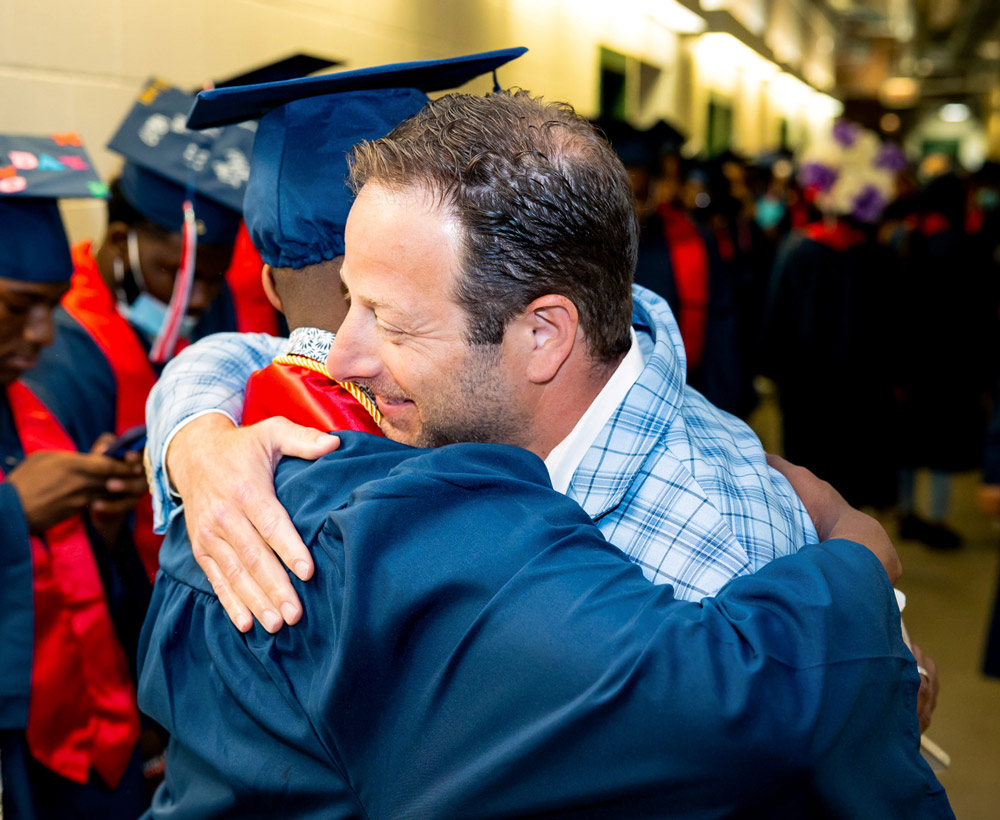
The parent scholarship gives the idea another dimension. Adults can return for a degree or credential while their children pursue theirs. A family can accumulate qualifications together, potentially changing more than one person's employment options. For Kadens, the ambition is to interrupt poverty across generations. The program gives that ambition an everyday form: two people with somewhere to study.
The arithmetic after the assembly
Once the surprise has worn off, a scholarship organization needs a different kind of evidence. Hope Chicago's 2025 impact page reported that 70 percent of its Parent Scholars remained enrolled after one year, compared with 45 percent of adult students nationally. Those are reported persistence figures, rather than graduation rates or proof that the program alone caused the difference.
One year later, still in class
One-year persistence, as reported by Hope Chicago. Different populations; this comparison does not establish causation.
The distinction is worth preserving. An offer, enrollment, persistence and completion describe different moments in a student's life. Treating them as interchangeable would make a prettier brochure and a poorer account of the work. Kadens's original insistence on finishing supplies a useful standard for reading every subsequent number.
By August 2026, Hope Chicago reported investing more than $60 million in pathways for over 3,000 students and parents since 2022. It had celebrated its first wave of four-year graduates that May. More than 440 parents had enrolled, and another 800-plus students from the high-school class of 2027 were being offered support. The organization now had graduates as well as promises.
Toledo supplies the harder part of the story. In 2025, HOPE Toledo struggled to cover college bills. Management of its college Promise program subsequently shifted to the Greater Toledo Community Foundation, which established a Scott Promise Fund with anonymous donors. HOPE Toledo's later cohorts had followed Kadens's initial commitment.
That history makes the operational question unavoidable. Who keeps paying when the first announcement is several years old? Advisers, donors, administrators and partner institutions have to keep showing up. A founding idea can travel faster than the machinery required to sustain it.
A year with fewer invitations
In a public post, Kadens announced plans for a yearlong sabbatical beginning July 1, 2025. He described time with his wife and three children, travel and activities chosen for curiosity. Hope Chicago would remain an exception to the pause. The list even included plans to shadow a homicide detective and work a minimum-wage job. These were intentions he announced, rather than adventures whose completion can be assumed.
“Time is the ultimate flex,” he wrote. There is a businessman in that sentence, still making a judgment about scarcity. The scarce thing has changed. After years spent building organizations, he was putting boundaries around his own availability.
The two decisions sit comfortably together: room in a classroom for a parent, room in a calendar for a child. Both begin by noticing who gets squeezed out of an otherwise successful arrangement. Kadens's career has produced companies, exits and board appointments. His more revealing question is smaller and harder to dismiss: when an opportunity arrives, who else can come?
Class is still in session
- Hope Chicago · August 2026 program update
- Pete Kadens on LinkedIn · Public booking profile
- Watch: Hope Chicago on 60 Minutes ↗
- Watch: Kadens discusses the scholarship ambition on MSNBC ↗
- Read: The Gift of Education · Kadens returns to a Bucknell classroom
- Explore the 2025 impact report · Read about Toledo’s program handoff