Debra Cafaro’s father brought his pay home in silver dollars. A Pittsburgh mail carrier, he had discovered that certain coins were worth more than their face value. The family sorted them on the dining room table. He learned which ones to sell, eventually opened a small coin shop, and helped pay for his daughter’s education. There are more glamorous introductions to finance. Few are quite so easy to picture.
Years later, Cafaro would be responsible for a public company, complicated negotiations, and decisions involving sums that made a dining table an inadequate piece of equipment. Yet the family story remains a useful place to begin. Someone had looked closely at an ordinary thing, recognized an overlooked possibility, and done the work required to turn it into an opportunity.
Her career would take a similarly indirect route. She became a lawyer, moved into business, and accepted a chief executive’s job at Ventas in 1999, when the company was in serious trouble. The impressive dates came afterward. At the beginning, the attraction was the chance to learn, the trust of a mentor, and a willingness to take responsibility before the outcome was comfortable.
The family investment
Cafaro grew up in Pittsburgh, the daughter of a postal worker and a homemaker, with Italian and Lebanese family roots. She was the first in her family to attend college. When she speaks about her parents, education appears as a shared undertaking, made possible by sacrifices at home. The diploma would have one name on it. The effort behind it belonged to several people.
She graduated from Notre Dame in 1979 and earned her law degree at the University of Chicago in 1982, receiving academic honors at both. A federal appeals court clerkship followed. Then came legal practice in real estate, corporate matters, and finance. For part of that period, she also taught real estate transactions and finance at Northwestern’s law school.
The legal career supplied an education in deals and in the people who make them. It also gave her relationships that outlasted individual transactions. In 1997, she became president and a director of Ambassador Apartments. David Glickman gave her that opening. Two years later, another former client and mentor, Doug Crocker, encouraged her to take the Ventas job.
A job with very little cushioning
An established executive could have found plenty of reasons to pass. Cafaro had been in business for less than two years. Ventas faced a financial emergency. Its principal tenant, Vencor, filed for bankruptcy within months of her arrival. The landlord’s fortunes were tied tightly to a tenant that could no longer proceed as before. A collection of properties did not automatically amount to a diversified business.
The first work was practical and slow: preserve liquidity, negotiate with banks, and keep rent coming during the tenant’s restructuring. An agreement kept payments flowing while Vencor worked through bankruptcy. The problem required several parties to accept a solution they could live with. A stirring speech would have been cheaper, and considerably less useful.
Even her arrival had an unnecessary complication. The airline lost her luggage on day one. The detail is almost offensively tidy for a story about a difficult beginning, but it survives in the account of her early days. There was a company to stabilize, and apparently a wardrobe to locate. Executive responsibility does not exempt anyone from the baggage carousel.
Cafaro’s legal training helped with negotiation. Running an organization asked for additional skills. She has described learning to communicate, motivate, and recognize people’s contributions. A lawyer’s skepticism can expose a weakness in an argument. A leader must also give people a reason to move forward together. The transition continued well after her business card changed.
“I believe you can be aggressively conservative.”
Debra Cafaro, 2011
The brake pedal belongs in the growth story
After the immediate danger passed, the question became what Ventas could become. The company expanded, and in 2009 joined the S&P 500. Cafaro became chairman in 2003 while continuing as CEO. The appointment that began as an attempt to rescue a company had developed into a much longer responsibility: deciding how to grow it without forgetting what financial vulnerability felt like.
Her phrase about being aggressively conservative sounds as though two investment committee members have tried to share one adjective. It describes a coherent position. She has pursued acquisitions while stressing limits on borrowing and attention to the downside. The enthusiasm for an opportunity has to coexist with an unromantic question: what happens if the assumptions are wrong?
Before the financial crisis, Ventas raised equity, refinanced debt, slowed acquisitions, and sold properties to reduce borrowing. The company entered the downturn with cash and a stronger balance sheet. Those choices gave it room to act afterward. In a growth story, restraint can look like a gap between the interesting chapters. Here it helped make the next chapter possible.
A long tenure can make a career appear deceptively stationary. One employer, one chief executive’s title, year after year. The work underneath changes. Negotiating survival requires a different emphasis from making acquisitions. Both differ from managing a larger organization. Cafaro’s public reflections return to that need to keep learning rather than relying indefinitely on the skills that won the original appointment.
Three different assignments
- StabilizeKeep cash available. Negotiate time.
- BuildRecruit a team. Broaden the business.
- AdaptReconsider the plan as conditions change.
A reading of Cafaro’s career, rather than a formula for every company.
The people outside the org chart
Cafaro’s account of success leaves room for help. She has described the value of peers who understand the responsibilities of leadership and can offer advice without a separate agenda. That is a different relationship from reporting to a board or directing a team. A friend in a comparable role can recognize a problem without needing a lengthy introduction to its pressures.
It also complicates the familiar portrait of the solitary decision maker. Public responsibility may settle on one person, but useful judgment can develop in conversation. Cafaro has credited colleagues and directors with friendship as well as insight. The distinction matters: an organization needs formal authority, while the person exercising it can still need somewhere to think aloud.
In a 2016 interview, she defined leadership through motivating people around a shared goal and achieving it. It is a definition with a result attached. The relationships in her story carry that same practical weight. Someone offers an opening. Someone contributes expertise. Someone understands the difficulty. The person with the title still has to do the work.
Black and gold, even in Chicago
The sports references in Cafaro’s interviews have a specific geography. She attended the Steelers’ Immaculate Reception game with her father in 1972. Her parents had been at the Pirates’ deciding World Series game in 1960. These are family memories with unusually good scoreboards attached. Pittsburgh loyalty did not dissolve when her working life moved elsewhere.
She later became an owner of the Pittsburgh Penguins. Her official biography also lists ownership interests in the Baltimore Orioles and Chicago Stars FC. The fan in the stands acquired another perspective on what happens around the field. It gives her talk of teamwork a literal second setting, beyond conference rooms and annual meetings.
She has lived through Chicago’s Michael Jordan era as a spectator, attended the Olympics, and described a love of hiking, national parks, and books. In 2022, her reading included A Gentleman in Moscow. The details offer a little breathing room around a résumé dense with appointments. There is room in the same life for a balance sheet, a novel, and an opinion about Pittsburgh sports.
Buying somebody else more choices
In 2013, Cafaro committed $4 million to the University of Chicago Law School to establish full-tuition scholarships. The plan was to support 22 students with significant financial need over nine years. For someone whose parents had stretched to finance her education, the connection was direct. Another family’s available money would have less power to decide whether a student could attend.
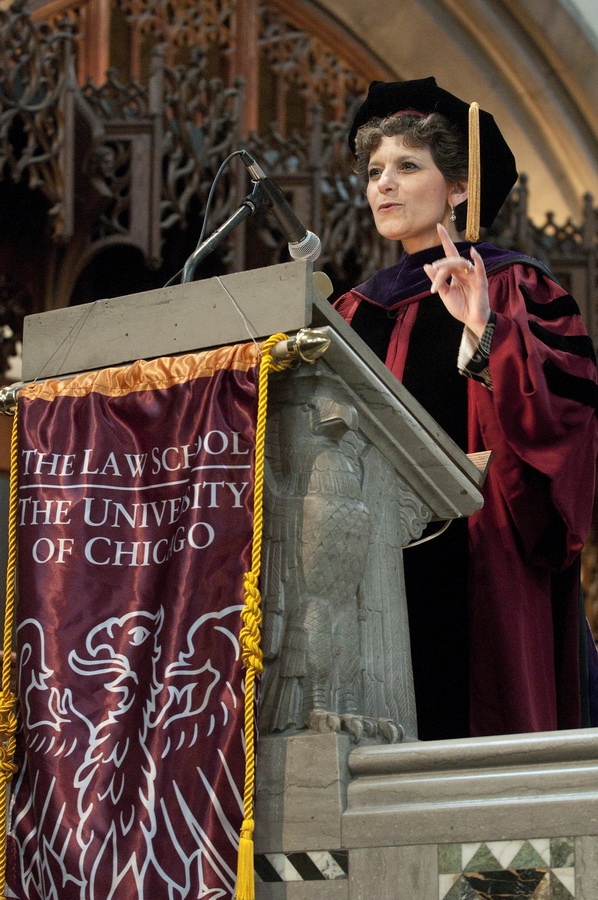
The effect becomes clearer through Constance Grieves, an early recipient. She had worked while pursuing her undergraduate education. The scholarship meant she could concentrate on law school without continuing to juggle a job. It also reduced the pressure that debt could exert on her choice of work. Her ambition to pursue criminal defense had more space around it.
That is a useful measure of educational philanthropy: the options a recipient gains. A tuition bill is an immediate number. The consequences spread into study time, professional decisions, and the ability to try something that may pay less. Cafaro’s own career had benefited from openings offered by others. The scholarships made an opening tangible, with a financial commitment attached.
Her relationship with the university continued. In January 2026, the law school announced a $1 million gift to its Constitutional Law Institute. The support would expand its annual conference and bring visiting constitutional scholars to the school. Cafaro expressed support for rigorous, nonpartisan inquiry and open discussion. The former law student was investing in the institution’s arguments as well as its students.
Chicago recognized another part of her public life that year. The Chicago History Museum named her a Making History Award honoree for corporate achievement, with Laura Ricketts announced as her presenter. By then, Cafaro’s work extended across company leadership, civic organizations, university governance, and sports. The Pittsburgh beginnings remained legible beneath the Chicago appointments.
The silver-dollar story is easy to enjoy because the object is so small. The later decisions are harder to hold in your hand. Still, a line runs between a father financing his daughter’s first college year and that daughter helping other students make their own choices. Cafaro took the opportunities people offered her seriously. Some of what she built has gone toward offering the next ones.