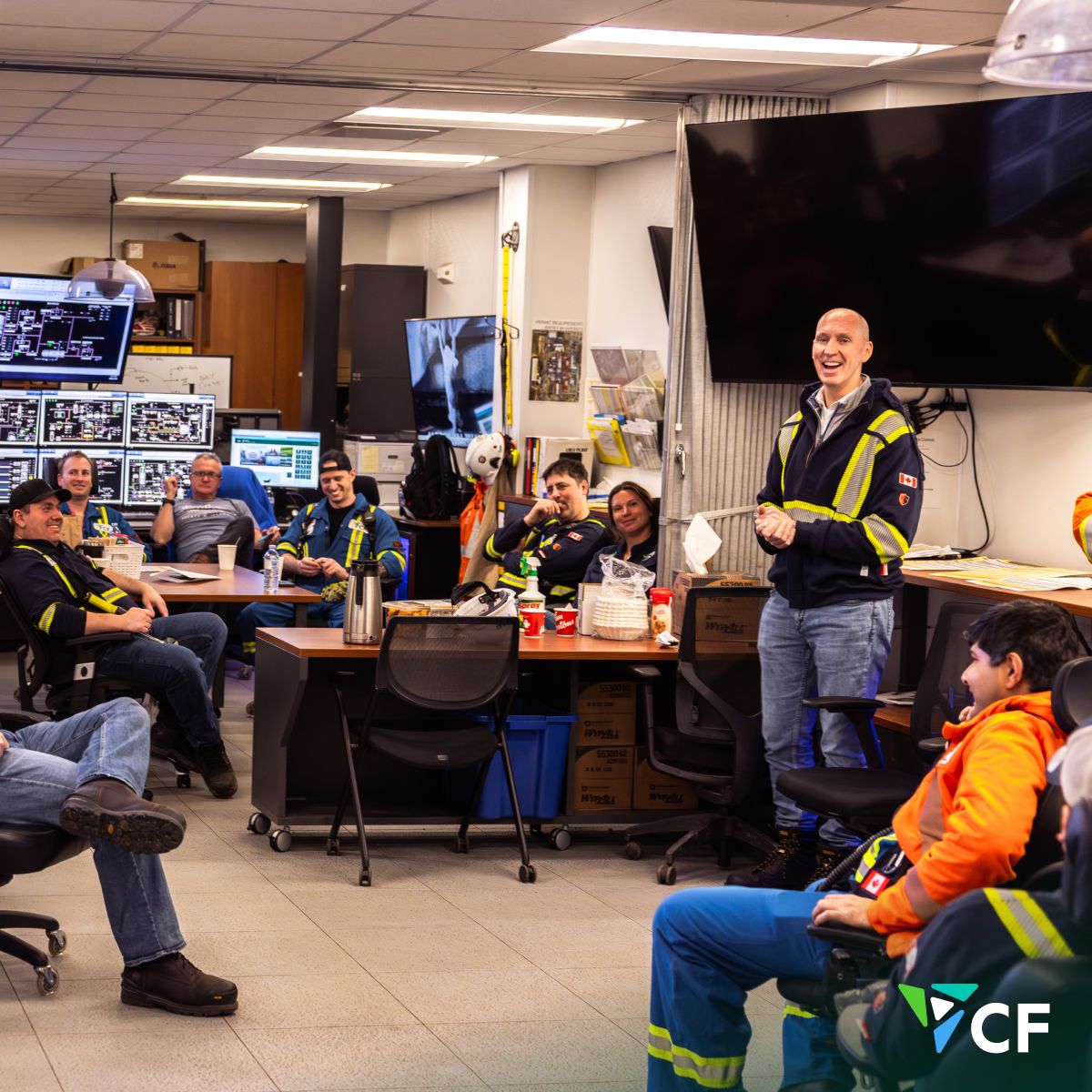
The room has fluorescent lights, crowded tables and enough screens to make a spreadsheet feel underdressed. Christopher Bohn is standing among employees at CF Industries’ Medicine Hat Complex in Alberta, smiling in a jacket with reflective stripes. There is no lectern. Coffee cups and work boots have the floor. In February 2026, a few weeks into his tenure as chief executive, the company shared photographs of his visit: a facility tour, time with the maintenance team and business updates.
It is a useful place to begin with Bohn. His appointment can be told as a tidy succession story: longtime executive replaces longtime chief executive at a nitrogen-products company based outside Chicago. But the interesting part is the distance he covered inside the business before getting the title. Planning. Supply chain. Manufacturing. Finance. Operations. His career has made repeated crossings between the money and the machinery.
Those crossings matter now. CF Industries is pursuing lower-carbon ammonia alongside its established fertilizer business. Bohn helped develop that direction before becoming CEO in January 2026. The next part involves construction schedules, customers, partners and cash. Industrial ambition has a habit of requesting a purchase order.
The numbers came first
Bohn’s education was in finance: a bachelor of science from Indiana University and an MBA from Northwestern University’s Kellogg Graduate School of Management. Before CF, he worked in global financial planning and analysis at Merisant Worldwide. From August 2007 to September 2009, he was chief financial officer at Hess Print Solutions. Printing and ammonia are different businesses; both made appearances on his route to the executive suite.
He arrived at CF Industries in September 2009 as director of corporate planning and analysis. In October 2010, he became vice president of corporate planning. These were jobs concerned with how a business fits together: what it costs, where it earns and what deserves investment. His first assignment at CF was a long way from the CEO title, but close to the questions a CEO eventually has to answer.
By October 2011, he was explaining part of that business before the U.S. International Trade Commission. Appearing at a hearing on Russian and Ukrainian urea imports, he introduced himself through his planning role and finance education, then set out CF’s support for continuing the trade orders. It is an early public glimpse of Bohn doing something that would remain relevant: connecting the economics of nitrogen products with decisions made beyond the factory gate.
The product was hardly incidental. Ammonia sits at the beginning of CF’s nitrogen business, supplying fertilizer and other applications. Its production connects natural gas, industrial equipment and agricultural demand. A financial model in this business has to account for a very physical world. A plant, unlike a cell in a workbook, cannot be dragged into a more convenient column.
A detour through the machinery
In January 2014, Bohn moved into leadership of the supply chain. A year later, he became senior vice president of that function. Then came a more revealing turn. In November 2015, CF announced that he would take responsibility for manufacturing, effective January 2016. The finance graduate was moving closer to the plants that made the numbers possible.
Distribution joined his manufacturing remit in May 2016. He held that combined role until September 2019. Read together, the assignments suggest why his later promotion was more than a finance succession: his responsibilities had taken him through the movement of materials, production and delivery. That interpretation rests on the jobs themselves, rather than a claim about what he privately learned from them.
- 2009Planning
- 2014Supply chain
- 2016Manufacturing
- 2019CFO
- 2024COO
- 2026CEO
In September 2019, he returned to a familiar title, chief financial officer. His financial responsibilities included strategic planning, business development and investor relations. After years overseeing manufacturing and distribution, the CFO job placed him back at the intersection of operating performance and capital decisions. The route had curved back toward finance, carrying a broader set of responsibilities with it.
February 2024 brought the chief operating officer appointment and election to the board. His remit covered manufacturing, distribution, sales, supply chain and clean energy initiatives. The list is almost a diagram of the company: make the product, move it, sell it, plan what comes next. By the time the board chose him to succeed Tony Will, Bohn had been responsible for much of that diagram.
Buying a plant, buying an obligation
One transaction helps make this career concrete. CF completed the acquisition of the Waggaman ammonia production facility in Louisiana in December 2023. The agreed purchase price for the plant and related assets was $1.675 billion, subject to adjustments. It was a substantial addition to an existing industrial business, with a customer arrangement folded into the economics.
About $425 million of the price was allocated to a long-term agreement to supply ammonia to Incitec Pivot’s Dyno Nobel subsidiary. The arrangement covered up to 200,000 tons a year at production economics. Such terms receive less attention than an acquisition headline, yet they help explain what the buyer is actually taking on. Along with equipment come relationships and obligations.
Waggaman also offered several ways to move its output: pipeline, barge, truck and rail. Its location on the Mississippi River carried potential for vessel loading for lower-carbon ammonia exports. For an executive whose earlier jobs included supply chain and distribution, those details belong near the center of the story. Production capacity needs a route to a customer.
When CF announced the CEO succession in September 2025, it specifically credited Bohn with an instrumental role in Waggaman, the Blue Point joint venture and the expansion of its low-carbon ammonia strategy. That connects the long internal apprenticeship to identifiable decisions. He was taking over a direction he had already helped shape.
Louisiana, with partners in Japan
Blue Point One makes the scale of his next assignment visible. CF formed the venture with JERA and Mitsui in April 2025. CF holds 40%, JERA 35% and Mitsui 25%. Each partner is responsible for taking its share of the ammonia independently. CF has responsibility for operating and maintaining the production facility.
The ownership split is an instructive detail. This is a project shared by three businesses, with production and commercial responsibilities arranged around that partnership. Bohn’s job reaches across company boundaries as well as departments. The venture brings a U.S. manufacturer together with Japanese energy and trading partners, making a Louisiana construction site part of an international supply chain.
On August 26, 2026, the partners broke ground in Modeste, Louisiana. The updated announcement put the venture’s investment at $3.7 billion, with CF investing an additional $550 million in shared infrastructure. Production is expected in 2029. Its planned annual capacity is 1.4 million metric tons of ammonia. These are project commitments and targets; the production record still lies ahead.
The engineering plan combines autothermal reforming with carbon capture and permanent storage. The groundbreaking announcement projected capture of 98% of the carbon dioxide generated in production. That percentage describes a planned production process, rather than a claim that every emission across the product’s life has disappeared. Keeping the boundary visible makes the ambition easier to judge.
What happens after the announcement
Bohn also inherited a nearer-term example at Donaldsonville. In July 2025, CF started its carbon dioxide dehydration and compression facility there. The project was designed to enable transport and permanent storage of up to two million metric tons of carbon dioxide annually, with ExxonMobil handling transportation and storage.
At startup, the storage arrangement used permanent geological sites through enhanced oil recovery on an interim basis. The stated plan was to move to dedicated storage after applicable permits. That distinction belongs in any account of the project. Carbon capture is a chain of equipment, transport and storage arrangements, with different responsibilities at each step.
For Bohn, these projects join his former disciplines in one place. There is the operating question of keeping equipment running, the commercial question of finding buyers and the financial question of earning a return. CF’s environmental strategy also includes efficiency improvements and work on emissions beyond its own facilities. A capture percentage is one measure within that wider task.
“stewardship grounded in action, not words.”
Chris Bohn · first corporate stewardship message as CEO
His first stewardship message as CEO emphasized value creation, responsible leadership and practical action. The wording offers a public statement of his priorities. It also sets a test for them: announced investments will eventually have to show up in operating performance. The sentiment is easy to print. The timetable requires considerably more steel.
The apprenticeship meets the calendar
The company reported first-half 2026 net earnings of $1.34 billion and adjusted EBITDA of $2.18 billion. Those results included an approximately $170 million litigation-settlement gain. In discussing the period, Bohn emphasized the North American asset base, strategic growth, the balance sheet and returning capital to shareholders. The investment program is unfolding alongside the ordinary demands of a public company.
His external roles extend that work into industry organizations. He serves on the International Fertilizer Association’s board and The Fertilizer Institute’s executive board, and is a steering member of the Hydrogen Council. He also belongs to the Business Roundtable and Commercial Club of Chicago. The affiliations reflect the markets and communities touched by his remit, from agriculture to energy.
Return to the Medicine Hat photograph and the career becomes less abstract. There are people who maintain the equipment behind all those investment figures. Bohn’s earlier jobs gave him responsibility for several parts of their working world. Now he has responsibility for the whole company, including projects whose largest tests remain ahead.
His story so far is a succession of assignments made larger by their connections. Finance led into planning, supply chain into manufacturing, and operating experience back into capital allocation. The CEO title arrived after that circuit. The next date to watch is 2029, when Blue Point One is expected to begin production and another set of plans is due to become a working plant.