A french fry has a short career. It leaves the fryer with a crisp exterior and a reasonably bright future. Then somebody puts it in a box. By the time it reaches a front door, its prospects may have softened considerably. For James Zallie, that small domestic disappointment belongs on a business agenda. The distance between the food people expect and the food they actually eat is where an ingredient supplier can earn its keep.
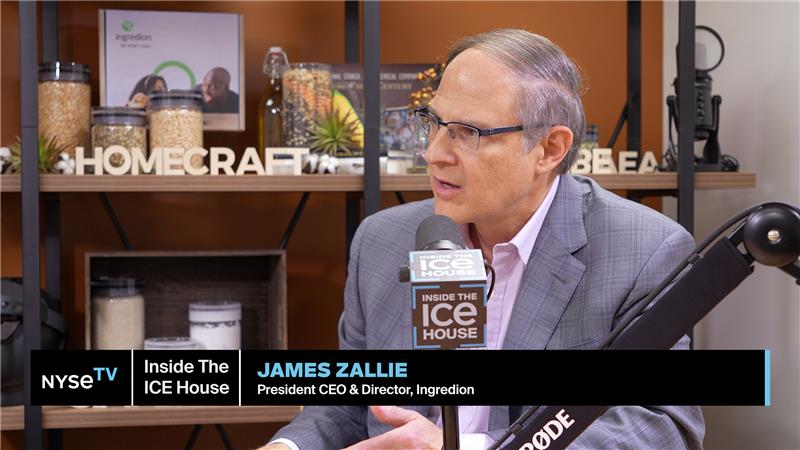
Zallie runs Ingredion, the Illinois company whose work generally appears under somebody else’s brand. Its ingredients help determine the behavior of products that shoppers buy without thinking about the laboratory behind them. His particular interest is texture: the quality that makes a bite satisfying, disappointing, familiar or strange before the eater has assembled a useful explanation.
It is a fitting preoccupation for someone who began around groceries, trained as a food scientist and spent decades learning what happens between a raw material and a finished product. His story follows food backward through the shop, the laboratory and the factory, then forward again toward the customer. The job titles have become longer. The questions remain surprisingly physical.
The book before the business card
As a child, Zallie worked in his family’s grocery store. Later, a library book helped inspire a career in food manufacturing. These are details he has shared while discussing his upbringing: a beginning with shelves and shoppers, followed by the discovery that the objects on those shelves were also scientific problems. Food science offered a way to make a profession out of that curiosity.
He graduated from Penn State with a bachelor’s degree in food science in 1983. At Rutgers, he added a master’s in food science in 1988 and an MBA in finance in 1991. The sequence matters. First came understanding the product; then came a formal education in the economics around it. In his later career, both kinds of training would have work to do.
His early employer was National Starch and Chemical Company. The name possesses a certain resistance to glamour. It also describes a field where modest-looking materials can have complicated, commercially valuable effects. Penn State’s account of his work credits him with helping develop the Novation line of functional native starches. In 2004, the university’s College of Agricultural Sciences named him an outstanding alumnus.
A career that changed companies around him
Zallie spent more than 27 years at National Starch, moving through technical work, marketing and international business management. He became its president and CEO in January 2007. His experience crossed the usual boundaries between the people who develop an ingredient, the people who sell it and the people responsible for producing it consistently. Eventually, all three conversations landed on his desk.
In October 2010, Corn Products International acquired National Starch. Zallie arrived inside the buyer as an executive vice president and president of global ingredient solutions. Here was an unusual career transition: a new corporate setting reached through the purchase of a business he already knew closely. The accumulated knowledge came with him, along with the responsibility to help make the combination work.
His assignments then stretched across regions. From 2012 he held responsibility for EMEA and Asia-Pacific alongside global specialties; North America followed, and then the Americas. The expanding map suggests how much of the preparation for a chief executive’s job happens before the appointment. He had already been asked to understand different markets, manufacturing operations and customer expectations.
In September 2017, Ingredion announced that he would succeed Ilene Gordon. He joined the board that month and became president and CEO on January 1, 2018. The handover placed a scientist with extensive operating experience in charge of the whole company. Gordon remained executive chairman during the transition, with her retirement planned for July 2018.
The texture of an idea
By 2024, Zallie was giving texture a more prominent place in Ingredion’s public explanation of itself. The company reorganized to sharpen its focus on the business, and he described the attribute as underappreciated. A supplier that helps control mouthfeel, appearance and consistency has something more specific to discuss than a catalogue of ingredients. It can discuss what the customer wants the finished food to do.
That distinction changes the sales conversation. An ingredient is bought in a quantity, at a price, against a specification. A successful food product must also meet expectations that are harder to put on a purchase order. Creamy, chewy and crisp sound wonderfully simple until someone has to reproduce them across batches, factories and routes to market. The adjective on the package comes with engineering obligations.
Ingredion’s Idea Labs give that work a place to happen with customers. Zallie helped create the network, which connects ingredient development with practical formulation. The premise is collaborative: bring the problem into a setting where it can be worked on, tasted and revised. For an executive trained in food science, there is an obvious appeal in a meeting whose output can actually be eaten.
At the company’s November 2024 Texture Innovation Day in Bridgewater, New Jersey, an introduction rounded his career there down to 40 years. Zallie supplied the correction: “It’s actually 41 years, but who’s counting?” He was returning to the place where he had started. A corporate anniversary had briefly become a very human objection to arithmetic.
A shared investment in taste
The same interest appears outside his executive assignments. Jim and Helen Zallie pledged $20,000 a year for five years to support sensory-science research at Penn State. The total commitment was $100,000, directed toward understanding how people experience food. Their gift connected his former department with questions that had remained central to his working life.
There is a personal connection to the industry as well. Jim and Helen met at National Starch in Singapore, where she worked in human resources. International business had become part of the family story. The detail gives the regional titles on his résumé another dimension: assignments abroad can reshape a life in ways that never appear in a segment report.
Sensory science provides an especially apt meeting point for his interests. Chemistry can explain how an ingredient behaves; finance can ask what a solution costs; research into perception asks whether the person taking a bite likes the result. Each discipline supplies a different test. A formulation can satisfy one and still require more work on another.
His gift also makes the familiar alumni relationship unusually specific. Rather than attaching his name to an unrelated cause, he backed a field close to his expertise. There is a pleasing circularity to a food-science graduate helping support the investigation of the very preferences that food companies spend their working days trying to understand.
The cornfield belongs in the picture
For all the laboratory vocabulary, the business still begins with crops. In December 2025, Ingredion marked 50 years of partnership with Indiana’s Lamb Farms. “It starts with the corn,” Zallie said. The statement is short enough to survive a management presentation and concrete enough to deserve the space.
The partnership links Indiana-grown waxy corn with Ingredion’s Indianapolis operations. The companies described work involving no-till farming, cover crops, composting and biodiversity. These are decisions upstream of formulation, yet they belong to the same production system. The chef’s brief and the grower’s field occupy different ends of a chain that has to function all the way through.
This is part of what makes Zallie’s remit broad. An ingredient company must be intelligible to customers developing finished foods, while keeping track of raw materials, manufacturing and investment. His career has touched each layer. The challenge is to connect them without losing the particular problem that brought a customer through the door.
“It starts with the corn.”
James Zallie · December 2025
The next chapter comes with conditions
In November 2025, Ingredion’s board waived the policy that would have required Zallie to retire as CEO at 65. He agreed to remain beyond April 2026. In February 2026, the board added the chairmanship to his responsibilities, while independent directors selected Victoria Reich as lead director. The arrangement extended his tenure and widened his formal role.
A larger test followed. In June 2026, Ingredion agreed terms for a recommended all-cash offer for Tate & Lyle. Its second-quarter filing put the equity consideration at approximately £2.7 billion. Tate & Lyle shareholders accepted the offer in July. The combination would add another substantial integration assignment to a career already shaped by acquisitions.
The transaction remained subject to closing conditions, including regulatory and court approvals. Ingredion’s second-quarter filing anticipated completion in the second half of 2027 and said Zallie would lead the combined group as chairman and CEO. Those conditions matter: an agreed transaction is a plan with obligations still ahead of it, and a future company still has to be assembled.
There was movement on his immediate team, too. Ingredion appointed Diego Reynoso as chief financial officer effective October 1, 2026, reporting to Zallie. The announcement highlighted Reynoso’s experience in integrations and portfolio transformations. The choice fits the practical work awaiting the company: allocating capital, managing operations and preparing for a proposed combination.
It is tempting to let a transaction of that size swallow the rest of a profile. Yet the thread through Zallie’s career is smaller and more tangible. A book opens a professional possibility. A scientist learns the commercial side of his subject. Years of regional responsibility lead to the chief executive’s office. The company grows, and the product still has to work.
Somewhere at the end of all that organization is a person opening a package or lifting the lid off a delivery box. That person has no obligation to admire the research, the acquisition history or the executive résumé. The next bite will receive its verdict in seconds. Zallie has spent his career learning how much can be decided in that moment.
Keep the conversation going
- Ingredion
- James Zallie on LinkedIn
- Watch: Zallie’s 2025 Investor Day presentation
- Listen: The Executives’ Exchange
- Watch: Inside the ICE House at Bridgewater
- Read: The Penn State sensory-science pledge
- Read: Food Dive’s interview on texture
- Read: Tate & Lyle offer update
- Read: 2026 second-quarter filing
- Ingredion on X
- Ingredion on Facebook