Before Erik Fyrwald officially started at IFF, a customer gave him an unusually useful welcome. At an industry meeting in Florida in January 2024, a procurement executive told him the company was losing ground in taste. There was another problem: the customer could not work out whom to call. IFF had a business called Nourish. The customer wanted somebody responsible for taste. A corporate name had become an obstacle to buying something.
Fyrwald recalled the encounter in September 2026. It helped prompt a practical question: should Taste and Food Ingredients be separate businesses? There is something pleasingly economical about this episode. An incoming chief executive attends a meeting about scent and leaves with a problem about taste. The customer, meanwhile, has performed an organizational review without submitting a consulting invoice.
By then, Fyrwald had spent more than four decades in industries whose products tend to disappear inside somebody else’s product. DuPont. Nalco. Univar. Syngenta. Now International Flavors & Fragrances. His career runs through factories, water systems, crop fields and the ingredients behind everyday purchases. The names on the consumer’s shelf change. The recurring challenge is making a complicated company useful to the person buying from it.
The long apprenticeship
Fyrwald graduated from the University of Delaware with a chemical engineering degree in 1981 and joined DuPont that year. He completed Harvard Business School’s Advanced Management Program in 1998. It was executive education undertaken during an established career, an opportunity to step outside his company and learn alongside people from other industries.
His DuPont years covered technology, manufacturing, sales, marketing and strategic planning. They also included four years in Asia. In 2003 he became group vice president for Agriculture and Nutrition, with responsibilities spanning Pioneer seeds, crop protection and Solae food ingredients. That is a broad education in the distance between inventing something and persuading somebody to use it.
He spent 27 years at DuPont. For five of them, from 2003 to 2008, he and his family lived in Des Moines. Returning there to speak at the World Food Prize in 2017, he recalled those years with affection. Agriculture had become a substantial part of his working life well before he arrived at Syngenta. The eventual appointment would reconnect him with problems he already knew.
- 1981DuPont
Engineering to agriculture - 2008Nalco
Water and industrial systems - 2012Univar
Chemical distribution - 2016Syngenta
Agricultural technology - 2024IFF
Flavors and fragrances
A new job, followed by a financial crisis
When a recruiter approached him about Nalco, Fyrwald initially declined. He liked his work at DuPont. Persistence, followed by his own investigation of water treatment and energy services, changed his mind. He joined Nalco in February 2008. The timing left him a short introduction to the company before the financial crisis arrived with a considerably less courteous introduction of its own.
Asked how he built trust under those circumstances, he answered: “The first thing I did was to listen.” He visited employees and customers, gathered complaints alongside successes, and reported back through emails, videos and town halls. His account emphasized discovering what the organization knew before deciding what its new leader ought to do.
“The first thing I did was to listen.”
Erik Fyrwald, recalling his arrival at Nalco
There was a technical side to the work too. Nalco’s 3D TRASAR system continuously monitored industrial water systems so additives could be controlled more precisely. In a 2010 interview, Fyrwald described its ability to reduce water demand and chemical use. Here was an environmental argument expressed through a customer’s operating system: measure what is happening, adjust the process, avoid unnecessary consumption.
He also argued for employees being able to raise problems without fear of retaliation. A global chief executive, he acknowledged, could not personally understand every local complication. Hiring, training, clear expectations and repeated communication mattered. When Ecolab acquired Nalco in 2011, he became Ecolab’s president. In May 2012, he moved to run chemical distributor Univar.
Farming across a political fault line
Syngenta appointed him chief executive effective June 1, 2016. Its announcement explicitly described helping close the ChemChina transaction as part of the transition. He therefore arrived with a major ownership change already on the agenda. ChemChina’s $43 billion purchase followed in 2017; the formation of Syngenta Group followed in 2020.
The assignment combined agricultural technology with the diplomacy of running a Chinese-owned business rooted in Switzerland and active around the world. In 2023, Fyrwald described spending time in the United States explaining how the company operated. Trust required personal conversations. A company’s passport, he understood, could reach a meeting before its representative did.
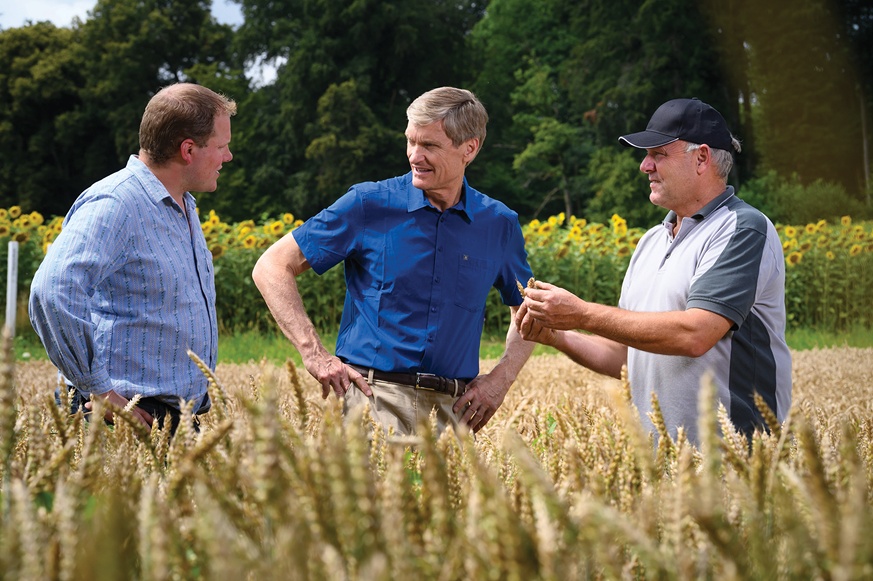
His agricultural argument joined productivity with environmental restraint: help farmers grow more while making better use of land and resources. He advocated regenerative practices, including crop rotation, cover crops and reduced tillage. He also supported agricultural technology and genetic tools. Those positions put him in debates where agreement about the desired outcome does not guarantee agreement about the means.
Partnership was a recurring part of his response. In 2021 he described more than 500 collaborations with universities, research institutes and commercial organizations. He pointed to work with The Nature Conservancy in Brazil on returning degraded pastureland to production. The attraction of such projects was practical: preserving land and improving agricultural output could be considered together, rather than assigned to separate conversations.
In remarks to a U.S.-China agriculture roundtable in 2021, he presented farming as a place to build cooperation between the two countries. It was an aspiration with a concrete constituency: farmers who need markets, customers who need dependable supply, and businesses whose work crosses borders whether the political mood welcomes it or not.
An orange offers a useful explanation
Fyrwald became IFF’s chief executive and a board director on February 6, 2024, succeeding Frank Clyburn. The company’s appointment announcement emphasized his operational experience across agriculture and chemicals. The Florida customer’s complaint suggested how quickly that experience would be tested. An organization can possess considerable scientific talent and still make itself surprisingly difficult to understand.
His public visits also brought him close to IFF’s creative work. In September 2024, he described spending time at its Atelier du Parfumeur in Grasse with perfumers and Fine Fragrance president Sabrya Meflah. This was a different setting from a water treatment system or a crop field, with another set of specialists whose knowledge a chief executive needed to understand.
In April 2025, IFF opened its Citrus Innovation Center on the campus of Florida Polytechnic University in Lakeland. The 30,000-square-foot facility brought botanical research, processing, analytics and scent and taste creation together. Citrus gave the company a tangible way to explain the relationship between its scientific work and its creative businesses. An orange can make a corporate presentation considerably easier to follow.
“Citrus is vital to our creations in scent and taste,” Fyrwald said at the opening. The center also made partnership visible: a company investing on a university campus, close to Florida’s citrus industry. Research, ingredients and customers were being brought into the same physical conversation. For an executive who repeatedly talks about getting out to meet people, the geography seems appropriate.
The difficult arithmetic of doing less
The portfolio has been changing too. On May 29, 2026, IFF announced an agreement to sell its Food Ingredients business to CVC in a transaction valuing the business at approximately $4.3 billion. IFF expected roughly $3.8 billion in net cash proceeds and planned to retain an approximately 10 percent equity interest. The announced closing timetable extended to the second quarter of 2027, subject to approvals and other conditions.
Food Ingredients sale agreement with CVC. Expected closing by the end of Q2 2027, subject to conditions.
The distinction between agreement and completion matters. Separating a business requires work beyond announcing its price. For Fyrwald, the stated purpose was to concentrate investment and research resources where IFF believed it could create more value. Selling a business with established customers and substantial sales is a decision about what the remaining company should become.
Results offered an early view of that changing shape. For the second quarter of 2026, IFF reported $1.95 billion in sales from continuing operations and $408 million in adjusted operating EBITDA. Comparable currency-neutral sales rose 6 percent. Those figures exclude discontinued operations; adjusted EBITDA is a company-defined measure. They describe a particular reporting perimeter, rather than a simple comparison with the old company’s total size.
The accompanying plan included an enhanced $2.5 billion share repurchase authorization. These were choices about proceeds and capital as well as products. A chief executive who argues for investment in innovation must also explain what the company will own, how it will finance itself and what shareholders should expect while the structure changes.
The conversation gets larger
In August 2025, Fyrwald was elected chair of the Council on Competitiveness, whose members connect business, universities, labor and national laboratories. He expressed particular interest in its growing emphasis on the bioeconomy. The appointment extended a familiar part of his career: bringing scientific work into a wider discussion about investment, manufacturing and economic opportunity.
At IFF’s October 2024 New York Stock Exchange bell ringing, he joined colleagues marking 135 years of company history and 60 years on the exchange. The celebration supplied a sense of scale in time. His own assignment had only just begun. A long corporate history offers plenty to draw upon, alongside plenty of accumulated decisions to reconsider.
The customer in Florida had asked a smaller question. Who should I call? More than forty years into Fyrwald’s career, it remains an exacting test. Research budgets, transactions and organizational charts eventually have to produce an answer that makes sense to somebody outside the company. In that sense, the next chapter of IFF will be written partly in laboratories, partly in its accounts, and partly in how easily the next customer gets through.