Alan Schnitzer had a job he expected to keep. He was a partner at Simpson Thacher & Bartlett, advising corporate clients, working with friends and serving clients he liked. After 16 years at the firm, he could imagine retiring there. In 2007, he left for Travelers. Asked years later to identify the biggest risk of his career, he chose that move. For someone whose eventual business would be putting a price on uncertainty, the answer had a pleasing lack of abstraction.
Corporate biographies tend to make a career look inevitable. A date, a title, another date, a larger title: the whole thing resembles a staircase installed before the occupant arrived. Schnitzer’s own account introduces the missing hesitation. The lawyer who would become an insurance chief had once been happy being a lawyer. His next job required giving up a future he could already picture.
He brought two kinds of training to the decision. A Dallas native who became a longtime New Yorker, Schnitzer studied finance and accounting at Wharton before earning his law degree at Columbia. Numbers and legal language would both matter in insurance. A policy is a financial promise written in words, and eventually someone will want to know precisely what those words mean.
He also knew Travelers from the outside: he had been its lead outside counsel. That gave his move an unusual shape. He was joining a familiar client while changing his responsibility to it. Advising a business and helping run one are different occupations, even when the people around the table already know your name.
A lawyer learns the operating business
His first Travelers title, vice chairman and chief legal officer, still carried the old profession with it. The assignments then widened. He led Financial, Professional and International Insurance and later took charge of Business and International Insurance. Along the way he oversaw field management, corporate communications and public policy. The progression put him closer to the machinery of the company: its products, distribution relationships and operating decisions.
The July 2014 promotion made him vice chairman and chief executive of Business and International Insurance, reporting to president and chief operating officer Brian MacLean. It is a useful detail in a career often compressed into lawyer-becomes-CEO. There was an operating apprenticeship between the law firm and the top job. He had businesses to run before he had the whole company to run.
When Travelers announced that he would succeed Jay Fishman, the effective date was December 1, 2015. Fishman’s message to employees emphasized his successor’s judgment, versatility and knowledge of the business. The endorsement helps explain the handover: Schnitzer was an established colleague taking on a larger obligation. The board elected him chairman in August 2017, adding oversight of the board to leadership of the business.
There is something revealing about that sequence. Insurance rewards an ability to keep several clocks running at once. A customer needs an answer today; a claim may arrive much later; an investment may mature years from now. Schnitzer’s career had already crossed several professional time horizons before he inherited responsibility for reconciling them.
The curious business of preserving an advantage
His shorthand for the job became “perform and transform.” It is a compact phrase for an awkward management problem: the operation producing today’s earnings must also pay for changes whose usefulness will be judged tomorrow. A company can become rather attached to the habits that made it successful. Those habits have, after all, been paying the bills.
By 2019, the practical examples included adjusting claims through a customer’s smartphone, making payments through PayPal and working with technology businesses such as Amazon and Lyft. He described three priorities: greater risk expertise, better experiences for customers and business partners, and improved productivity. These were recognizable insurance jobs translated into newer tools. The policyholder still wanted a claim resolved; the route to resolution could change.
His language about culture is considerably less mechanical. In 2021, he used “pixie dust” for the intangible qualities holding Travelers together, then supplied ingredients: collaboration, long-term thinking, putting the company first and helping colleagues succeed. It is an unexpectedly theatrical term from a former corporate lawyer. Somewhere between the contract and the spreadsheet, apparently, there is room for a small enchanted substance.
The underlying argument is practical. Thousands of people make judgments about risk and reward. A central office cannot write a fresh instruction for every one of those decisions. Shared habits influence what happens when an employee reaches the point where the manual stops. Read that way, Schnitzer’s interest in culture belongs beside underwriting discipline. The two concern the same everyday question: what will people do with the discretion they have?
“pixie dust”
Alan Schnitzer’s term for the intangible qualities of company culture, 2021
When the policy becomes a signal
In his 2024 annual-report essay, published in March 2025, Schnitzer took up the availability and affordability of insurance. He argued that prices and policy terms need to reflect changing risk, and that rules breaking that connection can push insurers out of a market. He also challenged the expansion of public markets of last resort beyond their intended function.
That is an insurer’s policy position, with consequences for families trying to buy coverage. Lower prices are attractive to the person paying the bill. A carrier also has to assess whether the premium supports the promise it is making. Schnitzer’s argument places that tension in public view. His financial and legal background is particularly relevant here: the subject joins capital, contracts and the rules governing both.
The public role goes beyond pricing debates. Travelers’ 2022 annual report described Citizen Travelers, a nonpartisan initiative encouraging employees to participate in their communities’ civic life. Activities included voter-registration reminders and support for employees running for or serving in elected office. A corporation whose business depends on durable institutions was encouraging its employees to spend time inside those institutions.
There is a modest but demanding idea underneath the program. Citizenship involves work between elections as well as at them. A local office, a community institution or a public meeting offers little of the tidy distance available in a boardroom presentation. Participation means encountering other people’s priorities, including the inconvenient ones. For an executive concerned with long-term conditions for business, those encounters have a purpose.
The next bet has a software budget
By January 2026, Schnitzer was describing the next stage as “Innovation 2.0.” On the fourth-quarter results call, he said more than 20,000 employees were regularly using AI. Travelers had spent more than $1.5 billion during 2025 on AI and other technology initiatives. He presented the new work as a continuation of a decade of operational change, with AI extending what the company could do across its workflows.
The scale makes the question concrete. An insurer has documents to read, submissions to evaluate, claims to process and software to build. Travelers’ technology organization describes 2026 as its Year of Learning AI. Its learning program frames the task as moving employees from curiosity toward competence and proficiency. Buying tools is one line in a budget; getting people to use them well is a much longer management assignment.
A small earlier example gives the workforce story a human face. In 2023, University of Hartford computer science student Rahul Kumar described a Travelers internship using machine learning to examine claim payments. He also recalled connecting with Schnitzer and valued the way colleagues treated one another’s contributions. The account offers a view from much farther down the organizational chart, where a company’s culture becomes a series of actual conversations.
The latest quarterly numbers put Schnitzer’s responsibilities in perspective. For the third quarter of 2026, Travelers reported $1.917 billion in net income, $11.480 billion in net written premiums and a combined ratio of 86.8 percent. That ratio measures claims and expenses against earned premiums; a figure below 100 percent indicates an underwriting profit. The results also included higher catastrophe losses than a year earlier. Even a profitable quarter contains reminders of what the business is paid to absorb.
A podium, a scholarship, and tomorrow’s colleague
At the January 2023 dinner honoring him as St. John’s 2022 Insurance Leader of the Year, Schnitzer announced a $250,000 pledge for the Travelers Scholarship for Future Leaders. The event raised $4,210,500 for scholarships and academic programs and drew nearly 1,600 people. An evening organized around an established executive also financed people who had yet to begin their careers.
His acceptance remarks imagined a future scholarship recipient returning to that stage to be honored. The thought fits the arc of his own working life: a person’s next role may be visible to someone else before it becomes visible to them. Travelers had once looked at its outside lawyer and seen an executive. The scholarship turned that possibility into something a student might use.
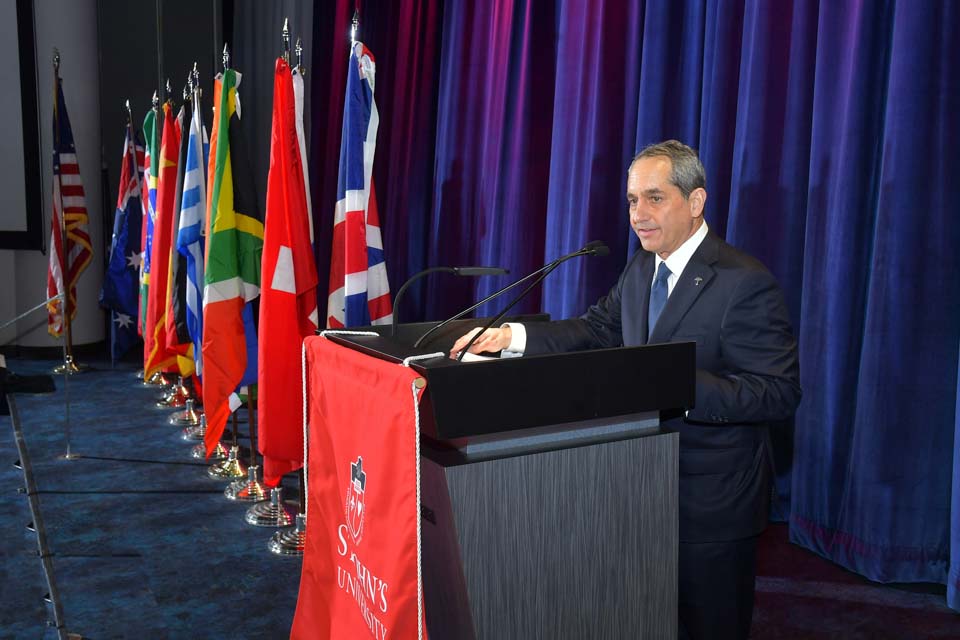
The public commitments extend into New York’s cultural life and his own university: he has served on the boards of New York City Ballet and the University of Pennsylvania. Together with the scholarship, these roles show where he has chosen to spend time beyond the operating business. They connect him to institutions whose work, like insurance, depends on people supporting something that will outlast the current year.
For all the institutional language, the personal details can be agreeably ordinary. Asked in 2023 what might surprise people about his day, he mentioned bringing lunch to work. He likes leftovers. It is a detail with no useful place in an earnings model and an excellent place in a profile. The executive allocating billions to technology is also deciding what to do with yesterday’s dinner.
The thread running through his career is a willingness to keep evaluating a comfortable arrangement. The law partnership, the established operating habits, the next generation’s place in the industry: each raises a question about whether what works now is enough for what comes next. Schnitzer made his own consequential choice in 2007. Years later, he still described how uncertain it had felt. That recollection leaves the career looking a little less inevitable, and the decision a little more interesting.