The trouble with a supplement ingredient is that it has several audiences to please. The consumer wants a benefit. The brand wants a reason to charge for it. The manufacturer wants the powder to stop sticking together. NNB Nutrition occupies the awkward territory where these demands meet. Its proposition begins with a useful suspicion: an ingredient that looks splendid on a specification sheet may still be a nuisance in a bottle.
- NNB supplies ingredients and formulation expertise to other businesses.
- Its selling points include absorption, taste, solubility and stability.
- Branded molecules reach consumers inside somebody else’s finished product.
A molecule with an entrance problem
Consider berberine. NNB’s GlucoVantage is dihydroberberine, a reduced form developed to address berberine’s poor absorption. The commercial idea is appealing: improve the molecule’s journey into the body rather than simply put more material in the capsule. A smaller ingredient requirement can give a formulator room to work. Anyone who has swallowed an ambitious supplement capsule will appreciate the attraction.
The evidence deserves a close look. A randomized crossover pilot published in December 2021 tested five healthy men, comparing placebo, 500 milligrams of berberine and 100 or 200 milligrams of dihydroberberine. The DHB treatments produced greater berberine exposure. Glucose and insulin did not differ significantly during the two-hour assessment. NNB funded the study; the senior author disclosed a paid advisory relationship.
That is a promising absorption result with a narrow remit. A manufacturer can use it to understand delivery. It cannot, by itself, establish that a finished supplement improves long-term blood-sugar control. The distinction is especially useful in a business where a number from a small experiment can acquire a remarkably large advertising budget.
Absorption measured. Long-term outcomes require separate evidence.
The powder has opinions
NNB’s founders bring different forms of ingredient knowledge. Kylin Liao, its president, has a chemistry background. Co-founder and chief science officer Shawn Wells is a nutritional biochemist and experienced formulator. The combination helps explain why the portfolio concerns itself with both physiological mechanisms and the less glamorous mechanics of making a product.


GeniusPure, for example, is alpha-GPC offered in 70% and 90% concentrations. NNB describes it as soy-free and non-hygroscopic. That last word means it resists taking up moisture. To a shopper, it sounds like a footnote. To someone making a powdered pre-workout, moisture behavior belongs near the top of the brief.
For an ingredient buyer, these details alter the comparison. A supplier’s price per kilogram is only one part of the bill. Concentration determines how much material the formula needs; handling and stability determine how easily it moves through production. A cheaper input can be an awkward bargain if it creates extra work. NNB’s manufacturer services address particle-size inconsistency, missed specifications and delayed lead times alongside the molecular questions. That makes the production team an important participant in ingredient selection.
Then there is HydroPrime, a glycerol ingredient designed to address clumping and stability. Its tagline, “More Pumps, Less Clumps,” has the rare virtue of admitting the problem. A powder must remain usable after it leaves the laboratory. The scientific promise and the scoopable product have to inhabit the same tub.
“More Pumps, Less Clumps”HydroPrime’s unusually practical sales pitch
Choose the process after the problem
NNB combines fermentation, enzymatic conversion, plant extraction and organic synthesis. Its development offer extends from creating an ingredient to adjusting it for manufacturing. The practical advantage is flexibility: the desired material need not be held hostage by a favorite production method.
36Kr reported a revealing example involving an unnamed ingredient. NNB initially pursued biosynthesis, but immature processes blocked commercialization. Chemical synthesis got it to market. Later, a hybrid route improved efficiency and stability. The useful lesson is to let production results settle the argument between technologies.
- 01 / DefineDose, flavor, format
- 02 / DevelopMolecule and process
- 03 / TestEvidence and stability
- 04 / ScaleRepeatable batches
An editorial guide to the work, rather than a promise of results.
The brand inside the bottle
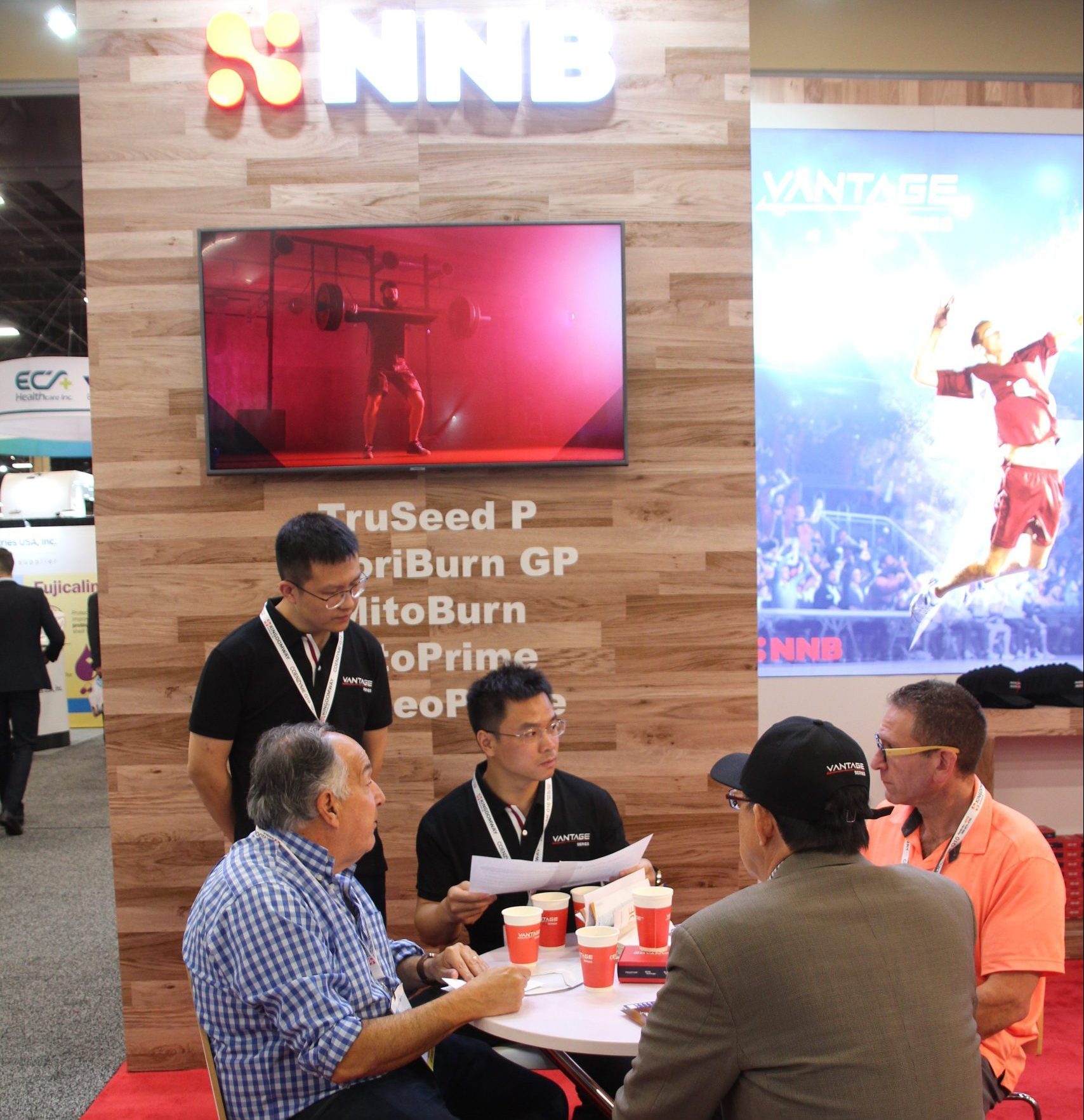
The portfolio spans several familiar supplement territories. MitoPrime is fermented L-ergothioneine for longevity and wellness formulations. MitoBurn supplies L-BAIBA, an exercise-associated metabolite. C8Vantage supplies C8-focused MCT powder. These are ingredients a brand can build into a finished formula, each with its own development rationale and evidence requirements.
C8Vantage’s non-dairy version illustrates how much work hides in the word “powder.” Its liquid oil is carried on plant-based fiber and protein, including tapioca fiber and pea protein. The carrier is part of the formulation decision: a brand choosing an MCT ingredient also has to decide how it will mix, taste and fit the intended product. Those choices belong in the brief before a supplier quote becomes a purchasing decision.
The business becomes particularly visible with DL 185: two leucine molecules bonded into a dipeptide. MuscleTech’s Peptide 185 lists the branded ingredient in its retail product. The consumer buys MuscleTech; NNB’s trademark travels inside. Ingredient branding gives the supplier a place in the shopper’s vocabulary without requiring it to own the whole bottle.
In August 2026, NNB and Axiom Foods announced PeptiClear, a clear hydrolyzed plant-protein platform. The partnership targets the taste, grittiness and opacity that can complicate conventional plant proteins in drinks and foods. Here the customer’s problem is immediately understandable: protein is welcome; an unwanted cloudy texture may receive a cooler reception.
Bring a brief, not a miracle
The scale requires capital. In July 2026, 36Kr reported nearly RMB 200 million in Series C+ funding led by China Life Private Equity Investment, with Moxi Capital participating. It reported 2025 revenue above RMB 400 million. Those are reported figures, rather than audited accounts presented here.
The retail economics are different from the supplier’s. MuscleTech listed Peptide 185 at $79.99 when checked for this profile. That is the price of a branded finished product, with its own packaging and commercial proposition. It should not be mistaken for what NNB charges a manufacturer for bulk dileucine. The two businesses sell different things at different stages.
A brand can request samples, pricing and formulation papers through NNB’s website. Buyers should specify the intended format, effective dose, sensory limits and production requirements. They should test the finished formula under its actual storage and processing conditions. A trademark cannot rescue an unsuitable dose or a beverage that separates on the shelf.
NNB competes for that brief alongside specialist ingredient developers, botanical suppliers and larger ingredient businesses. Its appeal is the combination of molecular work and manufacturing help. The sensible buyer judges the combination against a specific problem. Sometimes the valuable breakthrough is a new active. Sometimes it is opening a tub and discovering that the powder still behaves like powder.