There is a peculiar moment in drug development when a discovery becomes a procurement problem. A team has a gene worth investigating. It has a hypothesis, perhaps encouraging experimental results. Now it needs enough material to run the next study, produced consistently and accompanied by evidence of what is actually in the vial. The elegant idea has acquired a shopping list.
PackGene Biotech occupies that moment. Its customers buy the practical work of designing, making and testing genetic delivery materials. The company operates as both a contract research organization and a contract development and manufacturing organization: a laboratory partner early on, a production partner as a program advances. Its slogan, “Make Gene Therapy Affordable,” puts the factory at the center of the argument.
- What it sells: vectors, plasmid DNA, mRNA/LNP services and the testing behind them.
- Who buys: academic labs, biotech developers, pharmaceutical companies and clinical sponsors.
- The wager: better production processes can ease the cost and supply constraints around gene therapy.
The bottleneck in plain sight
Founder Huapeng Li’s explanation begins at the University of Massachusetts Medical School. In public interviews, he described a university operation that packaged viral vectors for researchers, including customers beyond the campus. What caught his attention was demand for those vectors and the limits of available supply. An enabling tool had become a constraint on the research it was supposed to enable.
That observation explains PackGene’s position in the market. It supplies the teams developing therapies, earning business from their experiments and manufacturing requirements. A useful vector can serve many different scientific programs. PackGene’s opportunity grows wherever those programs need help making it reliably.
Change the recipe before enlarging the pot
AAV, or adeno-associated virus, is a delivery vehicle used in gene-therapy research. Manufacturing it involves cells, DNA instructions and a process for recovering and purifying the resulting material. PackGene’s π-Alpha platform works on that production machinery: suspension cells, engineered plasmids and process optimization.
The company describes a three- to eightfold production improvement from foundational cell and plasmid changes, with up to tenfold overall yield improvement after further process work. Its August 2026 announcement describes π-Alpha 2.0 using a dual-plasmid system. These are PackGene’s reported platform results; a customer’s particular construct still has to perform in the process.
Normalized illustration of PackGene’s claim. Construct and process dependent; yield is not a price discount.
The economic logic is straightforward. More usable output from a production run can spread some costs across more material. But purification, testing and losses still matter. PackGene also targets an upstream expense through π-Omega, its plasmid-production platform. Its π-Icosa capsid-screening work addresses another question: whether the delivery vehicle reaches the intended tissue efficiently enough to justify making it.
A number is not a quality report
Counting vector genomes answers only part of the customer’s question. AAV preparations can contain empty capsids, residual DNA and other impurities. PackGene offers testing for genome integrity, identity, purity, infectious titer and safety, along with assay development and validation. The quality report has to describe the material well enough for the next decision.
The elegant idea has acquired a shopping list.A gene-therapy program’s practical turning point
For a researcher, the implication is pleasantly concrete: decide what the batch must prove before ordering it. A titer number, a purity measurement and a potency assessment answer different questions. Choosing the assays early can make the delivered material more useful than choosing a supplier from its largest production number.
A free tool, a paid journey
PackGene’s front door can be piVector Designer, a free online tool for building DNA constructs from vector backbones and gene elements. The company connects design to synthesis, cloning and viral packaging. Software here helps a customer specify something that will eventually arrive as physical material.
Its Express Gene-to-AAV service advertises delivery as fast as four weeks. The listed package includes a sequence-verified plasmid, AAV in a selected serotype and a quality-control report. This is a research-service promise. A clinical manufacturing project brings a larger scope: process development, scale-up, documented controls, release testing and regulatory support.
- 01DesignChoose the construct
- 02ProduceMake the material
- 03CharacterizeCheck what arrived
- 04DevelopPrepare the next stage
The business combines contract services with catalog research products. Larger manufacturing engagements are scoped by project. PackGene competes with providers such as Catalent and Thermo Fisher’s Patheon Viral Vector Services, as well as suitable academic or internal facilities. Its distinctive offering joins accessible research ordering to proprietary production platforms and clinical manufacturing support.
A factory needs more than a factory
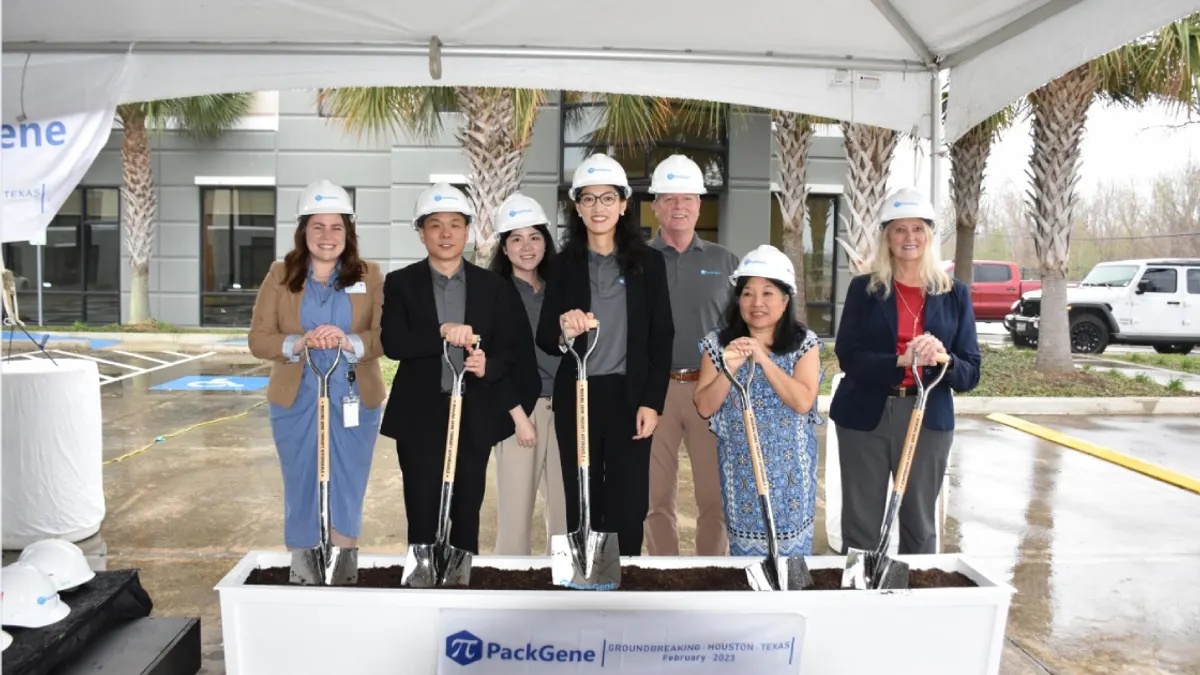
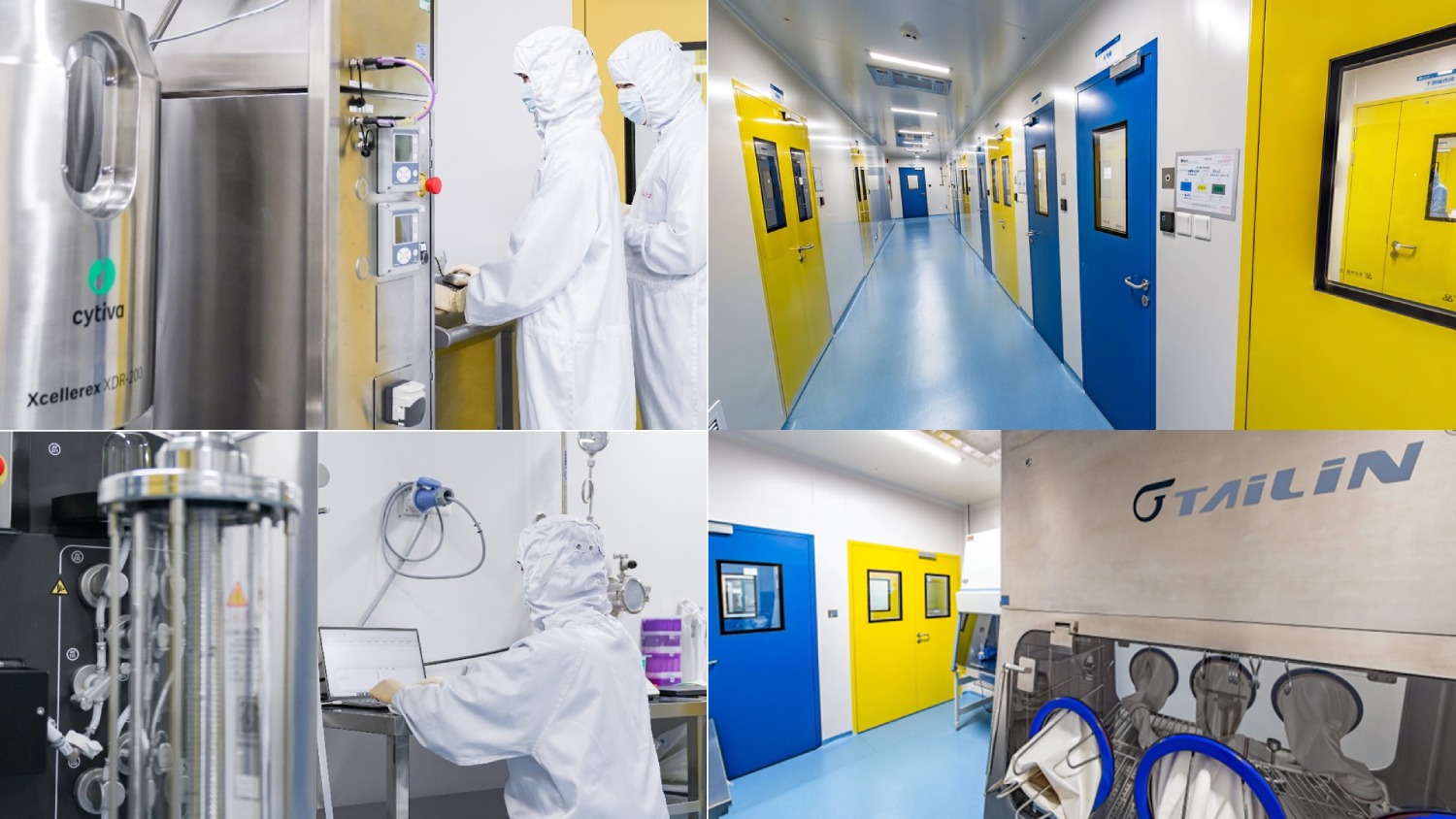
In February 2023, PackGene broke ground on a 25,000-square-foot Houston expansion. The announced plans included process and analytical laboratories, manufacturing cleanrooms and quality-control space. The combination matters: making a batch and establishing its properties belong in the same operational conversation.
Expansion also requires capital. A December 2023 announcement says the Guangzhou PackGene entity signed a C+ round exceeding RMB 100 million, funded by SDIC-CMC. The stated uses included global expansion and service-platform innovation. That distinction between the Guangzhou entity and the US business matters when reading the funding story: a group’s financing is not automatically a subsidiary’s balance sheet.
Its September 2023 partnership with Kudo Biotechnology extends that logic across companies. PackGene took responsibility for plasmid DNA development, manufacturing and cell banking; Kudo supplied mRNA and lipid nanoparticle development, production and fill-finish. The offer connects complementary operations. For a buyer, the responsibility at each handoff is as consequential as the list of services.
By August 2026, PackGene was reporting service to more than 2,000 pharmaceutical companies and research institutions across over 30 countries and regions. It also announced a Frost & Sullivan technology innovation award. Those claims describe a broad operation, although the useful measure for any individual customer remains the performance of their own project.
When the customer is a family
The stakes become less abstract in PackGene’s January 2025 collaboration with Genetic Cures for Kids and Weill Cornell Medicine’s Belfer Gene Therapy Core Facility. The project concerns SPG56, an ultra-rare neurological disorder affecting Tallulah Moon, whose parents founded the Australian nonprofit. The announcement says PackGene pledged to subsidize costs and accelerate clinical-grade development after meeting Tallulah.
The collaboration is a development effort. Its importance lies in how it assembles a small patient community, academic expertise and commercial manufacturing capacity around a program that needs all three. PackGene’s stated culture puts patients and fast delivery alongside integrity and innovation; this commitment gives those words a specific assignment.
Manufacturing efficiency cannot settle every question about a therapy. Biology, safety and clinical evidence still decide whether it helps. What PackGene can supply is a better organized route to the material those questions require. For the people waiting on an experiment, that is a considerable piece of the work.