The awkward thing about a radioactive medicine is that it refuses to wait. While a batch is tested, while a shipment travels, while a patient reaches the scanner, its activity declines. A promising molecule therefore comes with an unusually demanding business partner: time. RadioMedix, a Houston biotechnology company, has built its work around that inconvenience. Its story runs from finding tumors with PET imaging to developing a targeted treatment, with a manufacturing operation sitting between the scientific idea and the patient.
- Detectnet is an approved imaging agent; AlphaMedix remains an investigational therapy.
- RadioMedix also sells manufacturing expertise and a lead-212 generator platform.
- Its Sanofi deal assigns commercialization and manufacturing to different partners.
- The useful lesson: prove that the supply can grow alongside the science.
A physician’s problem becomes a company
Founder and CEO Ebrahim Delpassand came from clinical nuclear medicine, including leadership at MD Anderson Cancer Center. RadioMedix began in 2006. Its co-founders include chief scientific officer Izabela Tworowska, trained in pharmacy and chemistry, and Azar Delpassand, a nurse and healthcare entrepreneur. That combination matters: the company’s work crosses the boundaries between a chemical preparation, a medical procedure and an operating system for delivering both.
The underlying idea is radiotheranostics: use targeted radioactive agents to diagnose disease and, with therapeutic counterparts, treat it. A targeting molecule seeks a feature on a tumor; a radioactive payload supplies the imaging signal or treatment. The appeal lies in matching the agent to the biology. It also makes the quality of that match consequential. The target must be present, and the radioactive ingredient must stay attached as intended.
The extra hours inside an imaging agent
Consider Detectnet, copper Cu 64 dotatate injection. The FDA approved it in September 2020 to help locate somatostatin receptor-positive neuroendocrine tumors in adults using PET. RadioMedix developed it with commercial partner Curium. For clinicians, it supplies information about where those tumors are. For the people arranging the scan, its isotope supplies something rather less glamorous: breathing room.
Copper-64 has a 12.7-hour half-life. At the launch, the partners emphasized that this allows centralized production and shipment across the United States, helping address shortages and delays associated with other somatostatin analogue PET agents. Physics becomes scheduling flexibility. A medicine’s commercial usefulness can depend on whether the hospital can reliably receive it when the patient needs it.
The factory is part of the proposition
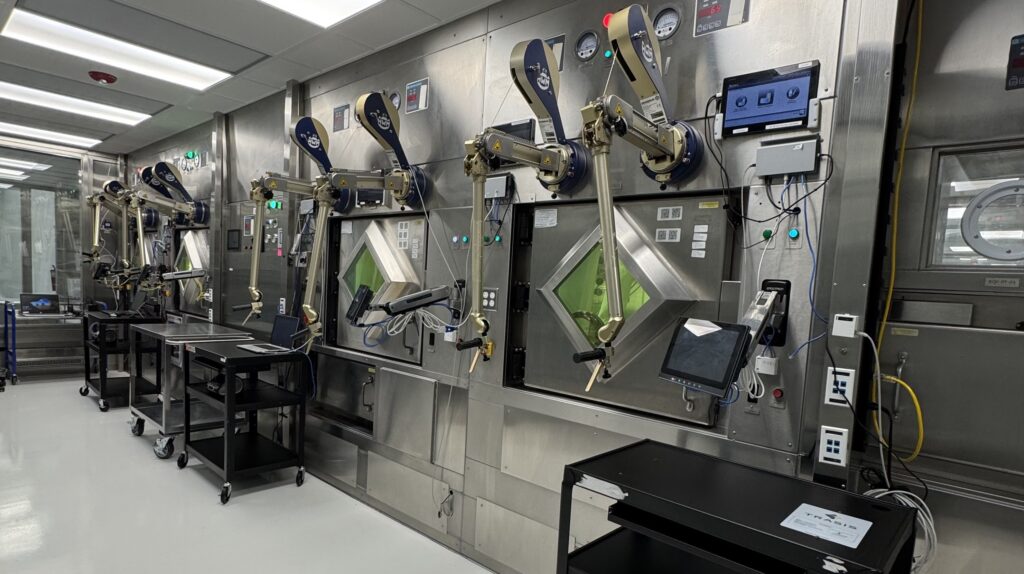
RadioMedix’s SPICA Center turns that delivery problem into a service business. The company offers radiochemistry, analytical method development, process validation and manufacturing for academic and industrial partners. Its roughly 27,500-square-foot facility supports clinical and commercial work. A developer can bring a program needing production expertise rather than attempt to recreate every capability inside its own laboratory.
There is an upstream business, too. RAHA-100 combines an automated synthesizing platform with a radium-224-based generator to produce purified lead-212 for radiolabeling. RadioMedix offers installation, consumables and service support. In December 2025, it announced five-year thorium-228 supply agreements with Thor Medical and Van Overeem Nuclear. Thorium supplies a precursor for lead-212 production. Diversifying access to that ingredient is a concrete response to a supply problem.
A therapy, three companies, divided duties
AlphaMedix is the larger therapeutic bet. It combines a somatostatin receptor-targeting peptide with lead-212, which acts as an in-body generator of alpha particles. The aim is concentrated radiation delivery to receptor-expressing neuroendocrine tumors. Approved beta-emitting therapy already occupies this market: Novartis’s Lutathera. AlphaMedix’s proposed distinction is its high-energy, short-range alpha payload. Whether that produces a better clinical outcome requires evidence.
In September 2024, Sanofi licensed AlphaMedix from RadioMedix and Orano Med. Sanofi took responsibility for global commercialization; Orano Med for manufacturing. The announced terms were €100 million upfront, up to €220 million in sales milestones and tiered royalties for the two licensors together. These figures describe a licensing agreement, not the cost of inventing the drug, and the public terms do not divide the proceeds between the recipients.
RadioMedix + Orano Med → licensed program
Orano Med → manufacturing
Sanofi → global commercialization
Read the small trial as a small trial
The October 2025 Phase 2 readout covered 35 patients without prior radioligand therapy and 26 previously exposed patients. Independent reviewers reported objective response rates of 57.1% and 19.2%, respectively. Investigator assessments were higher, at 60.0% and 34.6%. Both assessments met the key efficacy endpoints. The differences are a useful reminder that the method of measuring a result belongs beside the result.
This was an open-label study without a randomized comparator. It cannot establish superiority to Lutathera. Every participant experienced at least one treatment-emergent adverse event; grade 3 or higher events occurred in 54.3% of the untreated-by-RLT cohort and 42.3% of the previously exposed cohort. AlphaMedix remains investigational. Its 2024 FDA Breakthrough Therapy Designation is a development milestone, not permission to sell the medicine.
The lesson is sitting on the laboratory bench
“This isotope needs to be scalable.”Ebrahim Delpassand · September 2025 interview
Delpassand has described early isotope scarcity and an unfamiliar regulatory environment as obstacles, rather than a tidy story of one failed product. His later emphasis on compliant manufacturing and scalable isotopes explains the company’s operating choices. RadioMedix announced a $40 million Series A in 2022. It subsequently sought Sanofi’s commercialization experience. The sequence suggests a practical lesson for founders: identify the clinical need, then test the production assumptions before the sales ambitions outrun them.
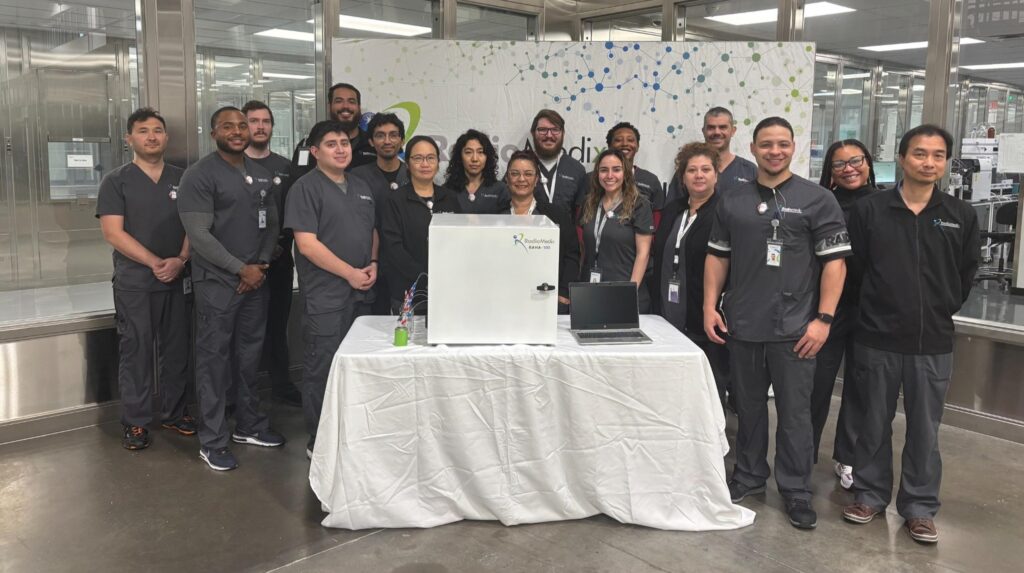
The approach has conditions. A target absent from the tumor, an unsuitable safety profile or insufficient isotope supply can defeat an attractive concept. Imaging centers need qualified staff and appropriate facilities; developers need quality systems and dependable production. In June 2026, RadioMedix announced approval of its generic Ga-68 PSMA-11 prostate imaging agent and reported an inspection with no Form 483 observations. It added pharmaceutical executive Brian Markison to its board in July. The company’s next chapter will depend on the same unromantic disciplines: usable evidence, reliable batches and getting the medicine there on time.