There is a decent chance that someone who says they have never heard of MGP Ingredients has already tasted its work. For years, the company’s most interesting position was just out of sight: behind the label, below the marketing copy and inside barrels eventually sold under somebody else’s name. At its Lawrenceburg, Indiana distillery, MGP produces bourbon and rye for young craft companies, established labels and multinational suppliers. The name on the bottle changes. The industrial choreography often begins in the same place.
This is not a secret so much as a feature of American whiskey. A new distiller can make spirit today, but cannot make a four-year-old whiskey today. MGP bridges that inconvenient gap. It offers established mash bills, custom recipes, maturing stock, warehouse space, quality control and help arranging freight. Customers are buying liquid, certainly, but also elapsed time and repeatability.
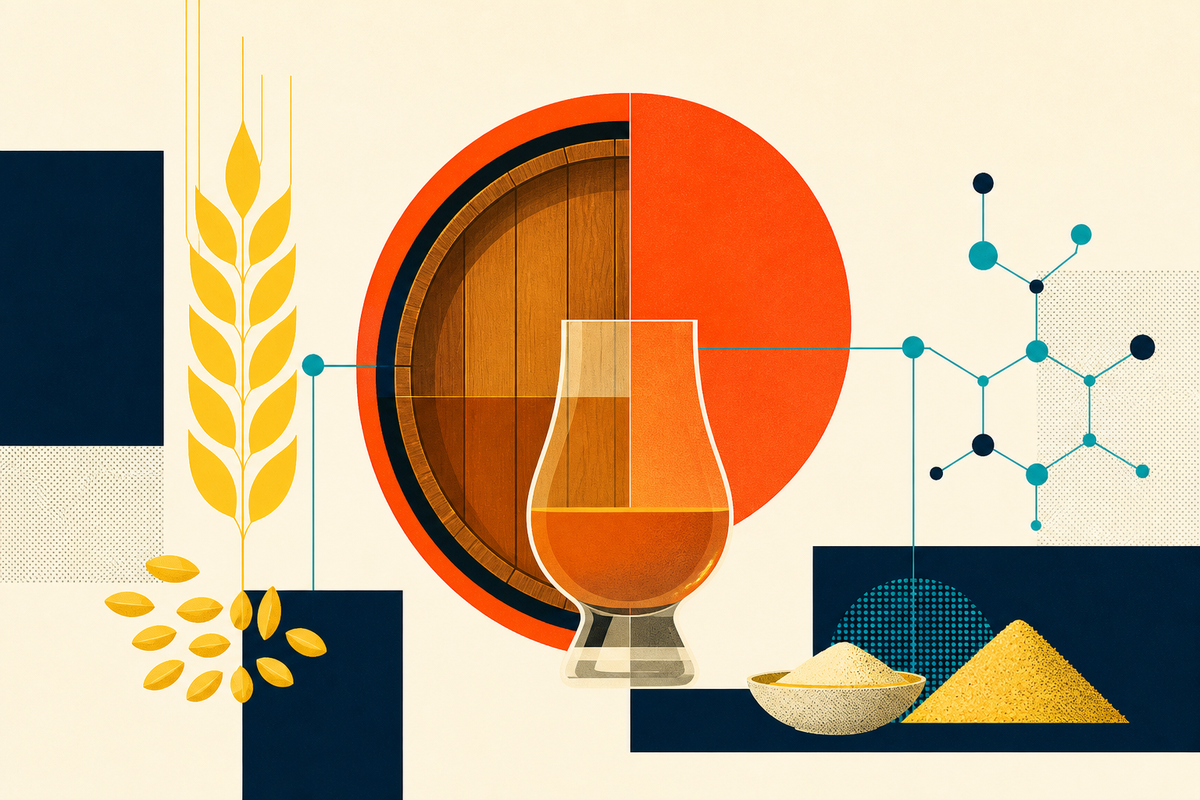
The useful company nobody needed to see
MGP began in Atchison, Kansas, in 1941, founded by Cloud L. Cray Sr. Its modern shape rests on three segments. Distilling Solutions supplies brown goods, grain-neutral spirits and related services. Ingredient Solutions sells specialty wheat proteins, starches, fiber and textured proteins. Branded Spirits, built at scale after the 2021 acquisition of Luxco, puts MGP closer to the person ordering a drink.
The overlap is the point. Distilling rewards process control, sensory judgment and patience. Food ingredients reward process control, sensory judgment and the less photogenic patience of formulation work. MGP’s Atchison Technical Innovation Center has 11 laboratories, a culinary kitchen and facilities for bakery, meat, prepared-food, sensory and analytical work. It behaves like an outside R&D department for customers who need an idea to survive mixing, heating, shipping and a supermarket shelf.
“When you think sourced rye whiskey it’s hard to think of anywhere but MGP.”John Stark · Boston Harbor Distillery
For a spirits founder, the company solves a capital problem: build a brand without first funding years of silent inventory. For a food scientist, it solves a formulation problem: add fiber, improve dough strength or reproduce the fibrous bite of meat without wrecking flavor and texture. The customer in each case is trying to shorten the distance between an idea and a dependable product.
Then the supplier bought the label
The strategic turn arrived in April 2021, when MGP completed its acquisition of Luxco at an enterprise value of $475 million. Luxco brought a national distribution platform and a shelf full of names: Yellowstone, Rebel, Ezra Brooks, Blood Oath, El Mayor, Everclear and others. Two years later, MGP bought Penelope Bourbon for $105 million at closing, with a substantial performance earnout.
The logic was plain. Bulk spirits can be cyclical and anonymous. A successful owned brand captures the value of the story, packaging and route to market, not only the distillate. It also makes MGP an unusual hybrid. The company can be a vendor to one whiskey label, a collaborator to another and a shelf competitor through Penelope or Yellowstone.
That tension is manageable because its services run deeper than a tote of whiskey. MGP can help a customer design a proprietary formula, scale it, mature the barrels, monitor quality and coordinate delivery. Its long production history and sizable stocks across ages give customers options that a new distillery cannot quickly manufacture. The distinction is less “we own a still” than “we own a functioning system around the still.”
A warehouse full of forecasts
Whiskey’s romance is also its accounting problem. Every barrel put away is a forecast about demand years later. During the category’s surge, the industry filled warehouses. Demand then softened, customers accumulated stock and some paused purchases. MGP’s 2025 sales fell 24 percent to $536.4 million. Distilling Solutions sales fell 45 percent, with brown-goods sales down 52 percent.
The pressure continued into the second quarter of 2026. MGP reported $124.4 million in sales, 15 percent below the prior year. Distilling Solutions sales fell 42 percent, and brown goods fell 59 percent. The company temporarily idled distillation at Lux Row and Limestone Branch in Kentucky, although bottling and visitor experiences continued. This is the less picturesque side of “grain to glass”: sometimes the glass is full and the grain must wait.
2025 sales mix · $536.4M total
There are counterweights. Warehouse-services revenue grew at a high-single-digit rate in the second quarter as MGP expanded the offering. Branded Spirits’ premium-plus sales increased 5 percent. Penelope rose 13 percent, while Yellowstone benefited from a limited release. Ingredient Solutions grew 29 percent in the first quarter and 2 percent in the second, helped by specialty-product demand and improved reliability. One division’s slow cycle can expose the reason for owning three.
The other half of the grain
MGP’s food portfolio is a cabinet of narrowly defined fixes. Fibersym RW is a resistant wheat starch that adds dietary fiber while remaining pale, smooth and neutral. Arise wheat protein isolates strengthen dough, improve elasticity and support higher-protein bakery formulas. Midsol starches can make a coating adhere or stay crisp. ProTerra, made from wheat or pea, is textured to imitate the mouthfeel of meat in vegetarian products or extend conventional meat.
These are not products most consumers request by name. They are tools for packaged-food developers, processors and bakeries. The buyer cares whether a tortilla stays pliable, a breading survives the fryer, a nutrition bar carries enough fiber or a plant-based filling chews properly. MGP competes with ingredient groups such as ADM, Cargill, Ingredion, Roquette, Manildra and Tate & Lyle. Its pitch is specialization and collaborative applications work rather than the broadest possible catalog.
The customer buys a barrel, but also the years it no longer has to wait. The food scientist buys a starch, but also the failed test batches it may avoid.
That is where MGP fits in the market: between commodity grain processing and consumer storytelling. Upstream, it buys and transforms agricultural raw material at scale. In the middle, it applies recipes, equipment, laboratories, aging time and logistics. Downstream, Luxco’s brands compete for attention and distribution. Few rivals span precisely the same three floors.
What customers can actually do with it
A startup distiller can sample mature whiskey, choose a mash bill, commission a custom formulation and launch while its own production ages. An established brand can smooth a supply gap, create a limited expression or add warehouse capacity. A food manufacturer can bring MGP a texture, nutrition or processing brief and work through applications testing toward a commercial formula. Consumers cannot order these services like software, but they encounter the result in bars, bakeries, freezer cases and snack aisles.
The company’s near-term task is disciplined rather than glamorous. It must reduce exposure to excess barrel inventory, protect cash, choose which brands deserve marketing dollars and restore ingredient margins pressured by waste-stream costs. Management’s 2026 sales guidance remains $480 million to $500 million. The portfolio offers options, but each option still needs operational execution.
There is another lesson in the cycle for anyone building a physical-product business. Capacity can look like a moat on the way up and a fixed-cost problem on the way down. A rickhouse filled during a boom does not shrink when depletion slows. A distillery cannot be turned like a software dial. MGP’s temporary Kentucky idling, lower capital spending and tighter production plans are attempts to match a long-duration asset base to a market that changed faster than the whiskey can mature. Its growing warehouse-services line is a small but telling adaptation: when customers need fewer barrels, they may still need somebody to look after the barrels they already own.
The owned-brand portfolio changes the conversation but not the physics. Penelope can win distribution and consumer attention, and Yellowstone can create interest with a limited release, yet both still move through wholesalers, retailers and control states. Shelf space is its own supply chain. MGP’s appointment of marketing and commercial leaders in 2025 and 2026 signals where it knows new muscle is required. The company mastered production before it had to master a portfolio of stories.
That makes culture unusually consequential. MGP’s published values are grouped under People, Pride and Progress, with an emphasis on working across job descriptions, keeping commitments and taking intelligent risks. Those phrases face a practical test when a food scientist, distiller, salesperson and brand manager all touch the same commercial decision. The useful behavior is not abstract collaboration. It is telling a customer that a formulation will not scale, stopping production when demand does not justify it, or finding a more profitable use for a grain stream that once looked like waste.
MGP’s peculiar advantage is not invisibility anymore. It is fluency at several points where products become real: the recipe, the factory, the warehouse and the shelf. Its next chapter depends on proving that those points form a system, not merely a collection. In a crowded rickhouse, the most useful thing may be knowing which barrel to fill, which one to sell and when to stop making more.