At first glance, Diageo looks like a crowded drinks cabinet. Johnnie Walker supplies the diagonal label. Guinness owns the black pint and cream head. Don Julio brings the tall tequila bottle; Baileys the dessert course; Smirnoff the nightclub rail. Put the doors back on, however, and the cabinet becomes an industrial system. The London company sources grain and agave, distils and brews, ages inventory, predicts demand, negotiates with distributors, trains bartenders and pays to make a label feel native in places its founder never saw.
That system contained more than 200 brands, 110-plus manufacturing sites and more than 29,000 employees in 2025. Its products reached nearly 180 countries. Reported net sales for the fiscal year were $20.245 billion. Diageo called 13 of its names “billion-dollar brands” and ranked itself first in international spirits by retail sales value. Scale is the obvious fact. The more useful fact is that scale sits behind brands designed not to look scalable.
A young company full of old ghosts
Diageo itself is not ancient. It was formed on December 17, 1997, when Guinness plc merged with Grand Metropolitan plc. The corporate parent is younger than Google. Its memory, though, reaches to Arthur Guinness’s Dublin brewery in 1759, John Walker’s Kilmarnock grocery in 1820, Charles Tanqueray’s gin work in the 1830s and Pyotr Smirnoff’s Moscow distillery in the 1860s. Baileys, born in 1974, is practically the teenager at the table.
The decisive move came after the merger. Diageo sold food assets including Burger King and Pillsbury and concentrated on premium drinks. That focus left it with a peculiar form of leverage: a new central company could fund, distribute and measure brands whose authority came from being old, local and specific. A Johnnie Walker drinker does not need to care that the same parent owns Tanqueray. A retailer does. The portfolio lets Diageo approach a customer with whisky, vodka, gin, rum, tequila, liqueur, beer and alcohol-free choices, then support the lot with one commercial relationship.
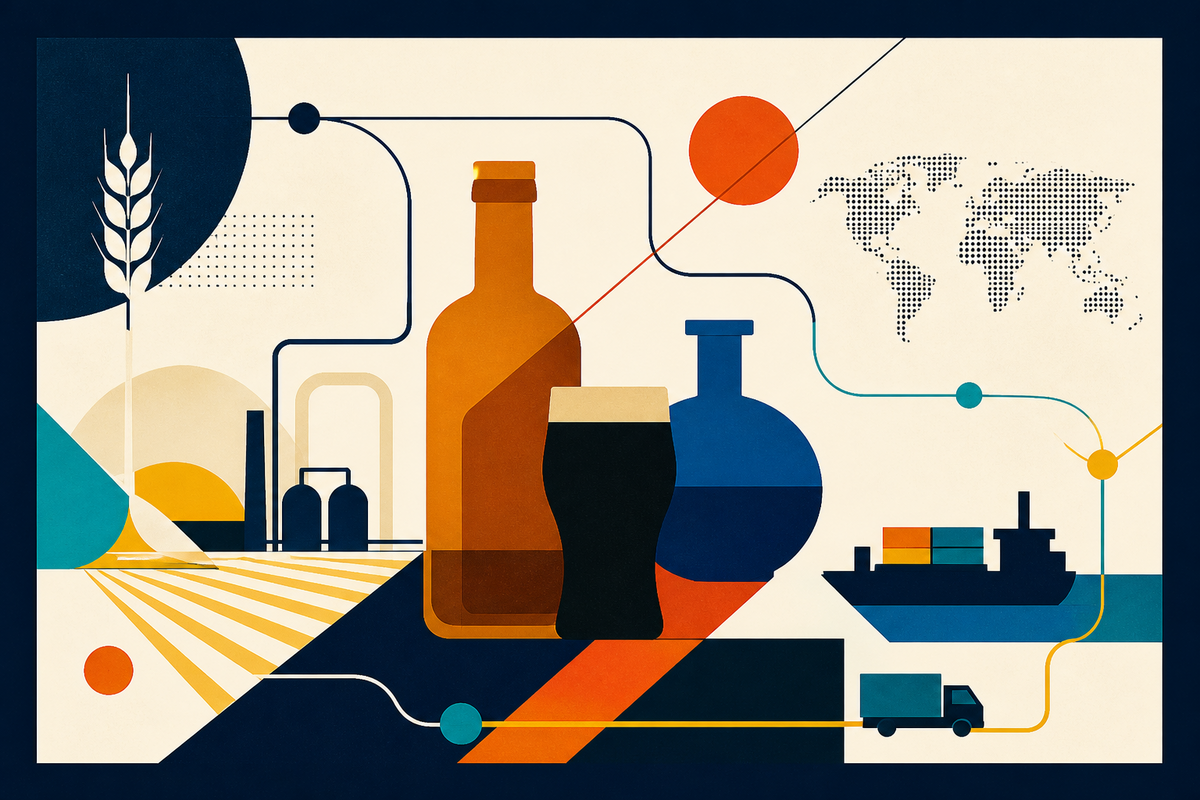
The portfolio is a map of occasions
Competitors such as Pernod Ricard, Bacardi, Brown-Forman, Suntory Global Spirits and Campari Group also assemble strong spirits portfolios. Beer puts Diageo beside much larger brewers such as AB InBev and Heineken. Diageo’s distinction is the breadth of its international spirits position paired with Guinness, a beer that behaves like a cultural franchise. The portfolio stretches from accessible mixing brands to bottles bought as gifts, collected or poured in luxury venues.
The customer is therefore two people at once. One is the adult choosing a bottle, cocktail or pint. The other is the operator choosing what to list: a supermarket buyer, wholesaler, bartender, hotel group, restaurant, airport retailer or ecommerce platform. Diageo solves a different problem for each. Consumers get dependable flavours, recognizable signals and products for different budgets or levels of moderation. Trade customers get demand generation, a broad catalogue, supply reliability, category data and training. The company’s own business model describes the chain plainly: source, innovate, make, transport, sell to customers, market to consumers, help consumers celebrate.
Old ritual, new liquid
The portfolio works only if Diageo can change a product without stripping away the reason people recognize it. Guinness 0.0 is the neatest demonstration. Its development took four years. The technical problem was to remove alcohol while retaining the dark colour, balance and creamy visual signature. The commercial problem was larger: persuade a pub drinker that choosing no alcohol did not mean leaving the round, the branded glass or the slow settling pour.
By early 2025, distribution of Guinness 0.0 in British pubs was up 69 percent, while Guinness had become the biggest-selling beer in Great Britain. The alcohol-free version was also made the official non-alcoholic beer of the Premier League. This is portfolio innovation at its most efficient. Diageo does not have to invent a new social ritual and then buy awareness for it. It inserts another option into a ritual that already exists.
Johnnie Walker Red Soul, introduced in March 2026, uses the same logic in Scotch. Consumer research found that more than a quarter of non-Scotch drinkers were open to the category but wanted sweeter flavours. Master Blender Emma Walker’s answer was a smoother, vanilla-forward whisky without smoky notes, designed for a simple lemonade serve and an entry-level price. It is less a rebellion against Red Label than a new doorway into the same house.
Selected signals, not a common scale
Reported net sales for FY25 and H1 FY26; estimated net proceeds from the agreed East African Breweries and Kenyan spirits disposal. Bars aid comparison within each label and are not a financial forecast.
A machine under renovation
Heritage did not protect Diageo from a difficult market. In the six months through December 2025, reported net sales fell 4 percent to $10.46 billion; organic net sales fell 2.8 percent. Growth in Europe, Latin America and Africa was offset by weakness in North America and China. Net debt stood at $21.7 billion. The board rebased the dividend, prioritizing financial flexibility and leverage reduction - a conspicuous change for an income stock.
Sir Dave Lewis became chief executive on January 1, 2026. His résumé includes nearly three decades at Unilever and a turnaround at Tesco. His early formula for Diageo was blunt: build competitive category strategies around relevant brands, put customers at the center and redesign the operating framework for sustainable returns. The language matters. Diageo’s recent problem is not an absence of famous labels. It is making that fame convert into volume, cash and share without letting complexity swallow the benefit of scale.
The physical portfolio is being edited alongside the brand portfolio. Diageo agreed to sell its 65 percent stake in East African Breweries and its Kenyan spirits holding to Asahi, expecting roughly $2.3 billion in net proceeds. Long-term licenses are intended to keep Guinness and other Diageo labels in the system. It also moved to divest the Royal Challengers Bengaluru cricket business. These deals separate owning an asset from reaching a market - Diageo can retain brand economics and routes to consumers without owning every brewery or adjacent entertainment property.
Elsewhere, it is spending. A $415 million factory and warehouse opened in Montgomery, Alabama, in April 2026, bringing production closer to customers in the southern United States. The site uses automated guided vehicles, electric boilers and real-time water and energy metering. In May, Diageo opened the nearly €300 million Littleconnell Brewery in County Kildare, powered by renewable electricity, and outlined roughly €400 million more for a second brewery focused on Guinness and Guinness 0.0. Divest where ownership is no longer essential; build where demand and logistics reward control.
Marketing the celebration - and the limit
Alcohol companies live with a tension that snack and software businesses do not: more consumption is not an uncomplicated good. Diageo’s “Spirit of Progress” programme includes responsible-drinking messages, underage-drinking education, water goals, emissions targets and representation commitments. DRINKiQ explains alcohol and moderation. Campaigns with the NFL, Mothers Against Drunk Driving and Uber tell fans to plan a safe ride. The 2026 FIFA World Cup partnership activates five brands across the Americas while attaching responsible-consumption language to the spectacle.
Those efforts are both social commitments and protections for the company’s license to operate. They also follow the market. “Drink better, not more” neatly aligns premiumization with moderation: higher-value products, more choice, fewer assumptions that growth must mean extra servings. Low- and no-alcohol products make that position tangible. The honest test is not a slogan but whether product design, advertising, sales incentives and public reporting point in the same direction.
Where does Diageo fit in the market? It is a brand house with the muscles of a manufacturer and the nervous system of a distributor. Its expertise lies in blending and brewing, sensory science, long-dated inventory, packaging, consumer insight, regulatory compliance, route-to-market design and the patient work of cultural relevance. A bottle may begin with barley in Scotland or agave in Jalisco. The commercial craft is getting it to arrive in Mumbai, Montreal or Madrid with its story intact and its price justified.
That is why the shelf is the real product. Not the literal plank in a shop, but the privileged position in a buyer’s plan, a bartender’s memory and a consumer’s repertoire. Diageo can acquire a label, build a factory, sponsor a tournament and train the person who pours the drink. The next phase asks a harder question: can it make that entire route simpler and more productive? The cabinet is already full. Lewis’s job is to prove every bottle has a reason to stay.