On a bus in Peru, Andrew Vrbas briefly imagined becoming a tea entrepreneur. He had been walking with his host grandfather on Saturdays, smelling plants and learning what people used them for. Tea seemed plausible. Then came the practical doubts: food rules, barriers, complications. His next thought smelled better. Soap used ingredients available near the equator. It could be made with modest equipment. People needed it. By the time the bus reached wherever it was going, Vrbas had the beginning of a company.
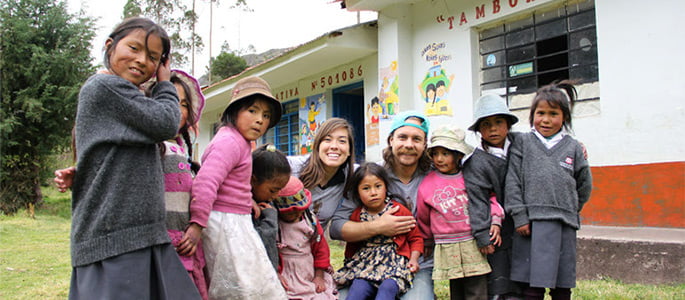
He was 19, turning 20, and volunteering while a student at Hastings College in Nebraska. Peru was not entirely new to his family. His mother had visited in 1965 and formed relationships there; she encouraged him to make his own trip when he turned 18. On the second visit, he was not passing through. He lived, worked, taught and paid attention to the connections among sanitation, education and economic opportunity.
The fashionable answer of the moment was one-for-one charity. Buy something here, give something there. Vrbas liked the energy and distrusted the mechanism. A free product might meet an immediate need while undercutting the person who made that product locally. A warm feeling at checkout was not evidence of a durable result. He traced the problem farther upstream and arrived at income: people needed useful work, reliable markets and room to build livelihoods.
We have an impact whether we want to or not. We can choose to make that a positive one or a negative one.Andrew Vrbas, 2019
The improper appliance
Conviction did not arrive with competence attached. Vrbas returned to Nebraska without knowing how to make soap. He borrowed his mother's crockpot and learned. Pacha's own history records the best detail: the same pot made both soap and chili. It is hard to imagine a cleaner rebuke to the polished-founder origin story. No laboratory, no immaculate product studio, just a college apartment and cookware with a divided loyalty.
His wife, Abi, then a fellow Hastings student, joined the work. Andrew graduated in 2012 and took Pacha full time; Abi worked on it while finishing college. They packaged products in the Bronco Village Apartments, designed an early wooden mold and sold at farmers markets. Production migrated from the apartment to a rented-house garage and then into renovated space in downtown Hastings. A small chili pot became a larger one, then a larger pot again. The molds grew the same way.
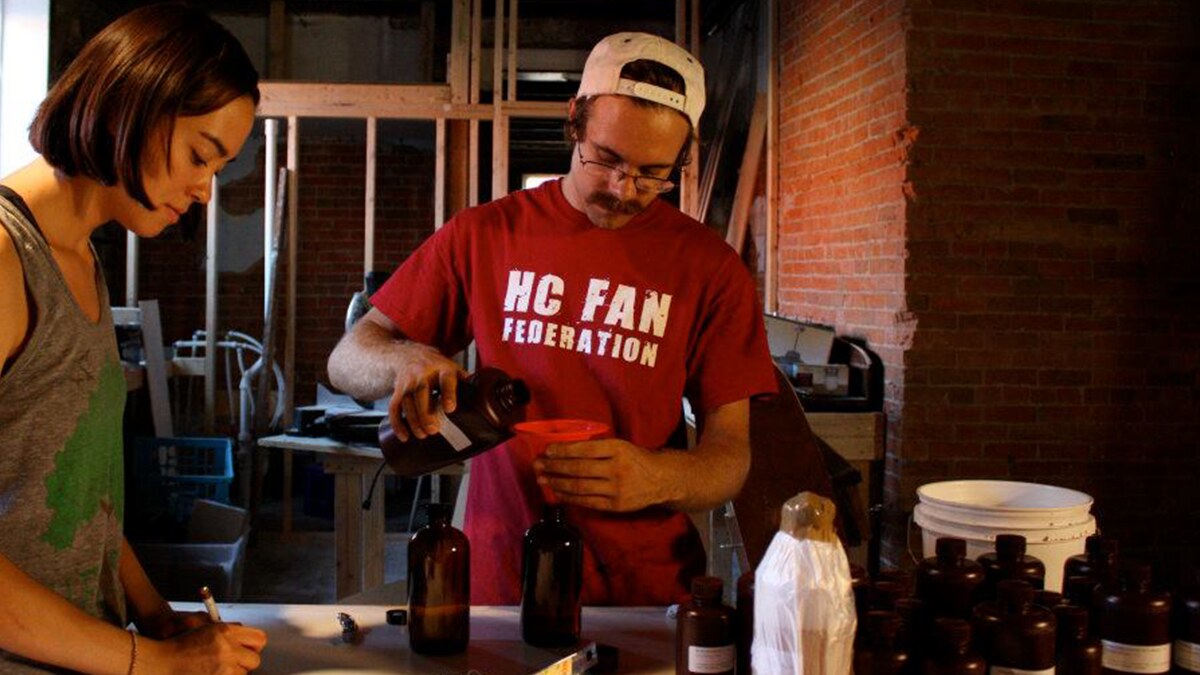
That sequence matters because it explains Vrbas as an operator. He has said he did not come from money, so growth had to fund growth. The company acquired capability one practical increment at a time. Soap is a physical education. Ingredients arrive, formulas behave or misbehave, batches cure, labels must fit and retailers expect the next shipment to resemble the last one. A mission cannot charm sodium hydroxide into cooperating.
The larger-pot theory of company building
Delight first, lecture later
Vrbas's theory of change came wrapped in a product that was supposed to be enjoyable. He had liked smelling the soap display at a Whole Foods in Denver before Pacha existed. Years later, Whole Foods became a major customer. The retailer gave Pacha its 2016 Supplier Award for Outstanding Innovation after the company developed Froth Bombs, bath bombs made in playful shapes, scents and colors. Andrew and Abi accepted the award together.
The circle is almost suspiciously neat, but the underlying principle is useful. Purpose does not excuse a dull product. Pacha's wares were colorful, fragrant and often cheekily named. Dirty Hippie, the original patchouli, nutmeg and clove bar, remains Vrbas's favorite. He once called the company a “Willy Wonka of personal care products.” The line works because the factory's seriousness coexists with the shopper's small pleasure. Nobody wants to bathe with a white paper.
Pacha's early “buy to give” promise was easy to understand. By 2017, the company reported more than one million donated bars, handwashing education for 75,000 children and 105 careers established. But the founders' thinking kept moving toward what happened before a purchase. Who grew the ingredients? Who made the bars used in an overseas program? Could local producers earn rather than wait for a shipment?
By 2019, Vrbas said Pacha-backed school programs in East Africa had distributed more than five million bars, all made in local communities from local ingredients. He described direct relationships with smallholder farmers as a way to move more margin toward growers while obtaining higher-quality materials. The bar became a meeting place for two systems: a pleasant retail ritual and a supply chain designed to reward more of the people inside it.
A factory is stored competence
In spring 2020, the abstractions became bottles. Pacha redirected part of its operation to produce 18,000 twelve-ounce bottles of sanitizer for hospitals, nursing homes and first responders. The company distributed them free. Vrbas worked with Nebraska officials and the ethanol industry on access to production inputs. For each soap bar bought on Pacha's website, the company also donated a bar within the United States.
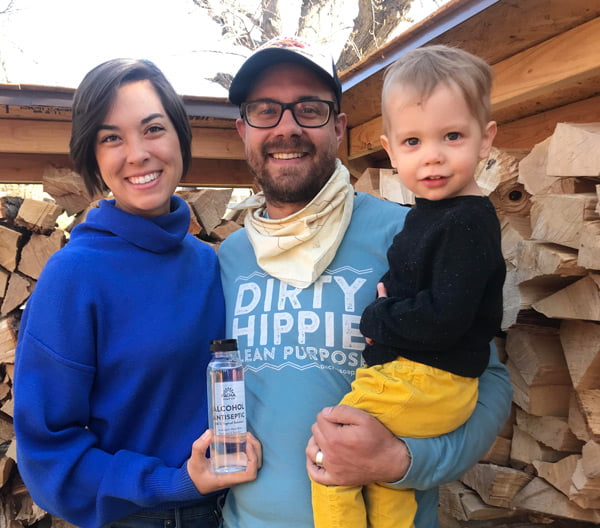
Manufacturing had given the company options. A factory is not merely walls and machines; it is sourcing knowledge, formulation, filling, labeling, logistics and a group of people accustomed to turning materials into repeatable objects. When the shortage arrived, those skills could be recombined quickly. Vrbas's claim that business can be useful became countable in pallets.
The response also brought the thesis home. Vrbas had gradually widened his view of impact beyond places commonly described as poor. Hastings has its own economic pressures. Pacha's local payroll, internships, supplier relationships and partnerships became part of the mission rather than the headquarters' incidental footprint. The company stayed in central Nebraska even as its products traveled across the United States and Canada.
The argument grows up
Scale complicates every clean story. Pacha took outside capital, combined with the purpose-led Hand in Hand brand in 2022 and later sunset that brand when it failed to connect with younger shoppers. It secured senior debt financing in 2024. In 2025, the company refreshed its main range and introduced Foxly, a fragrance-forward line aimed at Gen Z shoppers in the natural-grocery channel. The debut put Foxly in 500 Whole Foods locations.
Pacha also did the unromantic work of reading complaints. It altered a soap dish because bars stuck to it. It changed bath-bomb density so the bombs would float and turned a lavender sphere into a flower. These are small corrections, but that is exactly why they matter. Vrbas's grand idea has survived because the company keeps returning to ordinary friction: the sticky dish, the sinking bomb, the product a customer does or does not buy again.
At the same time, his language has moved deeper into the ingredient list. On a 2024 panel about regenerative supply chains, Vrbas said Pacha's thesis was rooted in positive impact “with ingredient integrity at its core.” The company had begun talking less about a simple gift after purchase and more about long-term partnerships, farmer livelihoods and environmental outcomes embedded before the product reached a shelf.
There is no frictionless version of this work. A consumer brand must finance inventory, win shelf space, manage formulas and stay interesting. A social enterprise must prove that its values persist when the purchasing order gets large and the quarterly choices get sharp. Vrbas's aspiration is therefore both lofty and stubbornly operational: deepen impact while expanding the business that pays for it.
I love the idea that business can be used as a tool to accomplish a lot of things.Andrew Vrbas, 2020
The story began with a young traveler asking why poverty made basic routines difficult. It continued with a skeptic asking whether an attractive charitable model actually strengthened local economies. Then came a maker asking how to get the next batch right, a seller asking what Whole Foods wanted and an employer asking what growth could mean in Hastings.
Soap turned out to be an unusually good object for holding all those questions. It is intimate but ordinary, necessary yet capable of whimsy. It disappears as it works. Vrbas has spent more than a decade trying to ensure that what remains after the lather is more than a pleasant scent: money paid to growers, work on a factory floor, a product someone chooses again and an argument about business sturdy enough to survive contact with the ledger.