A company can have a job opening and still be invisible. Maria Christopoulos Katris has spent much of her career studying that peculiar condition. In Chicago, she saw technology companies doing interesting work while the city argued about whether it had a technology industry. Later, she watched employers discover that telling their stories could bring people through the door. The vacancy was only part of the invitation.
There is a useful clue to her approach in the business she built before Built In: a nanny-placement agency. The distance from matching families with caregivers to matching engineers with employers looks considerable on a business card. In practice, both involve choices too personal to be settled by a list of qualifications. People want to know who is on the other side.
Today, as Built In’s co-founder and CEO, Katris is following that question into AI search. A prospective employee can ask a chatbot about a company before a recruiter knows the person exists. The introduction has moved again. Katris has been making a business of introductions for years.
The advice before the business plan
Katris was born in Mount Prospect, Illinois, and grew up in a Greek-American family whose businesses included a restaurant and a fruit market. She and her sister started helping in fifth grade. Entrepreneurship was ordinary family work, with all the obligations that the word “founder” can sometimes politely conceal.
After studying finance at Miami University in Ohio, she wanted to start a business immediately. Her father advised her to get experience first. She took the advice: two years at Arthur Andersen, then two at Huron Consulting Group. Consulting supplied an education in other people’s businesses, although the travel eventually lost its appeal.
While pursuing an MBA at Northwestern’s Kellogg School, she began preparing Nanny Boutique. She had been a summer nanny during college and knew the agency experience from the candidate’s side. In 2005, she began researching the venture, talking with families, nannies and existing agencies. She spent much of a year preparing. Her later advice to would-be entrepreneurs was suitably plain: “Don’t go in blindly.”
She eventually sold the agency. The ambition behind the sale matters: she wanted a business that could grow beyond its original boundaries. “I wanted to create something scalable,” she said. Matching people would remain the work. The size of the map was about to change.
“I wanted to create something scalable.”
Maria Christopoulos Katris
Chicago needed an introduction
The early Built In story has more than one beginning. Matt Moog founded Built In Chicago in 2010. Katris became its first employee in 2011 and helped develop the business that followed. The distinction is useful: a community can exist before someone figures out the company it might become.
Chicago had entrepreneurs, investors and technology businesses. Katris believed it was doing too little to tell the world about them. The problem was familiar to anyone who has attended a good party where nobody introduces the guests. The people were there. Much of the value lay in getting them talking.
Built In initially offered a social network and blogging platform. Startups could describe what they were building and connect with others locally. Then a revealing consequence appeared: participating companies attracted talent. Readers who came to understand a company sometimes wanted to work there. Publishing had become part of hiring.
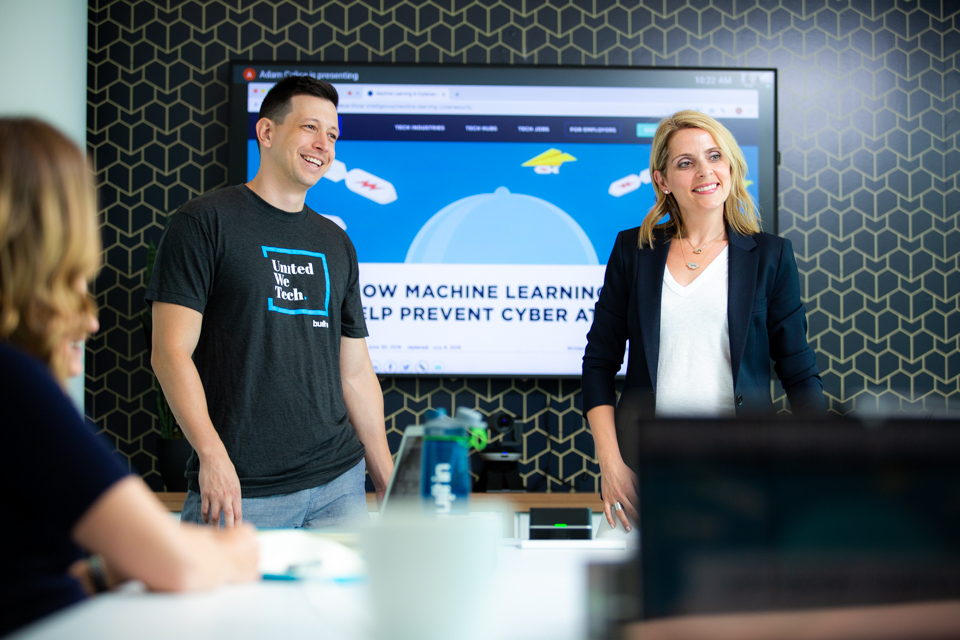
That discovery gave Katris and co-founder Adam Calica a direction. They could build a business around the information people sought before applying. A job description explained the opening; stories could show the purpose and people around it. For an employee deciding where to spend the week, and perhaps several years, those details had considerable weight.
The experiment traveled. Colorado launched in November 2012; Los Angeles followed in January 2013. Each expansion tested whether the Chicago experience depended on local affection or answered a problem shared elsewhere. The company also developed an annual employer package, creating recurring revenue to support the work. Even a lively community needs a way to pay its bills.
A thousand refusals, then a use for the money
Katris has recalled roughly a thousand refusals from customers and investors. There were stretches when she and Calica ran three markets with a staff of two. The eventual funding announcement is easier to put in a headline than the preceding conversations, but the conversations explain why her account of growth tends to include patience.
In July 2019, Built In announced a $22 million Series C led by Updata Partners, with MATH Venture Partners among the returning investors. Carter Griffin joined the board. The plans included expanding the team, improving the product and developing ways to match professionals with workplaces that suited their values.
The round was described at the time as Chicago’s second-largest venture round raised by a woman CEO leading a digital technology company. Katris’s own emphasis was on what the money would enable. She had wanted to know how capital would be used before raising it, and to avoid making survival depend on another check.
By August 2020, Built In reported more than 130 employees, 1.7 million monthly visitors and over 1,800 clients. It appeared on the Inc. 5000 that year. Those are dated milestones, rather than numbers to pass off as today’s headcount or audience. They mark a point when a local experiment had acquired a national business behind it.
Who gets a second look?
A company helping people find work inevitably reveals something about its leader when it hires for itself. Katris devoted close attention to Built In’s first hundred hires. She described a preference for potential and an interest in people whose ability might be underestimated by the conventional reading of a résumé.
Her stated criteria included curiosity, accountability, teamwork, passion and a willingness to solve problems. “Humility is one of our core values,” she said. For a business paid to draw attention to other companies, that has an unusually practical application. Being interested in someone else’s story is part of the job.
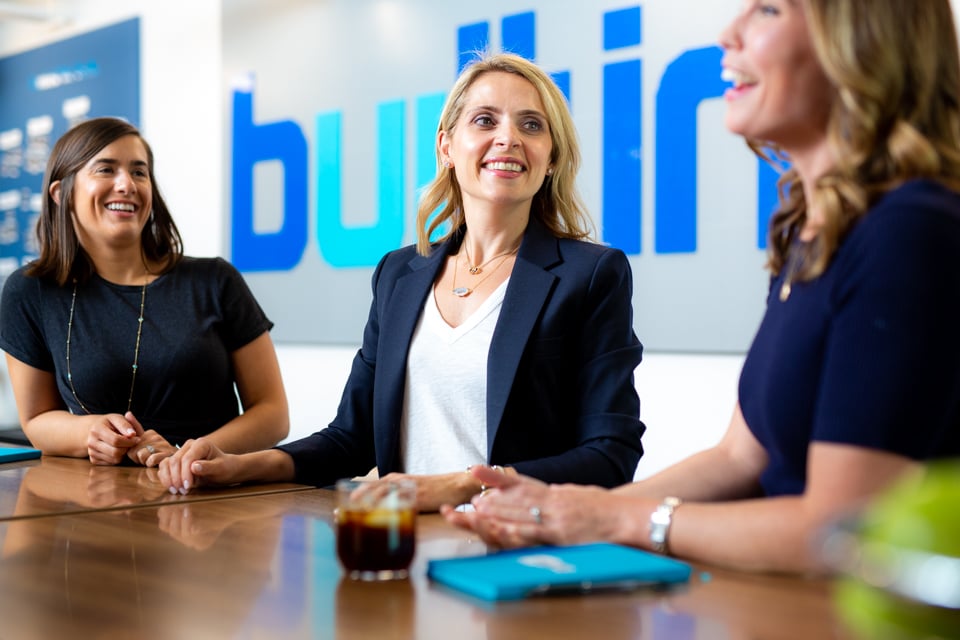
In a 2025 reflection on fourteen years at Built In, she credited colleagues who had stayed through changing markets and changing demands. She described difficult periods as occasions to become more focused, compassionate and oriented toward solutions. It is a statement of how she wants to lead, with the team’s longevity offered as something worth celebrating.
There is also a less ceremonial side to her public account of life. She likes traveling with her family; Dana Point, California, was a favorite destination alongside Greece. Asked how she chose the next trip, she pointed to where airline miles could take a family of five. Even the international itinerary had to clear procurement.
The map gets bigger
By 2024, Built In’s expansion had become international. In a public year-end review, Katris reported more than twenty international sites and over five million monthly visitors. The business that had helped Chicago explain itself was operating across borders, following employers and candidates whose working lives no longer fit neatly inside a city.
One detail made that expansion personal. Katris recalled that an engineer in India found a Built In Chicago posting in 2014. A decade later, she celebrated another hire in India, this time through Built In’s newly global candidate database. The company was using the connection it sold to others. An early surprise had become a planned capability.
The geography also exposed tensions. In a September 2024 interview, she said remote roles accounted for 70 percent of applications on Built In, while representing only 30 percent of listed jobs. These were figures from that moment, but the imbalance gives the discussion a useful edge. Employers and applicants can inhabit the same platform while wanting rather different things.
Katris described adapting to remote and hybrid hiring, expanding internationally and paying closer attention to enterprise customers. The decisions suggest a practical approach to a shifting market: follow where customers actually need to hire, and keep watching how candidates choose. A platform has to understand both sides of an introduction.
Now the first conversation may be with a machine
On May 5, 2026, Built In announced its Employer Intelligence Platform. The product helps companies examine and improve how they appear across AI and search. Its announced functions include analyzing employer perception, creating content and profiles, and distributing company information. For Katris, the question of being discovered has acquired a new intermediary.
Built In’s 2026 research gives a sense of the concern it is addressing. In an online survey of 162 talent acquisition and HR leaders, 91 percent said AI influenced candidate discovery and research. Only 33 percent expressed confidence that their employer brand was accurately represented. Most respondents were in North America; the figures describe this group’s views.
Katris has also challenged the habit of judging recruitment investments by the final application channel alone. If someone learns about an employer in several places, then applies wherever convenient, the last click records only the last step. Her proposed questions concern visibility, reputation and hiring outcomes, examined by market, function and role.
The commercial interest is clear: Built In sells help with that work. The human question remains engaging because it predates the product. What does someone need to understand before deciding to join you? Katris has approached it through a placement agency, a city’s startup community, a national recruiting business and an international platform.
For all the changes in technology, her attention keeps returning to the moment before a decision. Someone is curious. Someone else has a story worth hearing. There may be a vacancy, but there also has to be a reason to cross the room.