The cash register was waiting when Maria Christopoulos Katris reached fifth grade. Her parents, Tom and Georgia, had come to Chicago from Greece as teenagers, studied pharmacy and eventually opened a shop in Lincoln Square. The counter gave their daughter an unusually frank view of ownership. She saw customers arrive by name. She saw the business grow. She also saw her father stretch himself thin when the arithmetic became difficult. Long before she had a board, a funding round or the title of CEO, Katris understood that a company was a set of promises made in public.
There is a tidy temptation to call the pharmacy her first startup. It was not. It was better than that: a neighborhood institution where commerce could not hide behind vocabulary. People either came back or they did not. Shelves had to be stocked. The books had to close. Generosity and solvency had to share the same room.
“A lot of the lessons I use today to run Built In, I learned from watching my dad.”Maria Katris
She carried those lessons through a degree at Miami University, consulting jobs at Arthur Andersen and Huron, strategy work at Northwestern Memorial Hospital, and an MBA at Northwestern's Kellogg School. In graduate school she built her first company, Nanny Boutique. The idea had a practical origin: Katris had worked as a summer nanny in college and knew what it felt like to pass through an agency. She spent close to a year interviewing families and caregivers, researching other firms and assembling a business plan before she opened the doors.
The patience was revealing. So was the exit. Katris intended to sell the agency because she wanted her next project to travel farther. “I wanted to create something scalable,” she said. Nanny Boutique proved that she could make a market between two groups that needed one another and did not always know how to meet. The categories would change. The matchmaking would not.
A city in need of an introduction
By 2009, Katris was executive director of TiE Midwest, an organization for entrepreneurs. Chicago's technology community was full of capable founders, investors and companies, but its public story had an inferiority complex. The recurring conversation compared the city with Silicon Valley and found Chicago wanting: not enough talent, not enough capital, not enough myth.
Katris thought the diagnosis was wrong. The city had the ingredients. It lacked a way to make them visible. She sketched something like a public-relations engine for Chicago technology and talked through the idea with people in her network. Around the same time, entrepreneur Matt Moog gathered local tech leaders over pizza and beer and launched Built In Chicago, a social network and blogging platform. Katris saw the thing she had been describing, already alive. She joined in 2011 as employee number one.
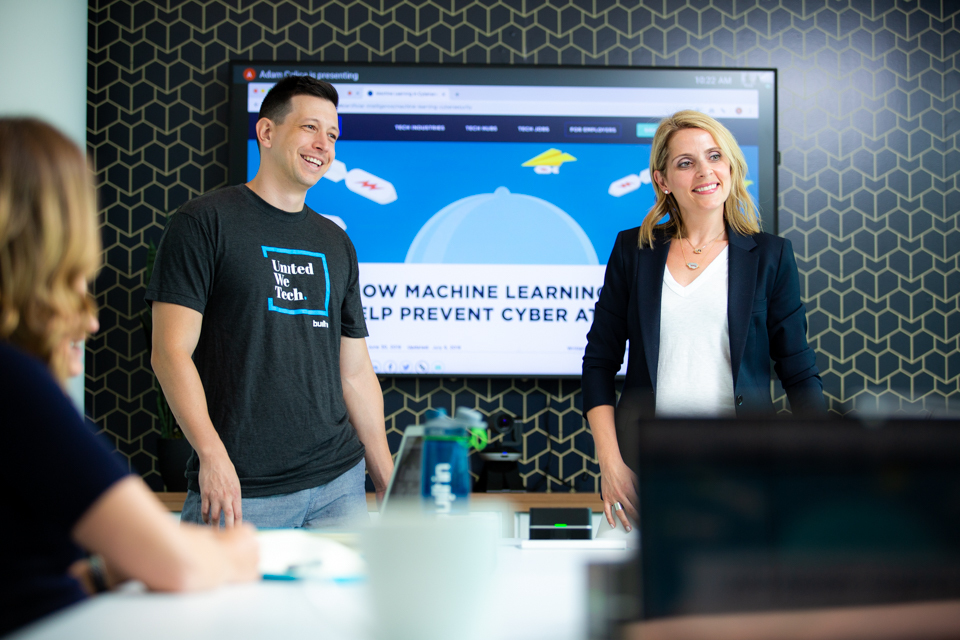
The early site did not begin as a job board. Startups wrote posts, people met one another, and a local scene acquired a common room online. Then the team noticed a useful side effect. Companies featured on Built In were attracting applicants. Candidates were learning what a business made, how it behaved and why the work mattered before they ever saw a list of openings.
That was the hinge. A community site could help solve the industry's persistent talent problem. Built In began using editorial stories and local knowledge to connect tech professionals with companies, turning what had looked like media into recruiting infrastructure. The business followed the discovery rather than forcing the discovery to fit the business.
The idea changes shape
The discipline of a thousand no's
The transition was not accompanied by a trumpet section. Katris and co-founder Adam Calica ran three markets with a staff of two. Colorado launched in late 2012, Los Angeles in early 2013, and each city tested whether a model born in Chicago could survive outside its accent. An annual package for employers gave the company recurring revenue and helped finance the early years.
Katris later estimated that customers and investors told her no about a thousand times. The refusal count makes a fine anecdote, but her response to it says more. She resisted making Built In dependent on outside money. The company raised a large round only when its leaders could say precisely what the capital would do.
In 2019, Updata Partners led a $22 million Series C, with existing investor MATH Venture Partners participating. At the time, it was described as the second-largest technology round raised in Chicago by a woman CEO. The money was designated for hiring, product development, a matching engine and professional education. A year later, Built In reported more than 130 employees, 1.7 million monthly visitors and over 1,800 clients. It also appeared on the Inc. 5000.
Numbers are useful, though Katris has a shopkeeper's suspicion of numbers without behavior. What mattered about one million visitors was not the extra zero. It was proof that a local premise could produce national habit. What mattered about capital was the freedom to build a known plan, not the glamour of having raised it.
A habit gets larger
Reported monthly visitors
The underdog as an operating system
Katris interviewed closely for Built In's first 100 hires. She looked for humility, curiosity, accountability, teamwork, passion and a bias toward solutions. More unusually, she said the company hired for potential instead of choosing the shiniest resume. Her ambition was to turn people who had been underestimated elsewhere into “secret weapons.”
The preference was partly cultural and partly autobiographical. Built In had been an underdog beside larger recruiting incumbents. Chicago had been treated as an underdog beside coastal tech centers. Katris had watched both produce more than the market credited. When an organization owes its existence to an overlooked signal, it becomes skilled at looking twice.
Employees described the resulting culture as inclusive and unusually connected. Weekly playlists, karaoke and game nights supplied the cheerful furniture. The load-bearing wall was ownership: a good idea was supposed to be shared, developed and carried through regardless of tenure. Katris's version of humility was not shrinking from responsibility. It was putting the mission ahead of the résumé.
Her public voice carries the same blend of warmth and steel. She talks about optimism as a choice made under pressure, not a refusal to see pressure. In a reflection on fourteen years at Built In, she wrote that hard moments made her more focused, compassionate and driven toward solutions. “People may forget the metrics,” she observed, “but they will always remember how you showed up.”
When the job board disappears
Recruiting has changed around the company Katris built. Candidates once moved visibly from a job posting into an applicant-tracking system. Now they encounter a company through news, employee posts, reviews, podcasts, search results and recommendations long before an application. Katris has argued that recruitment is now marketing because the candidate behaves like a consumer: comparing, researching and forming an opinion through many contacts that a last-click report cannot see.
Artificial intelligence complicates the route again. A candidate can ask a chatbot which employers offer good engineering work in Chicago, whether a leadership team seems stable or what a company's culture is like. The machine assembles an answer from scattered public material. A career site may no longer control the first impression. It may not even receive the first visit.
Built In's 2026 response is an Employer Intelligence platform that monitors how AI systems describe a company, identifies the public material influencing those descriptions and helps employers improve the information available. The premise is modern, but it carries the old Built In logic. Companies still need to become legible. People still need context before they choose where to spend their working lives. The first encounter simply happens inside an answer box now.
“Community is a force for good.”Maria Katris
Katris remains a Chicago founder with a global field of view. She speaks Greek, returns to Greece, and has said that travel with her husband and three daughters is chosen partly by whichever destination their miles can reach. The method is charmingly unceremonious. The aim is serious: let the children experience as many countries and cultures as possible.
That instinct to widen the map is the quiet constant in her career. A nanny and a family find each other. A startup and a software engineer discover a shared purpose. A city learns to describe itself. An employer learns what the machines are saying. Katris keeps returning to the space between parties that ought to meet and building a useful bridge across it.
The pharmacy counter was such a bridge too. On one side stood a family building a life in a new country. On the other stood neighbors with ordinary needs and long memories. The lesson was never merely to sell. It was to be useful enough that people returned, and attentive enough to understand why. Technology has made the counter larger. Katris has kept the neighborhood logic intact.