Kent Bennett had heard this pitch before. Another app would organize your finances. Another chart would reveal your spending. In 2020, when a colleague suggested he try Truebill, the Bessemer investor rolled his eyes. Mint already existed. Then he connected his accounts and found subscriptions he had forgotten. His published recollection contains the sort of question no spreadsheet wants to answer: “when did I sign up for Orange Theory??”
There was the opening. A recurring payment needs your attention once, when you authorize it. Stopping it requires your attention all over again. Truebill, now Rocket Money, built a company inside that imbalance.
- Find recurring charges, track spending and build budgets.
- Pay for cancellation help, richer tools and, with Premium+, an AI assistant.
- Compare fees with money actually saved. Convenience still needs arithmetic.
The subscription they nearly refused to sell
Brothers Haroon, Idris and Yahya Mokhtarzada founded Truebill in 2015 after noticing subscriptions they no longer used. Their initial problem was wonderfully ordinary. A service can remain on your bank statement long after it disappears from your life.
The business model took more persuasion. In a later interview, Haroon described running short of money and finally testing an idea he had resisted: charging a subscription for a subscription-cancellation service. Early conversion exceeded 6%, he recalled. Customers were willing to buy relief from the administration of their own money.
Bennett’s reversal came from using the product. He described discovering unwanted charges immediately, then seeing users explore the wider financial tools. That is a useful sequence for anyone building a service: finish one irritating job, demonstrate the benefit, then ask for a larger role.
A service can remain on your bank statement long after it disappears from your life.
THE PROBLEM ROCKET MONEY FOUND
The distance between a chart and a chore
Today, Rocket Money combines account aggregation with practical errands. Connect financial accounts, review recurring charges, examine spending categories and set budgets. Premium members can ask the cancellation concierge to contact supported providers. Bill negotiators pursue discounts on services such as internet and phone plans.
Its audience is US consumers whose financial lives are scattered across accounts and recurring payments. The company reports more than 10 million members. That figure describes membership, rather than a current tally of paying subscribers.
SEVERAL ACCOUNTS.
FEWER EXCUSES.
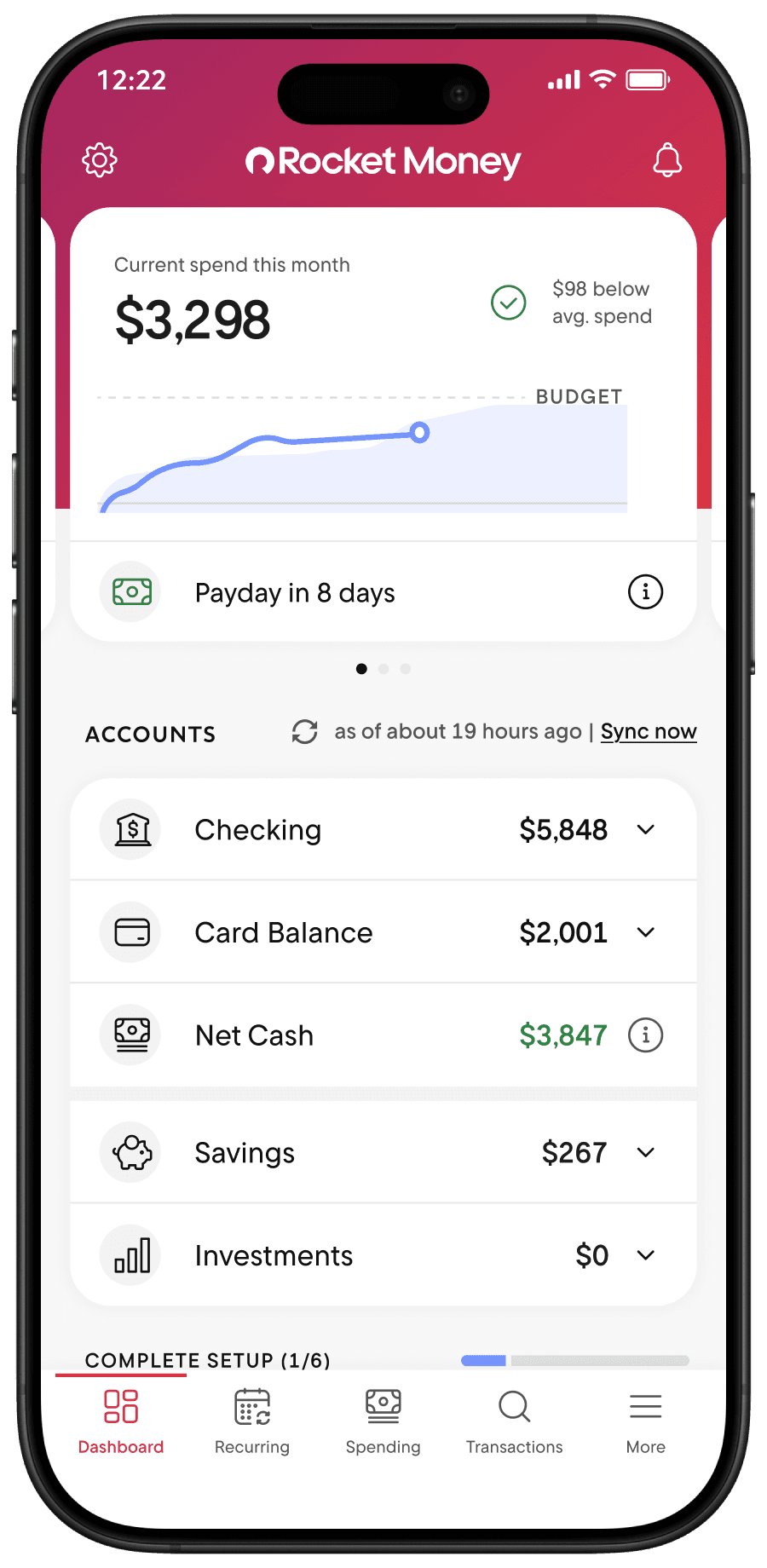
Financial Goals automates savings transfers. Credit features provide score insights and paid reporting tools. Net worth tracking combines assets and liabilities. A larger balance sheet becomes easier to inspect, although seeing it and improving it remain separate jobs.
Monarch Money, YNAB, Copilot Money and Origin compete for personal-finance attention. Rocket Money’s distinctive pitch is the combination of tracking and assistance with cancellations and bills. Its expertise sits where transaction data meets provider procedures. Someone must know which payment repeats, which account it belongs to and what a provider requires to stop it.
That picture relies on outside infrastructure. Plaid handles most account connections; Akoya connects Fidelity accounts, and Experian supplies credit data. Rocket Money says it does not store bank login credentials. Customers still authorize access to sensitive transaction information. Understanding those permissions is part of deciding whether aggregation is useful to you.
Do the subtraction
The free tier offers a useful starting point for inspecting spending and subscriptions. Published Premium pricing typically runs from $7 to $14 monthly, with offers varying. Premium+ is advertised at $15 monthly. A subscription that removes enough work may be worthwhile; one you forget to use recreates the original problem.
Negotiation deserves its own calculation. Before November 2, 2026, users outside Premium+ can pay 35%-60% of first-year savings after a successful negotiation. For an illustrative $20 monthly reduction, annual savings total $240. At a 40% fee, $96 goes to Rocket Money and $144 remains, before any membership cost.
Terms effective October 2 announce a change: from November 2, bill negotiation becomes exclusive to Premium+, without a separate negotiation success fee. Existing negotiations and payment plans continue under agreed terms. Check the offer at enrollment; an older review can describe a different product.
The limits are practical. Some subscriptions require you to cancel directly. Account connections determine what the app can see. A provider may offer no reduction. Someone already auditing statements and negotiating bills might prefer to keep doing that work themselves.
There is also a quieter distinction between saving and earning. Financial Goals moves money toward a target; it does not create extra income. Premium+ offers a high-yield savings account held at a third-party bank, with a variable interest rate. For a household with uneven cash flow, the transfer schedule matters as much as the target.
A billion-dollar reason to stay in touch
Truebill raised a $45 million Series D led by Accel in June 2021. That December, Rocket Companies announced a $1.275 billion cash acquisition. The purchase price paid for ownership; it was not another venture round. Truebill became Rocket Money in August 2022.
For the buyer, everyday money management offered frequent contact with consumers between larger financial decisions. Mortgage shopping happens occasionally. Spending happens constantly. The rebrand connected a small recurring chore to a group selling mortgages and other financial services.

The company’s stated culture favors evidence, open challenges and ownership. Its distributed team gathers several times annually. Those are employer descriptions, but the emphasis fits a business whose promise depends on executing many small tasks reliably.
Now the chore sends a text
In August 2026, Rocket Money announced Rowan, developed with Anthropic and initially offered to select subscribers. The Premium+ assistant brings financial questions and tasks into text messages. Its product page says actions touching money wait for the user’s approval.
The experiment extends the original idea: reduce the effort between noticing a problem and resolving it. Success will depend on reliable connections, appropriate permissions and completed tasks.
Even the headline savings number needs inspection. Rocket Money’s reported $2.5 billion-plus combines negotiated savings after fees, annualized subscription cancellations and automated savings deposits. Depositing money you already own differs from eliminating an expense.
The move readers can copy is modest: list recurring charges, calculate their annual cost and cancel what no longer earns its place. Then decide whether paying someone to keep doing that job buys back enough money and attention. The forgotten subscription is small. The habit of forgetting is expensive.