The trouble began with a car repair. Josh Sanchez needed money before payday and took out a $200 payday loan. Two weeks later, the repayment was $250. In the origin story he told in 2020, the unsettling part was the price of a very short wait. A modest emergency had acquired an expensive companion.
FloatMe grew from that problem: the distance between the day a bill arrives and the day income does. Its customers need petrol, groceries or enough cash to keep a bank account from slipping below zero. A financial plan can be impeccable on paper and still lose an argument with Tuesday.
- Small cash advances, with no interest or credit check.
- Current membership: $6.99 a month; instant delivery costs extra.
- A $3 million FTC settlement changed the obligations around the promise.
- The app now bundles advances with subscription and credit tools.
A company built around the calendar
Sanchez, Ryan Cleary and Chris Brown developed the idea in San Antonio in 2017. The company lists 2018 as its founding year; its public app launch came in March 2020. Those dates describe three different stages of the same enterprise: having an idea, establishing a company and putting a product into people’s hands.
By late summer 2020, Cleary said the revenue-generating customer base had passed 100,000. That December brought a $3.7 million seed round led by ManchesterStory. The founding roles were straightforward: Sanchez handled the chief executive job, Cleary operations and Brown technology. Their proposition was deliberately small. A person short a few dollars should not need a large, costly loan.
In January 2022, FloatMe announced a $16.2 million Series A led by Foundry Group. It also unveiled a rebrand and the tagline “Your Best Financial Friend”. The money would support more staff and a broader offering. Friendship is a pleasing ambition for a financial service; it also invites unusually close examination of the bill.
“We set out to help people who were drowning in debt.”Joshua Sanchez, January 2022
What a $50 bridge costs
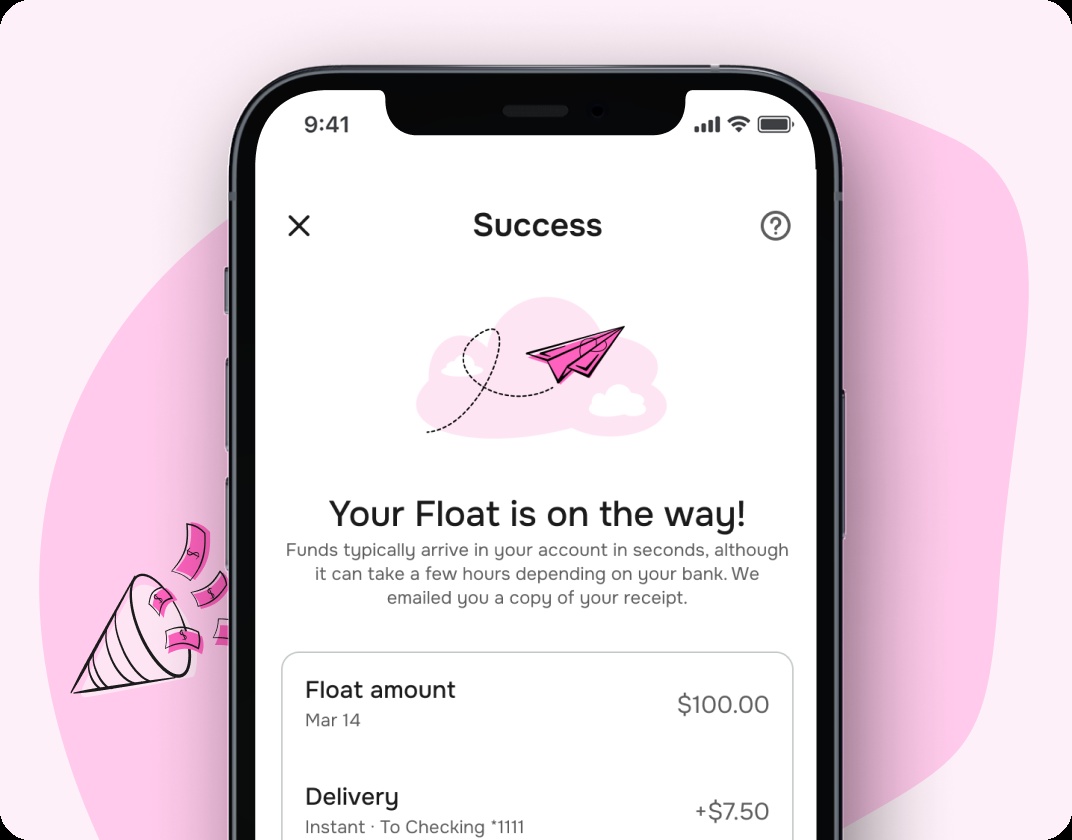
Today, FloatMe offers advances called Floats through its mobile app. First approvals range from $10 to $50; eligible users may eventually receive as much as $200. The company reports an average Float of $53 as of July 1, 2026. That average is a better guide to the product’s everyday job than the largest number in the advertisement.
The economics need separate columns. Under the September 2026 terms, membership costs $6.99 a month. A $50 instant transfer adds $5. Standard delivery has no transfer charge and generally takes one to three business days. There is also a disclosed way to request an advance without paying membership. Eligibility still applies.
Floats are nonrecourse: the terms promise no collections or credit-bureau reporting for failure to repay. An unpaid advance blocks another Float. Those protections distinguish the service from conventional debt, but they do not make every use economical. Speed and membership remain things a customer may purchase.
The promise reached federal court
The first documented fracture in the pitch was the gap between advertised access and actual access. In its 2024 complaint, the Federal Trade Commission alleged that fewer than 5% of customers received more than $20 in the most recent quarter examined. Advertising had presented advances of up to $50. Customers were buying the possibility suggested by the ceiling.
The agency also alleged that staff described an automatic system for increasing limits that did not exist. Other allegations concerned undisclosed instant fees, charges without consent, difficult cancellation and the exclusion of public-assistance income from eligibility. These were allegations about the earlier service, rather than a description of every current transaction.
FloatMe and co-founders Sanchez and Cleary agreed to a $3 million settlement. The court entered the order on January 23, 2024. It required changes to marketing, informed consent for charges, easier cancellation and a fair-lending program. The public record identifies an external force behind the change: a federal investigation and an enforceable order.
A customer promise became a company obligation.
The consequences extended beyond a press release. Refund payments began in September 2024. The FTC’s refund page now describes a second distribution: 255,739 payments totalling more than $1 million to people who accepted the first payment. A small fee, repeated across many customers, acquires a different scale.
More reasons to keep the app
FloatMe’s newer offering reaches beyond the emergency. Subscription Manager finds recurring charges; Credit Monitoring tracks an Equifax score and changes. Low-balance alerts and marketplace offers round out the bundle. The business argument is clear: give members reasons to open the app in months when they do not need cash.
Bank connectivity is central to that design. Its privacy policy identifies Plaid as the provider gathering financial-account information. The same connected account can reveal a cash shortage or an unwanted recurring payment. That convenience depends on a customer accepting the data relationship as well as the price.
The company kept growing after the settlement. Inc. ranked it 1,892 in 2025 and 2,268 in 2026, listing 149% three-year growth for the latter. In a 2026 announcement, Sanchez named Ken Rees as the new CEO and said he would remain President and involved at board level. Growth awards measure expansion; they leave the quality of individual experiences to be examined separately.
The detail worth copying
FloatMe sits among consumer cash-advance alternatives such as Dave, EarnIn and Brigit. Its useful organising idea is to build around a narrow, frequent problem. For another founder, the part to copy is the specificity: identify the size of the gap, the deadline and the customer’s actual alternative. Then make the eligible amount and total cost visible before commitment.
For a customer, the fit is equally specific. An approved small advance may bridge a temporary shortage. It cannot repair a persistent income deficit, guarantee an overdraft will be avoided or help someone outside supported states. Connecticut, Nevada and Washington, DC residents cannot receive Floats. The practical test is whether the amount arrives in time and leaves the next payday manageable. Even a financial friend must respect the calendar.