Einat Steklov had a job. She had a budget. What she did not have, after moving from Israel to the United States, was a credit profile that American lenders could recognize. Rishi Kumar, an immigrant from India, had encountered the same absurdity. The system could inspect their borrowing past. It struggled to see their working present.
- Kashable offers personal loans through workplace benefits, with repayments tied to payroll.
- Employment data supplements credit history; approval is still required.
- Loans currently range from $250 to $30,000. Advertised APRs span 6% to 35.99%.
- Monitoring, education and coaching extend the offering beyond borrowing.
The credit file with nobody in it
“Neither of us existed in the credit bureaus’ files.”
Einat Steklov · Founder interview
This was the failure that mattered: people with incomes could appear financially invisible. Their shared experience inspired Kashable, founded in 2013. The question was practical. Could employment tell a lender something useful that a conventional credit file missed?
Kashable’s answer combines employment and income information with credit data, then connects repayments to payroll. The company sits at a busy junction: consumer lending on one side, employer benefits on the other. An employee needs financing. An HR team needs a benefit it can administer. Kashable supplies the software and lending program between them.

The useful machinery behind the benefit
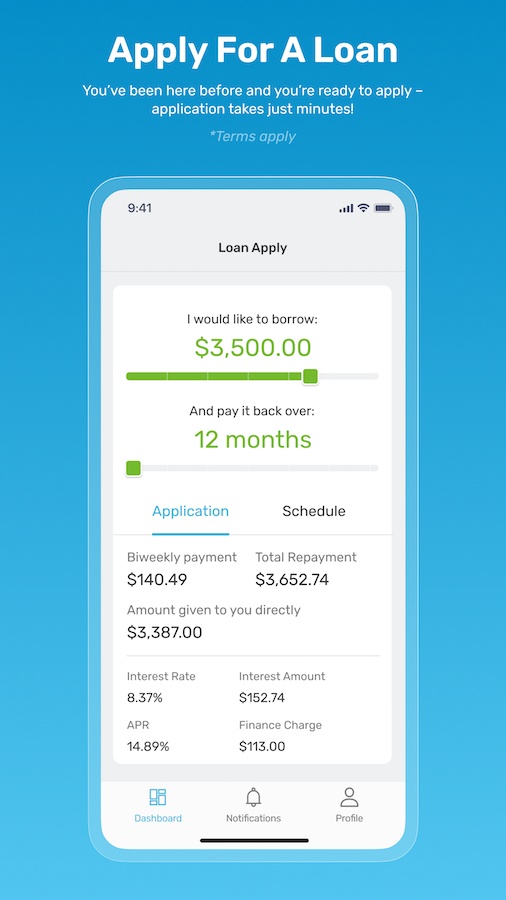
Consider the ordinary emergency: a car repair arrives before the next payday. This is a hypothetical, but the use is explicit in Kashable’s product materials. Employees can also borrow for medical bills or to pay down expensive debt. The applicant applies online; the resulting offer depends on employment, income and other underwriting factors.
The less photogenic work happens inside employer systems. Kashable describes using both group and individual employment data, including income stability. Employers supply an anonymized census, establish eligibility and payroll deduction feeds, then announce the benefit. Payments come from successive paychecks. That arrangement is intended to reduce repayment risk and support lower-cost offers. It does not guarantee approval.
Its 2024 announcement named Cigna, Reid Health, Huntington Ingalls and Alight Solutions among employer clients. Nearly half of customers, it said then, used loans to pay down existing debt. That makes Kashable as much a debt-reorganization proposition as an emergency-cash proposition: replace an existing obligation if the new terms improve the arithmetic.
Free for HR has a footnote
The employer and the borrower face different price tags. Kashable’s standard program costs employers nothing when they have at least 500 benefits-eligible employees. Custom eligibility and approval limits can carry a fee. Live financial coaching and webinars have separate employer pricing. The word “free” has a precise job here; it does not describe the loan.
Current disclosures advertise six- to 36-month terms and APRs from 6% to 35.99%. The lowest rate requires a responsible financial history. One published example is an 18-month, $5,000 loan with a $225 origination fee, 37 payments of $160.64 and a 28.50% APR. The headline rate and an individual offer can be quite different acquaintances.
Illustrative disclosure, not a quote for any reader. Terms vary by applicant and program.
The model earns money through paid credit and additional services; its public materials do not itemize every allocation between Kashable and lending partners. BMG Money’s LoansAtWork offers another US payroll-linked lending program. Kashable’s proposition combines that workplace route with employment-informed underwriting and wellness tools. Payroll deduction alone is not an exclusive invention.
Borrow now. Build a cushion next.
Kashable’s app supports loan applications and tracking, but it also offers free credit monitoring and a financial literacy library without requiring a loan. It reports payments to major credit bureaus, creating an opportunity to build credit through repayment. An opportunity is the appropriate word: a better score is not a contractual delivery.
The 2023 SecureSave partnership adds a particularly sensible companion: emergency savings accounts alongside Kashable loans, under one dashboard for participating employers. Borrowing addresses an expense that has arrived. A cushion changes the options when another one does. Pairing the two acknowledges that an emergency loan cannot be the entire financial plan.
Distribution is equally deliberate. PlanSource added Kashable to its benefits marketplace in 2023; Paylogix welcomed it into its enrollment and billing ecosystem in 2024. The company is making its product available where benefit decisions already happen. For another builder, that is a copyable lesson: find the existing channel and make the administrative work fit.
The money behind the money
Growth requires two kinds of capital. Equity can support staff, software and expansion. A credit facility finances lending capacity. In January 2024, Kashable announced a $25.6 million Series B. In May 2025, it announced a $250 million facility led by Nomura, alongside a separate MidCap Financial lending relationship.
By that May, Kashable reported nearly $1.5 billion in cumulative loan originations and access for more than four million workers. Access counts the employees who can reach the platform, rather than four million borrowers. Confusing the two would make the business look rather busier than the evidence permits.
April 2026 brought an announced $60 million Series C led by Goldman Sachs Alternatives. Its commitment included $25 million initially and another $25 million subject to conditions; existing investors contributed $10 million. In August, Kashable appointed Dar Miranda to lead go-to-market work, including employer adoption. Expanding workplace distribution remains central to the business.
A paycheck cannot solve everything
The mechanism needs boundaries. If an employee leaves, Kashable arranges an alternative repayment method. The debt remains. Federal employee availability excludes West Virginia, and current disclosures exclude active military members and dependents. A payroll connection makes repayment more orderly; it cannot make a payment affordable when the household numbers cease to add up.
The founders’ original observation remains useful beyond lending: a system can be accurate about the information it holds and still miss the person standing before it. Kashable tries to fill that gap with employment evidence and familiar infrastructure. Its value to a particular borrower rests on the actual offer, the repayment burden and the alternatives available.