Consider the small absurdity of a tax refund. Someone spends the winter counting grocery money, then celebrates in spring when the government returns money that was theirs all along. The balance has improved. The timing was dreadful. Grid, a consumer finance app, has made that gap between ownership and availability its particular patch of territory.
- Advance: eligible cash advances up to $200, with a lower starting limit.
- PayBoost / Keep: adjust withholding to keep more of your wages each payday.
- The price: Grid+ is advertised at $10 monthly; faster advance delivery costs extra.
- The distinction: moving money forward does not create more income.
The windfall hiding in a pay stub
Grid’s tax feature is called PayBoost on its website and Keep in current app-store descriptions. The proposition sounds pleasantly cheeky: stop overpaying federal income tax and take more money home. Underneath sits a familiar administrative lever, the withholding information supplied to an employer.
An employer withholds money during the year. If too much has been paid, the eventual refund can represent cash the employee could have used earlier. Adjusting withholding changes that schedule. Grid’s terms explicitly say the resulting increase in take-home pay is not a salary increase or additional compensation.
Its website advertises up to $250 more per paycheck. The actual amount depends on the person’s circumstances. The company’s FAQ targets employed adults with W-2 wages and federal income-tax withholding. Someone already withholding the right amount cannot summon a spare $250 by downloading an app. Arithmetic remains stubbornly immune to branding.
An accountant’s problem becomes a calendar problem
Grid’s ancestry helps explain the choice. Investor Defy connects founders Gernot Zacke and Edward Chung to Visor, the tax-preparation business that preceded Grid. It describes a move from preparing returns to a broader collection of financial products, including access to money tied up in tax withholding.
Chung had served as Square’s treasurer for four years. That background makes the emphasis on money movement less surprising. The interesting change was the frequency of the problem: tax preparation addresses an annual chore; groceries and bills keep inconveniently returning.
The public account supports a pivot, without proving that the earlier business failed. Grid’s story is more useful when read as a change in the question being asked: how much can a household use today?

The $200 headline has a $50 opening act
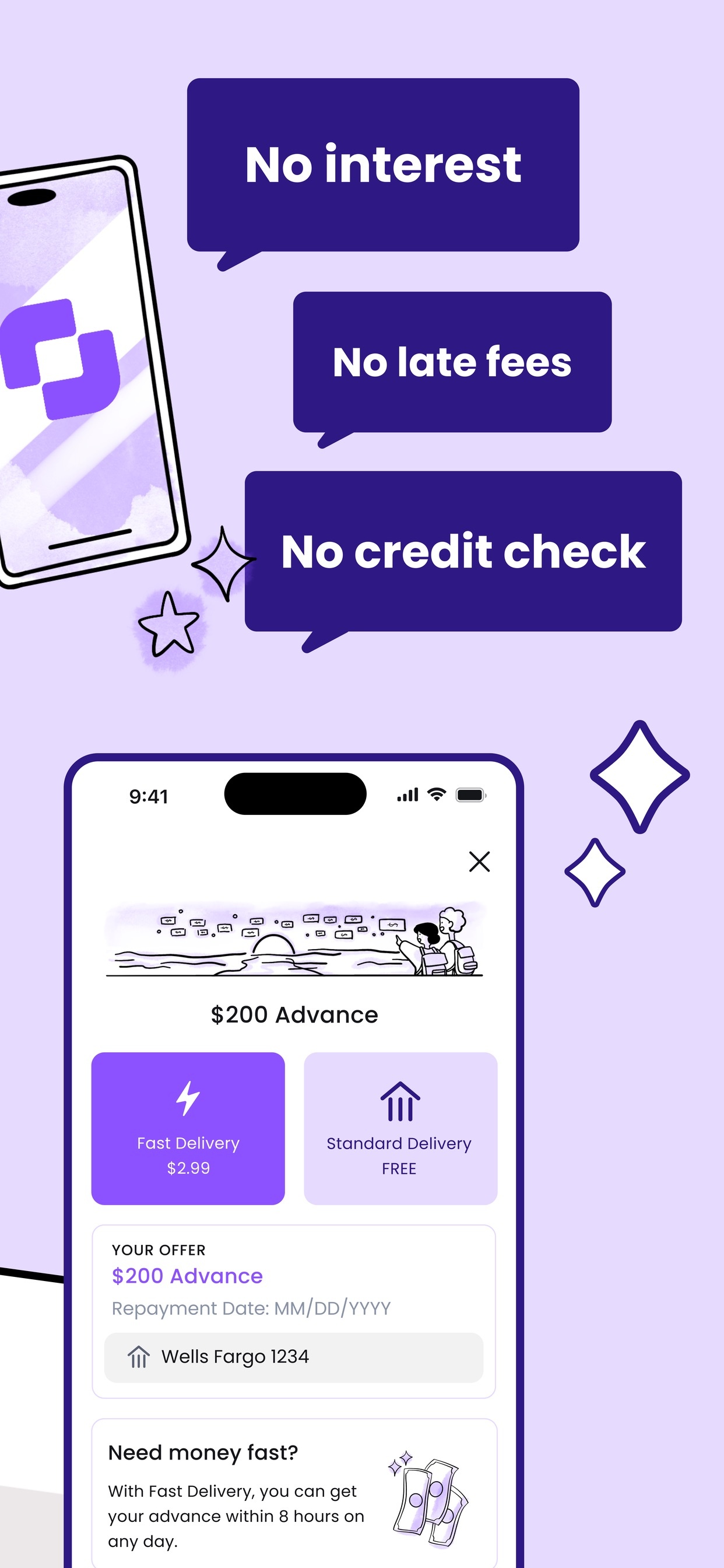
The other prominent product is Advance. Grid advertises up to $200 without interest, credit checks or late fees. The September 24, 2026 terms put the first advance at up to $50. Later limits depend on repayment ability and history, among other factors.
Account activity, balances, deposits, income projections and previous repayments influence eligibility. There can be only one outstanding advance. A maximum is therefore a ceiling, not a welcome gift. Someone planning to cover a $200 bill needs their actual approved amount, not the number on the shop window.
For an eligible user, this is a small bridge between expenses and incoming money. Grid’s terms also say an unpaid advance blocks further advances and may suspend services. A bridge is useful when there is somewhere to land.
Convenience has a receipt
Current app-store listings advertise Grid+ at $10 per month. The terms specify standard advance delivery in one to three days, or expedited delivery to a linked debit card within eight hours for $2.99. That is more precise than the FAQ’s breezy description of an “instant” advance.
Twelve uninterrupted months at that advertised subscription price cost $120 before optional delivery charges. One month plus one expedited transfer totals $12.99. Those sums are simple, but worth doing when the cash arriving might be $50.
There is another wrinkle. While the FAQ says membership is required, the newer terms allow customers to request an eligible, free advance through support without subscribing. The subscription checkout sets the actual recurring price and frequency. Readers should distinguish the advertised package from the available access route.
Grid also offers Earn, rewards linked to third-party games, apps and surveys. Its terms disclose possible referral compensation from partners. That adds another revenue mechanism beside memberships and delivery fees.
In the wider market, Dave and Brigit offer alternatives for short-term cash access. For withholding alone, the IRS provides a free estimator and instructions for changing a W-4. Grid’s competitive pitch rests on putting these money tasks into a consumer app and reducing the effort of getting started.
The laptop was the bottleneck
Inside Grid, a separate timing problem emerged. An August 2026 Summation customer case study says employees already used Claude for individual analyses. Sharing those workflows exposed the prompts, data knowledge and configurations that had lived inside one person’s working habits.
“The biggest delta in our workflow is that Summation is actually shared.”Mickey Reiss, Head of Engineering
Summation customer case study
The reported response was concrete: the product team opens a live dashboard at its morning stand-up, checks usage and system health, and investigates unusual numbers from that shared view. Recurring analyses run against refreshed data.
In one example, the team connected an engagement change to a recent interface change. This is a vendor’s account, rather than an independent measurement of improvement. Still, the transferable idea is clear: a clever analysis becomes operationally useful when colleagues can inspect and repeat it together.
Borrow the question, not just the money
Google Play lists more than 500,000 downloads. That establishes distribution, not the number of active customers or the size of their savings. Grid’s more interesting achievement is making an unglamorous question feel immediate: where is money waiting when it could be useful?
The question has limits. Reducing excessive withholding can improve cash flow; reducing necessary withholding can leave a tax bill. An advance helps with a temporary gap; it cannot repair spending that continually exceeds income. Grid’s proposition is strongest when the problem really is the timetable.
That is the idea readers can take away even without becoming customers. Before paying to accelerate money, identify the delay, calculate the full cost and ask what happens at the next payday. The refund may deserve less applause. A calmer Thursday deserves more.