A household bill has a remarkable talent for becoming furniture. The renewal arrives, gets glanced at and settles into the background. Changing it means finding the old policy, deciphering the new one and making a call that somehow never reaches the top of the list. Compare Club has built a business around that unfinished chore.
The Australian company helps people compare health and life insurance, energy plans and loans, then helps them act on the result. Its proposition combines a website with a substantial human operation: more than 300 Australian-based experts, according to the company. The useful part is the handover from “here are your options” to “let’s get this arranged.”
That makes Compare Club an interesting specimen in the comparison market. The interface attracts attention, but the business also needs conversations, applications and completed switches. A beautiful list of prices cannot do all of that by itself. For a customer who has been postponing the job, help with the last mile may be the thing worth coming for.
The search box acquired a sales desk
The present group took shape in 2017 through a merger of Alternative Media, a digital lead-generation business, and ChooseWell, a health insurance brokerage. Transaction adviser Stanton Road Partners identifies Andrew Davis and Lance Goodman as the co-founders. The combination joined two complementary skills: finding people interested in a purchase and helping those people complete one.
Its roots predate the merger. The company traces its household-savings history to 2008, while its LinkedIn profile lists 2010. The 2017 date describes the combined business identified by investor Next Capital. What matters commercially is the combination itself. Marketing could feed an operation equipped to explain products and handle a sale, rather than simply pass an enquiry along.
A 2021 interview with Goodman described the founders’ dissatisfaction with insurance recommendations built around a few broad characteristics such as age and relationship status. Their pitch was for a more detailed understanding of the customer. That ambition remains visible in the company’s current emphasis on conversations about individual needs.
Free to ask. A provider pays.
Compare Club says consumers pay nothing to use its comparison service. It earns commissions from providers when customers set up a policy or plan. That is the economic engine: a household gets help shopping, and a participating supplier gets a customer. The premium, energy bill or loan remains the customer’s expense.
The company says it is not owned by an insurance group. That distinction belongs alongside another fact: its comparisons use panels of participating providers. Independence of ownership does not mean the site searches every available offer. The energy page explicitly says it does not compare all products from all retailers, or necessarily every feature relevant to a customer.
For the reader, those two facts establish the right expectation. This is a commercial route through a complicated purchase. Its usefulness depends on the available panel, the quality of the discussion and whether the resulting product fits. A saving against an existing bill is meaningful, but it is a different claim from finding the lowest price anywhere.
Alternatives include iSelect, Compare the Market, specialist brokers and dealing directly with providers. Human assistance is not exclusive to Compare Club: iSelect also advertises local comparison experts. Compare Club’s competitive case therefore rests on execution and the relationship across several household expenses, rather than the mere existence of a telephone number.
One household, several different jobs
Health insurance comparison centres on hospital and extras cover. Compare Club’s specialists help customers examine policies from its panel and make a switch. The important distinction is between reducing a premium and changing what it buys. Cover, exclusions and out-of-pocket costs make the discussion more demanding than sorting a shopping basket by price.
Life insurance brings a different set of questions. The company’s guides discuss circumstances, occupations, premiums and waiting periods, while its group operates through authorised representatives of Alternative Media. It is a brokerage and comparison business; the insurer issues the policy. The paperwork and product terms remain part of the purchase, even when someone helps explain them.
Home loans add another substantial household commitment. Compare Club advertises comparison across more than 50 lenders and offers help with buying and refinancing. Energy comparison tackles electricity and gas, including assistance with the switch. Availability varies, so the range a particular customer sees is more useful than an impressive headline count.
Car insurance illustrates a lighter-touch route. Through its Qikio partnership, visitors can inspect an option and follow a digital journey to a quote and purchase. The platform also covers car loans, personal loans and credit cards. These categories share an audience, but they do not all share an identical service process.
The inbox that got in the way
One of the clearest accounts of operational friction appears in a 2023 impact.com case study. Compare Club wanted more partners, including cashback sites and financial apps. Recruitment was manual, different commission arrangements complicated payments, and individual emails piled up whenever partners needed communication or creative material.
The response was specific. Compare Club used impact.com to find and recruit partners, configure payouts, automate messages and tasks, and let partners download creative assets themselves. The case study reports quarter-over-quarter sales growth of 73% and revenue growth of 82% after the partnership expansion.
Those are vendor-reported results, with no named measurement quarters or audited company-wide comparison. They illustrate a claimed improvement, rather than establish Compare Club’s overall growth rate. The practical lesson is still useful: standardise payment rules and make routine material accessible before increasing the volume of relationships. Otherwise every new partner brings another small administrative queue.
A stock-market plan gives way to private capital
Compare Club pursued an IPO process in 2021 that was later abandoned, according to the independent expert material in iSelect’s 2022 scheme booklet. Next Capital and co-investors instead acquired a controlling stake in 2022, partnering with existing shareholders and management. Contemporary reporting put the transaction above A$100 million.
That figure describes a reported acquisition value, not the cost of building the website or a fresh funding cheque of the same size. VPEG4 separately disclosed approval of a A$2 million co-investment alongside Next Capital Fund IV. The distinction matters when a private business’s story is reduced to a single funding number.
Next Capital describes Compare Club’s attraction in terms of data-driven marketing and end-to-end sales capability. In December 2025, the investor also published a headline about a A$150 million debt deal and dividend. The financing history makes this a story about an established distribution business as much as a consumer-facing technology product.
A reason to return before renewal day
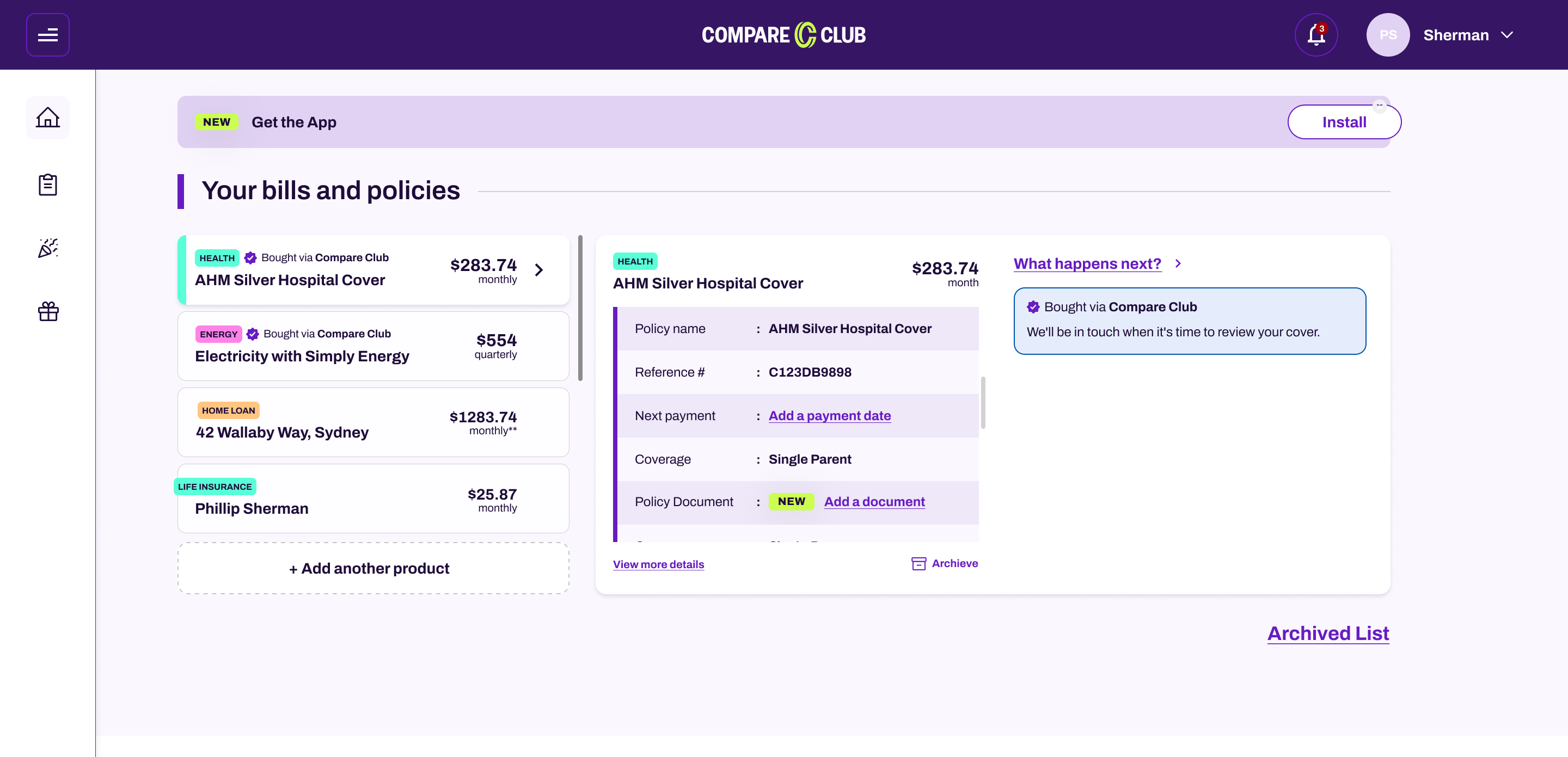
Club+ gives the relationship somewhere to live. The free account offers a place for quotes and policies, alongside prompts about when to review a deal. Its login page says more than 150,000 Australians use it. That is a separate company-reported figure from the broader service’s customer claims, not a count to add to them.
The official demonstration screen is cheerfully domestic: health cover, an electricity bill, a home loan and life insurance sit in one list. The sample mortgage address is 42 Wallaby Way, Sydney. Even a dashboard full of obligations can sneak in a wink. The amounts shown are demonstration content, not offers a reader can purchase.
Commercially, the inference is straightforward. A useful account can create reasons to return after the first purchase, rather than requiring the business to win the same person’s attention again from scratch. For the household, the test is simpler: does it make the next review easier? Keeping records together is useful even before a new saving appears.
The man on the log has a point
Compare Club’s Incomparable campaign dramatises the argument for specificity. An advertisement introduces a fictional John Smith, a 52-year-old competitive log roller with a troublesome left knee. His insurance needs are rather more particular than his name. The joke earns its place: broad demographic labels cannot describe every purchasing requirement.
Designer Christian Hewitt’s account credits Clemenger BBDO with the identity and campaign. The logo uses mirrored Cs to suggest alternatives being weighed. The work gives a service built around forms and conversations a recognisable visual personality. Its promise, however, still has to survive the actual conversation with a customer.
Leadership changed in 2025. Emma Fawcett announced she would start as CEO on August 25, following leadership roles at MYOB and News Corp. Zara Cobb’s appointment as chief marketing officer followed in October, bringing experience from Cashrewards and Lendi Group. In the appointment coverage, Cobb’s view of marketing was neatly expressed: “clicks without connection just don’t cut it.”
The people behind those clicks matter too. Compare Club promotes training and Australian-based expertise; recruitment also highlights sales performance and commissions. Both belong in the picture. A business promising patient guidance must make that promise work inside an operation that is paid when customers buy. The customer experiences the culture through the conversation.

“clicks without connection just don’t cut it.”Zara Cobb / CMO appointment coverage, 2025
Finish the task the customer started
The useful lesson for another business is to examine where its customer stops. Compare Club’s merger connected acquisition to brokerage; its partner automation reduced repetitive administration; Club+ gives a completed transaction an ongoing home. Each addresses a different point where work can stall. Copying the sequence requires a clear understanding of the underlying task.
The conditions matter. Assistance has less value to someone who wants an entirely self-directed search. A limited panel may miss the preferred provider. A lower price may buy different cover. And a dashboard helps only if its information is useful enough to revisit. These are ordinary product constraints, and they shape who the service suits.
For Compare Club, the durable opportunity is the pile of financial decisions households keep deferring. Its offer is most persuasive when the expertise and administration save real effort as well as money. The bill arrives regardless. Getting someone to help deal with it is the part the company has turned into a business.
Keep the conversation going
Explore Compare Club, open Club+, or browse the news and research hub.
Follow LinkedIn, X, Instagram, Facebook, TikTok and the YouTube channel.
Listen to Emma Fawcett on switching and saving or her July 2026 conversation about AI and work. Watch the John Smith campaign film.