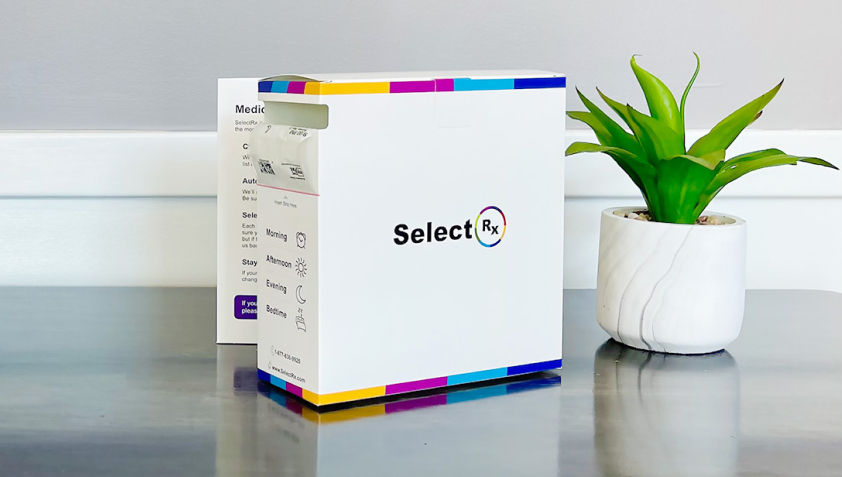
A SelectRx box does something rather ordinary. It organizes prescription medicines into packets, marked for the day and time they should be taken. Morning. Afternoon. Evening. Bedtime. The instructions belong on a kitchen counter. The business behind them belongs in a conversation about how companies discover what their customers actually need.
SelectRx is part of SelectQuote, the name associated with shopping for insurance. Yet in fiscal 2026, pharmacy sales supplied roughly 51% of the parent company’s revenue. An insurance distributor had become, by that measure, slightly more pharmacy than everything else combined. The surprising part is how closely the two businesses fit.
- SelectQuote compares policies through licensed agents; insurance carriers pay commissions.
- SelectRx extends the relationship into recurring prescription management.
- Customer acquisition, policy retention and trust determine whether the combination pays.
01Before the browser, there was the broker
Charan Singh founded SelectQuote in 1985. The original proposition was term life insurance comparison: make competing offers easier to examine without asking a household to visit each carrier separately. The company’s history predates the commercial web. Its insight was about distribution, long before distribution became something investors described as a platform.
Today, a consumer can request a quote online and talk with a licensed sales agent about needs and budget. SelectQuote markets life insurance, Medicare coverage, and auto and home insurance. It says it represents more than 50 carriers across those categories. The insurer issues the policy and bears the insured risk; SelectQuote earns money arranging the sale.
The appeal is practical. Families buying life coverage need to translate dependents, income and obligations into a policy. Medicare shoppers face a different tangle of coverage choices. An agent can help interpret those choices. The comparison still comes from the company’s carrier panel, which makes the panel’s breadth part of the product. For the shopper, that means the quality of the conversation depends both on the agent’s questions and on the policies available to compare.
02The expensive part happens before the sale
That agent is the visible end of a substantial acquisition machine. SelectQuote describes proprietary technology that sources and routes leads, coupled with consultative needs analysis. Its expertise sits where marketing, software and licensed sales meet. GoHealth and eHealth compete for Medicare shoppers; local brokers and insurers selling directly offer other routes.
A useful distinction: requesting a quote is free, but finding the person who requests it costs money. SelectQuote buys attention before it knows which callers will buy or how long their policies will remain in force. Renewal assumptions therefore matter alongside sales volume.
The company’s November 2023 investor presentation describes deteriorating Medicare brokerage economics during fiscal 2022. Competition squeezed acquisition economics; weaker policy persistence forced revisions to estimated lifetime values. Management shifted toward margins and cash flow. It reported $250 million of costs eliminated and more conservative forecasting. Growth had become an insufficient answer to the question of whether a sale was worth making.
03A customer already on the line
The pharmacy expansion began in 2021, before that redesign. SelectQuote acquired Express Med Pharmaceuticals for an agreed purchase price of up to $24 million and launched Population Health. Express Med became SelectRx. The connection was specific: seniors shopping for Medicare might also need help managing several prescriptions.
In June 2021, the company said most new SelectRx members at that stage were existing SelectQuote Medicare subscribers. Bob Grant, then president of SelectQuote Senior, described what the pharmacy needed: “greater scale.” SelectQuote already had people on the phone, discussing healthcare. A useful adjacent service could reach them through an existing relationship.
SelectRx handles medication organization, refills and delivery, with ongoing check-ins. Its packets reduce the work of sorting bottles into a daily routine. The company also announced care-provider partnerships, including ChenMed and Oak Street Health, when Population Health launched. Those were extensions of the same idea: help after enrollment.
“greater scale”Bob Grant, then President of SelectQuote Senior, on what the pharmacy needed · June 2021
04Revenue changes shape. Profit is another question.
By June 30, 2026, SelectRx reported 109,039 active members. Pharmacy revenue had reached $830.9 million, against $787.6 million in commissions and other services across the group. The mix had changed substantially since fiscal 2024, when pharmacy represented about 35% of revenue.
Prescription revenue comes with the cost of the prescriptions. Fiscal 2026 pharmacy cost of goods sold was $730.7 million. Treating a dollar of drug sales as equivalent to a dollar of brokerage commission would miss the economics. The Healthcare Services segment’s adjusted EBITDA margin was 3%, compared with 26% in Senior; adjusted EBITDA is a non-GAAP measure.
Capital also mattered. In February 2025, SelectQuote closed a $350 million strategic investment from funds managed by Bain Capital, Morgan Stanley Private Credit and Newlight Partners. It used $260 million to reduce its term loan. Adding a recurring service does not remove the financing problem of a business that spends to acquire customers.
Pharmacy’s share of revenue
05The promise has to survive the incentives
SelectQuote says its agents are not paid differently according to the carrier a customer chooses. That promise matters because the company’s commercial appeal rests on comparison people can trust.
In May 2025, the Justice Department filed a False Claims Act complaint against three insurers and three broker organizations, including SelectQuote. It alleged illegal payments connected with steering Medicare Advantage enrollments. SelectQuote rejected the allegations, calling them incorrect, and said it would defend itself. Allegations are not findings of liability. They nevertheless put a central question in view: who benefits from the recommendation?
06Copy the connection, check the arithmetic
The transferable idea is to examine the work that follows a customer’s first purchase. A company that already understands a difficult decision may be well placed to help with the next chore. SelectQuote’s move from coverage selection into medication management makes that possibility tangible.
The conditions matter. A related service needs an actual customer need, permission to engage, operational competence and enough margin to justify the extra work. Costly leads, departing policyholders or thin prescription reimbursement can erode the argument. More contact creates more responsibility as well as more opportunities to sell.
SelectQuote’s latest outlook keeps that tension visible. In August 2026, it projected lower fiscal 2027 revenue of $1.35 billion to $1.45 billion while targeting operating cash flow above $60 million. Those are forecasts. The experiment now asks whether a company can make a smaller revenue number produce a more dependable business.
Follow the comparison
Explore SelectQuote, how SelectRx works, the company’s history and its newsroom.