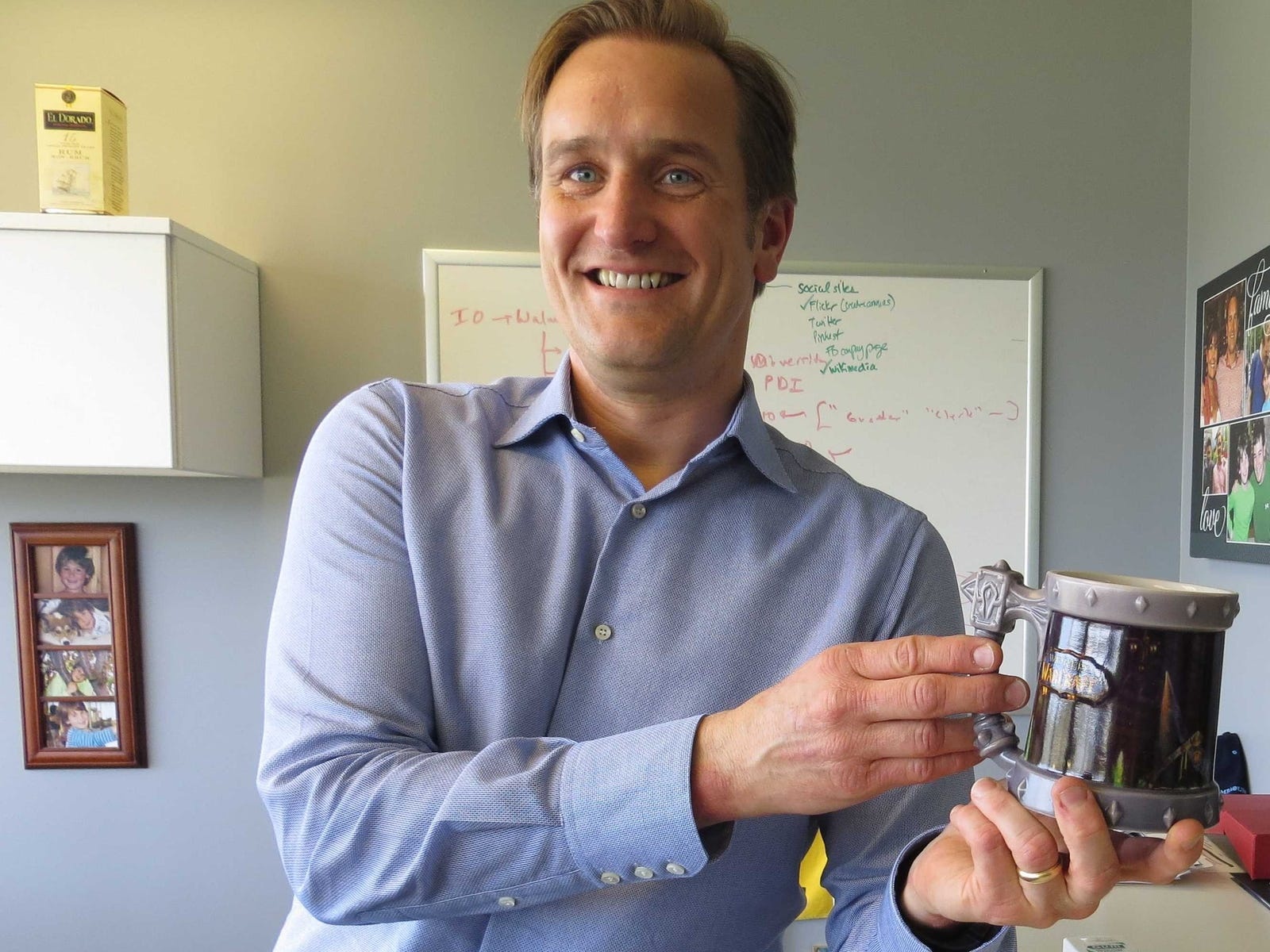
Robert Hohman’s office had room for a World of Warcraft mug. There it was among the evidence of an ordinary executive life: a desk, a whiteboard, family photographs. The mug belonged to a less ordinary intermission. After leaving the presidency of Hotwire in 2006, Hohman had spent a year playing the game. He would send the children to school, then join his guild. In the conventional account of a technology career, this is where someone is supposed to discover that leisure is empty and return gratefully to a spreadsheet. Hohman discovered that strangers could be remarkably useful to one another.
He later connected that experience to Glassdoor, the company he founded with Rich Barton and Tim Besse in 2007. A guild offered a small demonstration of a larger possibility: people separated by geography could pool what they knew and help one another get somewhere. The setting happened to involve an Orc Warrior. The next application would involve deciding where to work.
The connection has aged rather well. In summer 2023, Hohman and his sons Oliver and Elliott started making a game together. That experiment became Tweaking Cat Studios. A career that had passed through booking engines, employee reviews and a corporate acquisition had found its way back to play.
First, build the booking button
Hohman earned bachelor’s and master’s degrees in computer science at Stanford. He joined Microsoft in 1993, working in software before becoming part of Expedia’s early team. His engineering responsibilities included the systems that let customers book hotels, cruises and packages. Those are the parts of an internet business that must continue working after the exciting presentation is over.
At Expedia, his responsibilities widened. He was on the executive team when the company went public in 1999, later ran Classic Custom Vacations, and became president of Hotwire. The progression matters because Glassdoor’s founding CEO arrived with experience on both sides of the hiring conversation. He understood writing the software, and he understood being responsible for the people writing it.
Barton was central to that education. Hohman described him as a leader willing to give people work beyond what they had already mastered. The opportunities could be uncomfortable. They also gave an engineer practical experience running businesses rather than merely imagining how he would run one.
“Rich repeatedly had the courage to bet on people.”
Robert Hohman, 2015
His interest in leadership came with a sense of mischief. At Microsoft, he promised an engineering team that meeting a shipping deadline would earn them the sight of Barton having his head shaved. The team delivered. So did the barbering arrangement. It is a more memorable incentive than a revised performance framework.
What the applicant couldn’t see
By 2007, the internet had become useful for researching purchases. Choosing a workplace remained a strangely private exercise. An applicant could study a company’s website, read its announcements and, with luck, ask an acquaintance for the unofficial version. Finding out how the place actually operated depended heavily on whom one happened to know.
Hohman, Barton and Besse had worked together at Expedia. They had seen what happened when information previously mediated by specialists became accessible to consumers. For Glassdoor, the question was how to bring employee experience into the decision before someone accepted an offer. Pay, management and culture were all relevant. The people with direct knowledge were already inside.
The resulting proposition was straightforward enough to make executives nervous: let workers describe their employers and report their salaries. A company could continue to tell its own story. Other people would have a place to tell theirs. The applicant could compare the accounts.
Share experience
Compare workplaces
Join the conversation
Glassdoor’s early approach asked visitors to contribute information in order to see more of what others had supplied. It called the arrangement “give to get.” The principle made each reader a possible contributor. A person arriving with a question might also hold an answer useful to somebody else.
The company was operating an invitation-only beta by May 2008. Its early board brought together people from the founders’ travel and technology network, including former Expedia chief Erik Blachford and TripAdvisor co-founder Stephen Kaufer. Behind the provocative product was a familiar collection of working relationships.
A crowd has to begin somewhere
A review site has an awkward opening act. Before the reviews arrive, there is very little to review the reviews for. Glassdoor needed people willing to describe their jobs before it had much information to offer in return. The founders encouraged early contributions with the chance to win an iPod. A piece of consumer electronics helped begin a conversation about compensation.
Hohman’s account of the launch included a technical embarrassment: the traffic exceeded what the team had prepared for, the site went down, and people slept under their desks. Demand had arrived before the infrastructure was quite ready to accommodate it. This was presumably encouraging once everyone had somewhere more comfortable to sleep.
By July 2009, Glassdoor offered information about more than 26,000 companies. Hohman’s public explanation focused on practical questions: what a company was like, whether its leadership inspired confidence, and what constituted fair pay. These were questions applicants had always possessed. The novelty was having somewhere to ask them at scale.
The timing also complicated the usual story of a careers business. Glassdoor launched into a financial crisis. Hohman later argued that economic disruption increased the need for the information: people moving between jobs still needed to understand employers and compensation. Uncertainty made another worker’s account more useful.
The customer who might dislike the review
Hohman had previously run businesses, and he wanted employers to participate in Glassdoor. He argued that a workplace with a strong culture could use the platform to become visible beside better-known competitors. A smaller employer needed a way to explain why a candidate should consider it. Familiarity with a famous logo was an expensive advantage to overcome.
That created a delicate arrangement. Employers could buy recruiting products, while employees supplied opinions those same employers might dislike. The commercial opportunity and the credibility problem occupied the same building. Readers needed confidence that an uncomfortable review would survive a customer relationship.
In 2013, Hohman described a moderation process that included human review before publication. In 2017, he said that contributions meeting Glassdoor’s rules remained online regardless of a paid relationship. Employers could flag content and respond publicly. Those were his descriptions of the system at those dates, and the distinction between responding to criticism and purchasing its disappearance was essential to his argument.
He also addressed the familiar complaint that review sites attract only people with extreme opinions. His case for Glassdoor depended on encouraging a wider range of employees to contribute and on readers considering patterns across reviews. A single account could be useful without settling every question about a workplace.
For Hohman, the principle applied at home. Glassdoor’s own employees could rate its chief executive. Building a product that gives other people a voice means occasionally discovering they have something to say about you.
Millions of visitors, then a handover
On May 9, 2018, Recruit Holdings announced an agreement to acquire Glassdoor for $1.2 billion in cash. The announcement reported more than 59 million unique users in January that year, with reviews and insights covering more than 770,000 companies in over 190 countries. The deal closed on June 21.
Recruit already owned Indeed. It described an opportunity to bring Glassdoor’s employer information together with Indeed’s job-search capabilities. Hohman initially remained CEO. The company he had helped start would continue inside a larger employment business.
The next transition was announced in August 2019. Christian Sutherland-Wong, then president and chief operating officer, would become CEO on January 6, 2020. Hohman would become chairman. Sutherland-Wong had joined Glassdoor in 2015 and had already taken on responsibility for its daily operations. The handover followed roughly twelve years of Hohman leading the company.
His public advice about growth had been notably practical. He urged entrepreneurs to understand their core business before spreading attention across too many activities or countries. Internet distribution made expansion tempting; local understanding remained work. “Focus, focus, focus,” was his repeated instruction. It was an operator’s warning about how much an organization can actually absorb.
Three Hohmans, one new game
The interests outside the executive calendar were always there. Hohman talked about playing StarCraft with his sons and supported their enthusiasm for competitive gaming. The pleasure was partly intellectual: fast decisions, strategy, the fascination of watching someone else process a situation quickly. A family could have worse things to argue about than the next move.
In summer 2023, limited internship opportunities supplied an opening. Robert, Oliver and Elliott decided to build a game. They enjoyed making it together, and Tweaking Cat Studios grew out of that experience. The studio’s current website describes a funded team working in pre-production on a roguelike deck builder, with future playtesting and demo information to come.
There is a pleasing continuity here, without requiring every hobby to conceal a business plan. Hohman had learned to appreciate the social life of games before founding Glassdoor. Years later, making one became a shared project with his children. The audience and the product had changed. The willingness to gather a small group and build something remained.
The mug in the office makes a little more sense at the end of that chronology. A useful object, a joke about an intermission, a souvenir from a community. For a founder whose business depended on people passing knowledge to strangers, it was a reasonable thing to keep within reach.
Keep the conversation going
Interviews, public announcements and places to follow his work.
- Tweaking Cat Studios ↗
- Robert Hohman on LinkedIn ↗
- Robert Hohman on X ↗
- Glassdoor ↗
- Hohman on gaming and Glassdoor ↗
- The 2017 Glassdoor Q&A ↗
- Early career and Expedia ↗
- The early give-to-get model ↗
- The 2009 launch report ↗
- Hohman on employers and transparency ↗
- The 2013 data-integrity interview ↗
- Reviews beyond extreme opinions ↗
- The 2018 acquisition announcement ↗
- The CEO succession announcement ↗
- Hohman on focus ↗
- Barton and Hohman on leadership ↗
- The head-shaving anecdote ↗
- Career and family gaming interview ↗
- Listen: Marketplace’s Corner Office ↗