At fourteen, Rob Whitehead had customers in a world that most adults were still trying to understand. He had joined Second Life, the online environment in which people could build things, sell them and spend time together. His line of business was virtual weapons. The stock required no warehouse. The customers, however, were real enough to pay.
For a teenager growing up in Liverpool, this was an education in what a computer could make possible. Whitehead would later study computer science at Cambridge, at Robinson College. Before the venture capital and the executive titles, he had experienced a digital economy from behind the counter. A world on a screen could contain a working business.
There was a catch. Second Life became popular enough for its technical limits to become painfully visible. People wanted to congregate, and the machinery could struggle when too many gathered in the same place. Whitehead’s interest in the problem continued through college. A crowded room is ordinarily a social achievement. In a virtual world, it can also be an engineering emergency.
The detail matters because his career did not begin with a fashionable word for the internet’s future. It began with use: making something, finding buyers, noticing where the experience broke. He also made iOS games while at school. The boy selling imaginary equipment was already learning how much real work it took to keep an imagined place functioning.
A dissertation review with consequences
Whitehead met Herman Narula at a dissertation review at Cambridge’s Computer Laboratory. They shared an appetite for multiplayer games and a frustration with their restrictions. The meeting led to Improbable, founded in 2012, with Peter Lipka also part of the founding team. Their subject was expansive; their initial working arrangements were rather more domestic.
After graduating, Whitehead moved into Narula’s house. His family was bewildered, as he later recalled. That is a recognisable early business milestone, even if it seldom appears in a pitch deck: explaining why a computer science education has led to living with a fellow gamer while attempting something difficult to describe.
The pair initially sketched a game with complex systems operating inside a living world. Building it exposed a more fundamental task. They needed technology capable of supporting that complexity. Gradually, the framework for making many simulations became a more compelling project than the particular game that had started the conversation.
This would become a recurring turn in Whitehead’s work. An experience suggests a possibility; the practical constraints reveal a tool that somebody needs to build. It places him in an unusual relationship with entertainment. He is interested in what happens on stage, but a substantial part of his career has involved getting underneath it with a spanner.
The attraction of the machinery
As Improbable’s co-founder and chief technology officer, Whitehead helped develop the business around large simulations. SpatialOS distributed the work of a simulated world across computing resources. By 2017, he was describing both the underlying technology and its application to games, including Worlds Adrift, whose persistent environment involved customised flying ships and physical interactions.
The goal involved more than drawing a larger map. A persistent world must continue to make sense as people move through it and affect what happens. Objects, actions and players have to be coordinated. More activity means more work for the systems keeping everyone’s version of events sufficiently aligned. The attractive fantasy depends on some demanding administration.
Improbable raised $20 million in 2015. A $502 million funding round led by SoftBank followed in 2017, taking the company’s valuation above $1 billion. These were company milestones, shared with a founding team and a growing workforce. They made a youthful experiment into a business with resources, obligations and considerable public attention.
Whitehead’s titles changed as the company developed. He was subsequently its chief product officer and later became CEO of MSquared. The progression took him from the core technology towards the question of what people could do with it. The software had to become something that other builders could understand, adopt and put to work.
The room is part of the product
A central problem remained density: gathering people together inside the same space. Morpheus, the technology developed at Improbable, became the basis for much larger shared gatherings. A platform capable of handling a busy world opens possibilities beyond a battle. Concerts, conferences and social occasions also depend on the feeling that other people are there.
MSquared emerged in 2022, backed by a $150 million funding round. By 2023, Whitehead was describing a network connecting virtual worlds, with identities and possessions able to travel between participating experiences. He compared it to crossing international borders. A visitor should be able to arrive carrying something of their previous life.
That ambition gives the software a distinctly human problem to solve. People put effort into a character, an object or a reputation. Starting again at every boundary can make each world feel like a separate temporary engagement. Portability promises continuity, although it also requires different experiences to agree on what they will recognise and accept.
Whitehead allowed himself a joke about the terminology, calling the idea a “meta-metaverse”. The phrase threatens to require its own passport. Beneath it sits a straightforward proposition: developers should be able to build different places without obliging their users to abandon everything at the door.
A concert, then a very crowded battlefield
The BBC’s The Sound of Gaming event on 23 November 2024 offered a concrete use for shared presence. MSquared technology supported a virtual concert experience that incorporated live video and a conductor’s movements. Whitehead described an experience assembled by two or three technical designers using Unreal Engine 5 blueprints, without writing code for the experience itself.
His reaction concentrated on delivery. “The only way to properly push new tech capabilities is shipping things end-to-end,” he wrote. The important test was whether the entire experience could be made to work together: the performance, the people watching, the tools used to construct it and the technology connecting them.
A different gathering supplied a precisely countable result. On 22 February 2025, Otherside achieved a Guinness World Records title for 2,197 people in an online FPS battle. Yuga Labs’ Project Dragon used MSquared’s Morpheus platform. The result belongs to Otherside and the teams behind the event; it also gave the infrastructure a public examination under pressure.
Preparing for that kind of crowd involved load tests, attention to latency, capacity planning and a rehearsal. Even the process of joining mattered. A theoretical capacity is little comfort if people cannot get through the entrance. In this part of Whitehead’s world, the bouncer, the plumbing and the dance floor all need to cooperate.
People in the Guinness-recognised online FPS battle, powered by MSquared’s Morpheus platform.
Leaving room for other people’s inventions
By July 2025, MSquared was operating independently after its development inside Improbable. Its avatars and asset network were moving into the market, and Whitehead was discussing a team of about 43 people, mostly engineers. The commercial task was to make the platform available beyond the partners with whom it had already worked.
The work extended into another question familiar from Second Life: who gets to make things, and what can they do with them afterwards? Etherbase provided tools for interacting with blockchain data. MSquared chose Somnia as its default blockchain, with compatibility with existing Ethereum development tools part of the reasoning. Familiarity mattered alongside performance.
Chunked made the experiment tangible. Introduced in April 2025, it was a block-based multiplayer sandbox running on Somnia’s test network. Movement, mining, crafting and ownership were recorded on-chain. The team described building it in under three weeks, with game logic and storage handled on the blockchain rather than a conventional separate game server.
Its openness interested Whitehead as much as its construction. Developers could inspect the contracts, adapt the code and build applications around the game’s state. A trading service, for example, could be somebody else’s contribution. The aspiration was to give participants enough access to extend the world, rather than waiting for its original team to supply every activity.
“We had to go where the developers are.”
Rob Whitehead · on EVM compatibility, March 2025
The table, the chair and the world beyond
In November 2025, Whitehead appeared at Web Summit to present Mash. The product brought generative AI into the creation of game-ready 3D objects, starting with a photograph or prompt. The objects could become part of a shared collection, available for others to combine and use across different development environments.
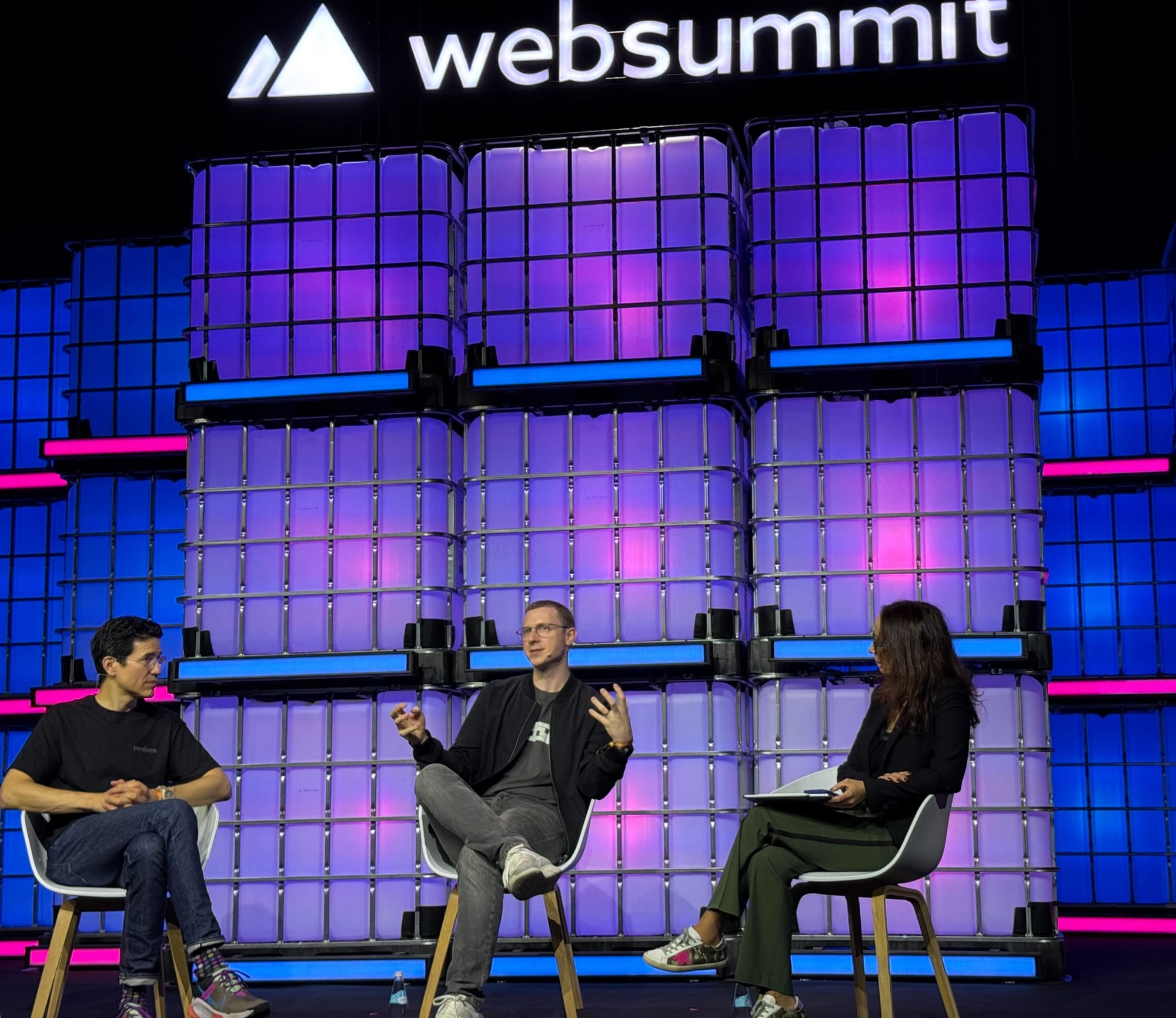
His explanation moved through everyday furniture. One person makes a table, another makes a chair, and somebody combines them into a dining set. Larger constructions follow. The ambition includes small royalty payments through the layers of contribution. The scene is modest enough to picture: a world assembled through people building on one another’s work.
The teenager’s virtual shop and the executive’s shared asset library are separated by years of engineering, but the relationship is visible. Both depend on individuals making digital things that other people want. The later version seeks to widen participation and make contributions reusable, while giving creators a way to share in the resulting value.
Whitehead also draws limits around the sales pitch. In an August 2025 conversation, he questioned whether spreadsheets or grocery shopping benefited from immersion. Those reservations make room for a more useful test: does this particular activity improve when people can inhabit a shared space? A concert has a plausible answer. A spreadsheet may quite reasonably decline the invitation.
His work now spans the systems that bring people together and the tools that let them contribute once they arrive. Each adds a condition to the original promise of a virtual world: people need access, the gathering needs to hold together, and there must be something worth doing. A technically impressive empty room still needs a reason for anyone to stay.