A wounded adventurer walks into a Homestead. There are beds for disease, wounds and damage to the mind. Treatment takes fifteen minutes. The owner sets the price, and the owner collects the Gold. This is a feature of Gala’s September 2026 update to Mirandus: Eternal Night. Even in a fantasy world, somebody has worked out how to charge for the room.
It is also a useful introduction to Gala. The company wants the people inside digital worlds to own more of what makes those worlds valuable: the character, the building, the land, sometimes the machinery that keeps everything running. Its experiment began with games and spread into music, film and blockchain infrastructure. The interesting question is who gets paid, who sets the rules, and who picks up the pieces when something goes wrong.
- Play: Gala publishes games with digital items players can hold and trade.
- Build: GalaChain provides the transaction network and developer tools beneath the entertainment.
- Participate: Collectors and node operators can receive rewards under product-specific rules.
- Read the terms: Ownership, usefulness and a dependable income are three different things.
A farm with an exit door
Gala’s CEO, Eric Schiermeyer, helped found Zynga. Michael McCarthy, another Gala founder, was the creative director behind FarmVille 2. They came from a business that understood the appetite for virtual goods. A crop, a character or a convenient shortcut could be valuable enough to buy, although the purchaser’s relationship with it remained governed by the game.
In an April 2020 interview, Schiermeyer described players trying to recover value from the time and money they had spent. Trading accounts and items outside a game could be murky. Gala’s proposed answer was to make ownership verifiable through blockchain records. The item would be represented by a token that its holder could transfer.
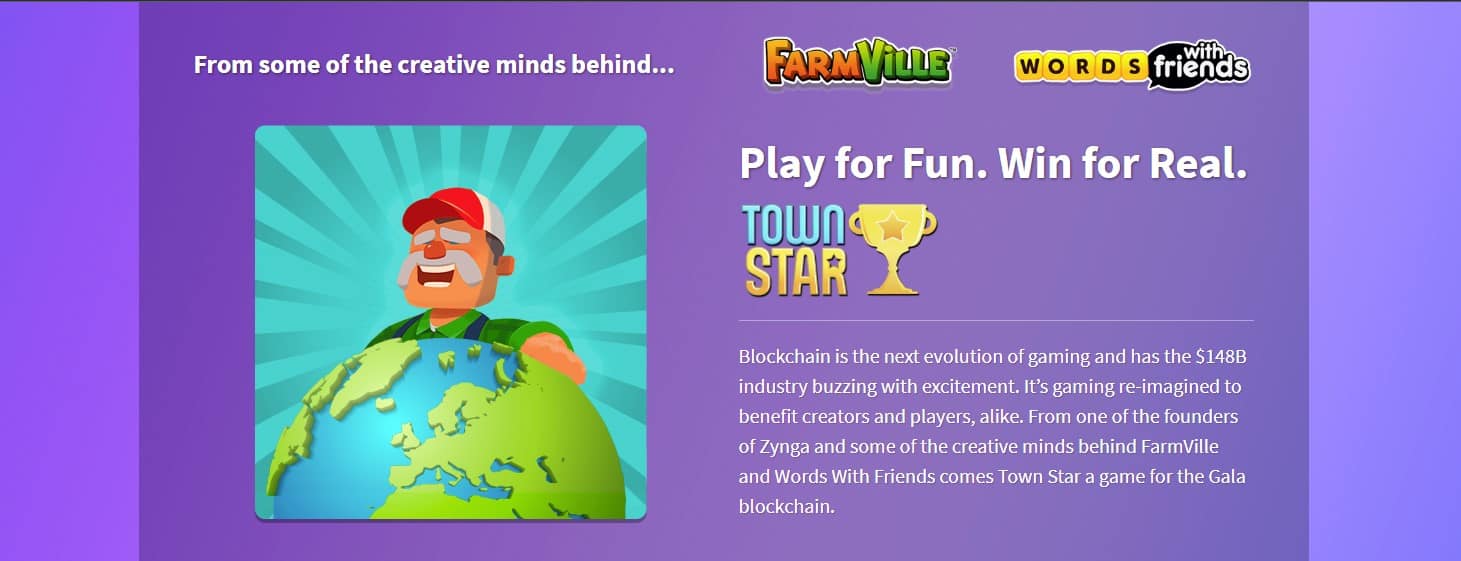
Town Star, its early farming game, gave that argument a familiar setting. It later became Common Ground World through a partnership with the Common Ground film and its regenerative-agriculture project. Gala had taken a genre associated with cultivating little plots and added an interest in who owned the tools.
The useful distinction is between holding an asset and controlling its surroundings. A token can establish who holds a particular item. The game still supplies its abilities, opponents and reasons to use it. Ownership may permit a sale; it cannot summon a buyer. The proprietor of a virtual farm has acquired a new right, along with an old dependency on a world that other people maintain.
The publisher becomes the plumbing
Gala’s blockchain ambitions were present early. In that 2020 interview, Schiermeyer laid out a plan to begin on Ethereum and develop a proprietary chain. By February 2022, Gala was discussing Project GYRI, the proprietary network intended to accommodate its expanding entertainment businesses.
The reasoning was practical: a network designed around financial transfers would need more work to handle the volume and variety of game activity Gala wanted. GalaChain became the layer beneath its games, music and film. Developers can work with its public TypeScript SDK to develop, test and deploy chaincode, the programs that govern transactions.
“Start on Ethereum and then develop our own blockchain.”
Eric Schiermeyer, April 2020
This changes Gala’s place in the market. A player encounters a game publisher. A developer encounters blockchain infrastructure. A collector encounters a market for digital items. Gala has to compete for attention at the surface and earn technical trust underneath it. Blockchain gaming networks such as Immutable and Ronin are alternatives for developers. Conventional game platforms remain alternatives for players. Gala’s distinctive arrangement puts a publisher, media brands and its own transaction network under one roof; that breadth also leaves it responsible for several different jobs.
Build applicationsGalaConnect
Connect and bridge
GalaSwap launched in February 2024 with a peer-to-peer exchange and a specified gas cost of one GALA for each side of a swap. That was a launch-era tariff, rather than a permanent price list. GalaConnect arrived in November 2024, opening wallet access without requiring an existing Gala entertainment account. The ecosystem has since added trading and token-launch tools, including GalaPump.
Somebody owns the forge
Mirandus: Eternal Night makes the business model unusually tangible. Its August 2026 market update describes players harvesting resources, making goods in shops and selling them to one another. Crafting carries a GALA fee. The shop owner receives the largest share, the landowner gets a cut, and Gala gets a smaller share. Sales also distribute proceeds among the seller, the hosting landowner and the company.
A token has become part of a working arrangement. The bow needs materials. The materials need labour. The workshop needs somewhere to stand. Buying from far away adds a delivery cost. Gala has introduced enough friction to give location and property a purpose, which is a more interesting design decision than simply declaring an object scarce.
The company sells digital items and node licences across its ecosystem; game-economy charges supply another mechanism. Users can enter some experiences for free, while purchased assets and reward eligibility follow each product’s rules. GALA, the network’s utility token, is separate from equity in the company. A busy token economy is also a different measurement from company revenue.
The customers consequently include several constituencies: players seeking entertainment, collectors seeking useful items, creators seeking supporters, developers seeking infrastructure and operators seeking network rewards. Their interests can overlap. They can also collide. An item prized for scarcity may make a newcomer’s first afternoon less enjoyable.
The hundred-million-dollar distinction
In December 2021, Gala and C² Ventures announced a $100 million blockchain-gaming fund. It was intended to invest in developers and emerging projects, with support for token design, game economies, distribution and marketing. The announcement describes a fund backing other businesses. It does not describe a $100 million equity round into Gala.
A joint investment fund for blockchain-game developers and projects.
That distinction matters because it tells us what Gala was trying to purchase: more people making games within the broader opportunity it saw. Its 2024 ecosystem blueprint describes the project’s origins as self-funded. The financial instruments around a company can make it look richer or simpler than the underlying evidence permits.
The mobile strategy provides another revealing change. In 2020, Schiermeyer said Gala was not planning to put games on Apple’s and Google’s stores, citing their fees. In February 2023, Gala announced plans to integrate fifteen mobile games from its acquisition of Ember Entertainment. It presented mobile distribution as a route to wider participation. Gala did not document one private moment of conversion; its public priorities had shifted toward reaching players where they already played.
The reward is part of the product
Gala applied similar ideas to media. Gala Music combines discovery with digital track collectibles and Jukebox Nodes. Gala Film launched in April 2024 with David Bianchi’s eight-episode science-fiction series RZR. Viewers could collect pieces associated with the show; Theater Nodes were intended to help host and deliver content.
The appeal to creators is a closer commercial relationship with supporters. The appeal to fans is participation beyond pressing play. A collectible can carry specific privileges or reward eligibility. It does not, merely by existing, confer the copyright to a song or the authority to distribute a film.
In June 2025, Gala announced a temporary pause in FILM emissions, citing long-term sustainability. The change affected participants including Moment holders, node operators and filmmakers. Reward rules are therefore a central part of the product, capable of changing the reason somebody participates. Entertainment has to retain an audience when the incentive changes.
Gala’s external infrastructure business has continued too. Its Shrapnel partnership brought an announced move of digital assets from Avalanche to GalaChain. A proposed connection to China’s Trusted Copyright Chain added a market-access ambition. The hundreds of millions of gamers cited in that announcement were a potential audience, rather than customers already acquired.
Ownership meets the maintenance bill
Gala’s difficulties have tested both governance and engineering. In September 2023, the company acknowledged competing lawsuits between Schiermeyer and co-founder Wright Thurston. Those proceedings involved allegations, not facts established merely by their inclusion in a complaint. The dispute made the company behind the decentralisation pitch impossible to ignore.
Gala’s May 2024 incident report described a different failure: a compromised Ethereum minter key enabled the unauthorised creation of five billion GALA. The company reported freezing tokens, recovering sale proceeds and changing access controls. In that account, privileged access failed before the token contract itself.
Then came the August 18, 2026 GalaChain attack. In its September post-mortem, Gala reported unauthorised transfers from nine wallets, involving approximately two billion GALA and other tokens. It identified a signature-verification flaw and described subsequent changes. The signature could be authentic while failing to cover the operation being performed. Gala’s attribution of the attack to an AI-driven agent remains its own assessment.
The practical lesson is precise: bind permission to the actual action, limit its lifetime, and watch what happens to balances. Gala described fixes along those lines. Neither a public ledger nor an audit removes the need to check the awkward edges of a system.
Economics require maintenance too. In April 2026, node operators approved a replacement emissions model, including an eventual fifty-fifty split of gas fees between operator payments and permanent burns. Approval was followed by an implementation plan. Gala was revising how the network would pay for its continuing existence.
For builders, the most copyable recent example may be smaller. Gala Playworks generates playable browser-game drafts from prompts. Its June 2026 guide asks creators to specify controls, scoring and failure, then test and revise individual weaknesses. That discipline travels well: give people something understandable to do, observe whether they return, and charge only for a proposition you can explain.
Gala works best as a proposition for people who value both the entertainment and the particular rights attached to its assets. It becomes harder to justify when participation depends entirely on rewards, when nobody wants the item being sold, or when a developer’s priority is infrastructure independent of Gala’s operational decisions. The farm can have a deed. It still needs a harvest.
Open a door into Gala
Explore the products, watch the games in motion, or inspect the code.