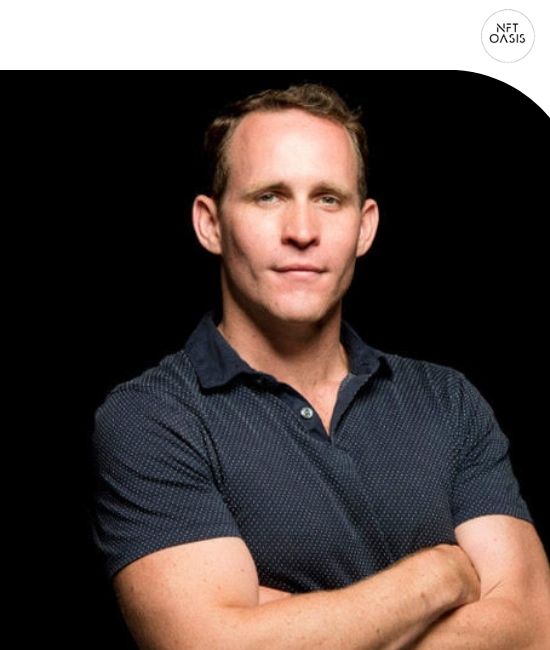
A pianist walks into the metaverse
In January 2021, Will O'Brien released a solo improvisational piano album called IANUAE. Two months later he co-founded a company to drag virtual reality into the mainstream. The two facts are not as unrelated as they look. O'Brien has spent his career standing at the spot where one industry ends and the next one has not quite begun, and improvising.
Today he is CEO and co-founder of NFT Oasis, the metaverse platform owned and operated by Provenonce, Inc., based between San Francisco and Los Altos. The pitch is unfashionably ambitious: take the non-fungible token, the virtual reality headset and the blockchain ledger, and weld them into a single ecosystem where a creator can step on a virtual stage and perform for the entire planet. NFTs are the wedge. VR is the stage. Blockchain is the floor everyone stands on.
It is the kind of sentence that sounds like a pitch deck until you notice the man saying it has already built the floor once before. From 2013 to 2015, O'Brien co-founded and ran BitGo, the company that made it possible to store Bitcoin without lying awake at night. BitGo pioneered multi-signature security at a moment when most of crypto's money was sitting in hot wallets waiting to be stolen. In 2014, with the industry still raw and the headlines still full of exchange collapses, his peers voted him Bitcoin CEO of the Year. BitGo would later be acquired by Galaxy Digital in a deal valued at roughly $1.2 billion.
NFTs are the wedge, VR is the stage, and blockchain is the infrastructure on which we will make this the reality.
Before crypto, there were dragons and demand
O'Brien did not arrive in blockchain from finance. He arrived from games. Between 2010 and 2013 he ran corporate and business development for Big Fish Games, the Seattle casual-gaming giant that was later acquired for $885 million by Churchill Downs and then sold again to Aristocrat for close to $990 million. He has also logged time as COO at the analytics company Keen IO, acquired by Scaleworks, and as a general manager at TrialPay, the commerce-and-payments outfit bought by Visa. Read the resume quickly and it looks like a man collecting acquisitions the way other people collect frequent-flyer miles.
The throughline is not the exits. It is the appetite for systems that are about to change shape. Gaming taught him how millions of people behave inside a virtual world. Payments taught him how value moves. Bitcoin taught him how to make that value safe. NFT Oasis is, in a sense, all three classes turned in at once.
The investor in the room
When he is not founding companies, O'Brien is funding them. He has backed more than 70 early-stage startups and foundational blockchain projects across the US, Europe and South Korea, and has served as a limited partner or advisor to venture funds including Blockchain Capital, Gravity Group and Fabric.VC. His stated areas of interest spill across fintech and blockchain, gaming and VR, media, data and analytics, and cloud. It is a portfolio shaped less like a thesis and more like a curiosity that refuses to sit still.
This is a moment in time to change the world and radically disrupt an industry that has been exploitative to artists.
A bigger stage
NFT Oasis was formed in March 2021 and closed a $4.4 million financing round that July, drawing in 32 individuals, family offices and funds spread across the US, Europe, the Middle East and Asia. The founding team pairs O'Brien with Greg Edwards, Jesse Nolan and Patrick Booth, Jr. The thesis is blunt about who it is fighting for: the artists. For decades, O'Brien argues, the machinery of distribution has skimmed value off the people who actually make things. His answer is to hand creators a virtual stage and a ledger that pays them directly.
The early proof points were loud. In September 2021, life-and-business strategist Tony Robbins stepped into the metaverse through NFT Oasis, the kind of name-brand validation that turns a press release into a story. By April 2022, the company was hosting a flagship bash at NFT LA, planting its flag in the center of the scene's biggest gathering. O'Brien has been a fixture on the conference circuit too, taking the stage at AWE to talk about, fittingly, the business of the metaverse.
The improviser
It would be easy to file O'Brien as another crypto operator with a tidy stack of exits. The piano album complicates that. IANUAE is improvisational, which is to say unscripted, which is to say exactly how he seems to approach the rest of his work: arrive somewhere new, listen for the shape of the thing, and start playing before the rules are written. He holds a B.A. in computer science from Harvard and an MBA from MIT Sloan, the kind of credentials that usually produce careful people. O'Brien spent them buying tickets to the frontier instead.
What comes next is, by design, a little undefined. That is the point. The companies change names - Big Fish, BitGo, Keen IO, NFT Oasis, Provenonce - but the role does not. He is the person who shows up where the map runs out, and improvises a way forward.
The business of the metaverse
There is a version of the metaverse story that is all hype and headset demos. O'Brien's version is quieter and more commercial. When he took the AWE stage in 2021 to talk about the business of the metaverse, the framing was telling. He has spent enough time inside game economies and payment rails to know that a virtual world only matters if value can move through it cleanly. That is the unglamorous part of the NFT Oasis pitch: not the spectacle of a concert in VR, but the plumbing that lets a creator get paid for it without a middleman skimming the top.
His read on virtual reality is also notably patient. For decades, he points out, companies tried to bring users into VR, marching consumers toward headsets that most of them did not want. NFT Oasis flips the camera around. The headset is not the destination; it is the stage. The audience can be anywhere. The creator performs from inside the immersive space and broadcasts out to the masses on whatever screen they already own. It is a small inversion with large consequences, and it is the kind of move that comes from someone who has watched a few platform waves crest and break.
Whether the metaverse arrives on his timeline or someone else's, the bet underneath it is consistent with everything O'Brien has done. He keeps buying early tickets to industries that the rest of the market has not finished pricing - casual gaming before mobile ate the world, Bitcoin custody before crypto went institutional, immersive media before the word metaverse was fashionable or, later, faintly embarrassing. The companies are different. The instinct is the same: get to the edge first, and start playing.
Four companies, one instinct
BitGo
Co-founder and CEO, 2013-2015. Pioneered multi-signature Bitcoin security. Later acquired by Galaxy Digital in a ~$1.2B deal.
Big Fish Games
SVP corporate & business development, 2010-2013. The casual-gaming giant later sold for $885M to Churchill Downs.
Keen IO & TrialPay
COO at analytics firm Keen IO (acquired by Scaleworks); GM at TrialPay (acquired by Visa).
NFT Oasis
Co-founder and CEO since 2021. A metaverse platform fusing NFTs, VR and blockchain for the creator economy.