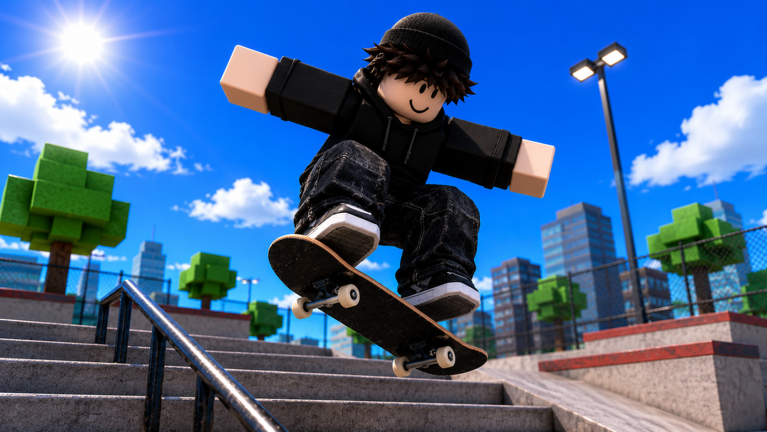
In 2019, Joseph Drennan was serving in the United States Navy. A year later, he launched a skate park that required neither concrete nor a planning permit. By February 2022, he was reporting 250 million plays. The park existed on Roblox, where a place to practise tricks could also become a place to spend an afternoon with friends.
Drennan, known online as StarMarine, had found a substantial audience for a fairly ordinary pleasure: going somewhere together. Skate Park offered boards, tricks and customisation. It also offered company. For a developer building a business inside somebody else’s platform, that combination gave a virtual public space a commercial life.
His company is Retro Shrimp. The name is refreshingly difficult to mistake for a bank. Its catalogue now runs from theme parks to horror games to a library in considerable need of tidying. Across those settings, Drennan’s career keeps returning to the same practical question: what can people do together once they arrive?
Before the company, a username
His Roblox history reaches back to June 2008. The distance between that date and Retro Shrimp’s later milestones matters. A career that can look sudden when measured in millions of plays had already accumulated years of building, publishing and finding an audience.
Roblox Point, his theme park project, belongs to that earlier period. The studio’s catalogue dates the classic experience to 2009. Its premise is wonderfully direct: a park with rides, somewhere to meet other players, a reason to wander. Later projects included a remastered version and Gravity Oasis. A digital amusement park can, apparently, have a preservation department.
His education lists Lake Minneola High School, with activities in web design and television production. Those are useful details for understanding a creator whose public work straddles constructing environments and making videos about them. They establish an early connection to both kinds of work without turning a school activity into a prophecy.
StarMarine also became a publishing identity on YouTube, TikTok and Twitch. The games and the videos occupied neighbouring territory: development, gameplay and the small pieces of information that keep players following a creator between visits.
A small experiment in getting noticed
In October 2018, Drennan put a specific proposal on the Roblox developer forum. He wanted an established developer to promote his family friendly Twitch stream. The arrangement would include advance social posts and a cosmetic item that viewers could obtain through a code given out during the stream.
He offered fifty cents per new follower, capped at $1,500, alongside a share of streaming revenue for the relevant month. It was a concrete attempt to connect an audience, an in-game object and a live broadcast. The proposal was public enough to attract objections, including a warning that borrowed attention might disappear almost as quickly as it arrived.
That exchange supplies a useful glimpse of the work around the work. Building a game does not automatically assemble its audience. Here was a developer thinking aloud about distribution, putting a price on an experiment and encountering disagreement. The promotional mechanism was more elaborate than simply hoping somebody would notice.
The park opens before the uniform comes off
Skate Park arrived in 2020, while Drennan was still in the Navy. His own account dates its launch to May. That order is significant: the game preceded the decision to work on Roblox full time. There was a period when military service and a growing games business occupied the same biography.
His Navy service ran from January 2017 to March 2021, with aviation specialist listed as his role. On March 18, 2021, he announced that his service had ended and that Roblox would become his full-time work. The change had a clear date, even if the years of preparation resisted such a tidy boundary.
By February 2022, he reported that Retro Shrimp had generated more than $1 million following Skate Park’s launch and the release of other games. In the same post, he contrasted that figure with earning under $25,000 a year in the Navy in 2019. Those figures describe different things: one is an individual’s annual pay, the other a company’s cumulative revenue.
The distinction leaves the achievement intact. A game built within Roblox had helped support a move into running a studio. Company revenue still has to pay for company work. It makes a good milestone without becoming an estimate of the founder’s personal fortune.
- 2008Begins on Roblox
- 2017Navy service begins
- 2020Skate Park launches
- 2021Games become full time
The people on the other side of the screen
One response to that milestone described an encounter at a much smaller scale. Chris LaBarbera recalled Drennan arranging a quality assurance server for roughly thirty children to play together. The Retro Shrimp team also talked with them about creativity and building games.
A later comment described Drennan and his colleagues appearing as guests at the North Florida Roblox Club. Children played alongside the creators and alongside one another in the room. For a business whose reach is expressed in vast counters, these were encounters with an audience small enough to speak to directly.
Drennan’s own posts also give the team credit. In March 2022, he celebrated a rapidly growing release that had reached ten million plays in less than a week. He said the team had created the experience in under five days. The combination of a short production cycle and a large response helps explain why a studio needs both creative decisions and dependable collaboration.
The contemporary discussion contains enthusiasm and congratulations. Its more revealing detail is the willingness to let players meet the people building their worlds. A creator can appear as a username, a video host, or someone answering a child’s question about how to begin.

A dance floor joins the map
In June 2022, Retro Shrimp announced a collaboration with Kinetix on Groovy Central. The proposed Roblox experience used AI-assisted animation for multiplayer dance battles. Players would be able to compete, judge or watch. Even the spectators had a place in the design.
The announcement described a team that had worked together since 2013 and formally established the studio in 2021. That history adds another useful timescale. A company registration can happen on one day; a working relationship has to earn its way through many more.
Drennan’s comment focused on what participants might create: “I am waiting with much anticipation to see all the amazing dances that players and content creators come up with!” The interest was in the activity that would happen after the developers supplied the setting and tools.
A skate park and a dance floor have different mechanics, but both leave room for performance, spectatorship and company. In that sense, the collaboration extended a familiar part of his work. The setting changed. The players still needed something worth doing when their friends turned up.
A different arena, with the same company
In September 2025, HYTOPIA announced that Retro Shrimp had joined its Creator Fund. Its account described a studio portfolio exceeding a billion plays and a new project, Hyper Ball Arena. The proposed game centred on deflecting an accelerating energy ball while navigating changing arena hazards.
This moved the story beyond Roblox. The fund offered financial and technical support, with the studio retaining its intellectual property. For a team associated so closely with one platform, the announcement represented a new place to apply its experience.
HYTOPIA also named lead programmer Daniel Pinheiro, who joined the team in 2020. That detail gives the company a little more substance than a founder biography alone can supply. The published projects depend on programmers, builders, artists and collaborators whose work sits behind the name on the announcement.
“Very proud of our team”
Joseph Drennan, celebrating a release in March 2022
And then somebody scattered the books
By 2026, Retro Shrimp’s catalogue included Clean The Library. Its task is easy to understand: books are everywhere, and players sort them, either alone or with friends. Leaderboards add a race to the tidying. A library, for once, has found a use for people who refuse to sit quietly.
Drennan celebrated its early growth publicly. A separate post from collaborator Björn Videler reported a milestone of 85,000 concurrent players. Unlike cumulative visits, concurrency describes people playing at the same time. It is another way to see how a simple shared activity can become a busy gathering place.
The studio’s website also lists Spray Paint & Skate, combining drawing with skating, and Fish and Clean, a collaboration with Pulsar Games built around catching and cleaning fish and treasures. Alongside the older theme parks and horror titles, they make for an agreeably peculiar business catalogue.

Drennan’s route runs through a long-standing username, Navy service, a skate park and a studio with several kinds of worlds to its name. The through line is visible in the activities themselves. Ride something. Make something. Survive something. Put the books back with a friend.
Those are modest instructions for places that have attracted so many visits. They also give the career a human scale. Somewhere behind the enormous counters is a player deciding where to go, what to do and whom to bring along. Drennan has spent years making places that can answer those questions.