The reports kept arriving. The people who needed to review them could no longer keep up. In an unnamed clinic described by Rhythm in May 2025, a few delays and a staff absence became a six-month backlog of remote cardiac transmissions. Documentation grew inconsistent. Handoffs frayed. The clinic’s monitoring program had outrun its capacity to do the work.
- The business: cardiac monitoring software with clinical and administrative support.
- The buyer: cardiology practices, device clinics, and health systems.
- The useful idea: give every transmission a path from arrival to completed follow-up.
Rhythm says it brought in clinical specialists, billing experts, and workflow managers, then cleared those six months of reports in six business days. Reviewers processed transmissions, escalated findings to clinicians, updated records, and prepared billing files. This is a company-reported account, rather than an independently evaluated result. Still, it describes the business unusually well: Rhythm sells the capacity to finish what connected devices start.
A nurse spots the missing work
Rhonda Bray came to the problem through nursing. She began in cardiac surgical intensive care, became interested in the devices supporting her patients, and moved into managing a pacemaker clinic in Washington, D.C. Over 12 years there, she saw the friction in bringing patients back for regular device checks. In a 2021 interview, she recalled: “I knew there had to be a better way for patients and practices.” She founded Rhythm in 2011.
That background helps explain the company’s appetite for ordinary tasks. A monitor needs setting up. A patient misses a transmission. Somebody must call. Rhythm’s clinical service includes CRAT-certified device clinicians, with its service page specifying at least three years of device experience. Its administrative team handles enrollment, monitor orders, missed appointments, and reconnection. The offering draws on clinical knowledge and the patient work surrounding it.

Four vendors, one queue
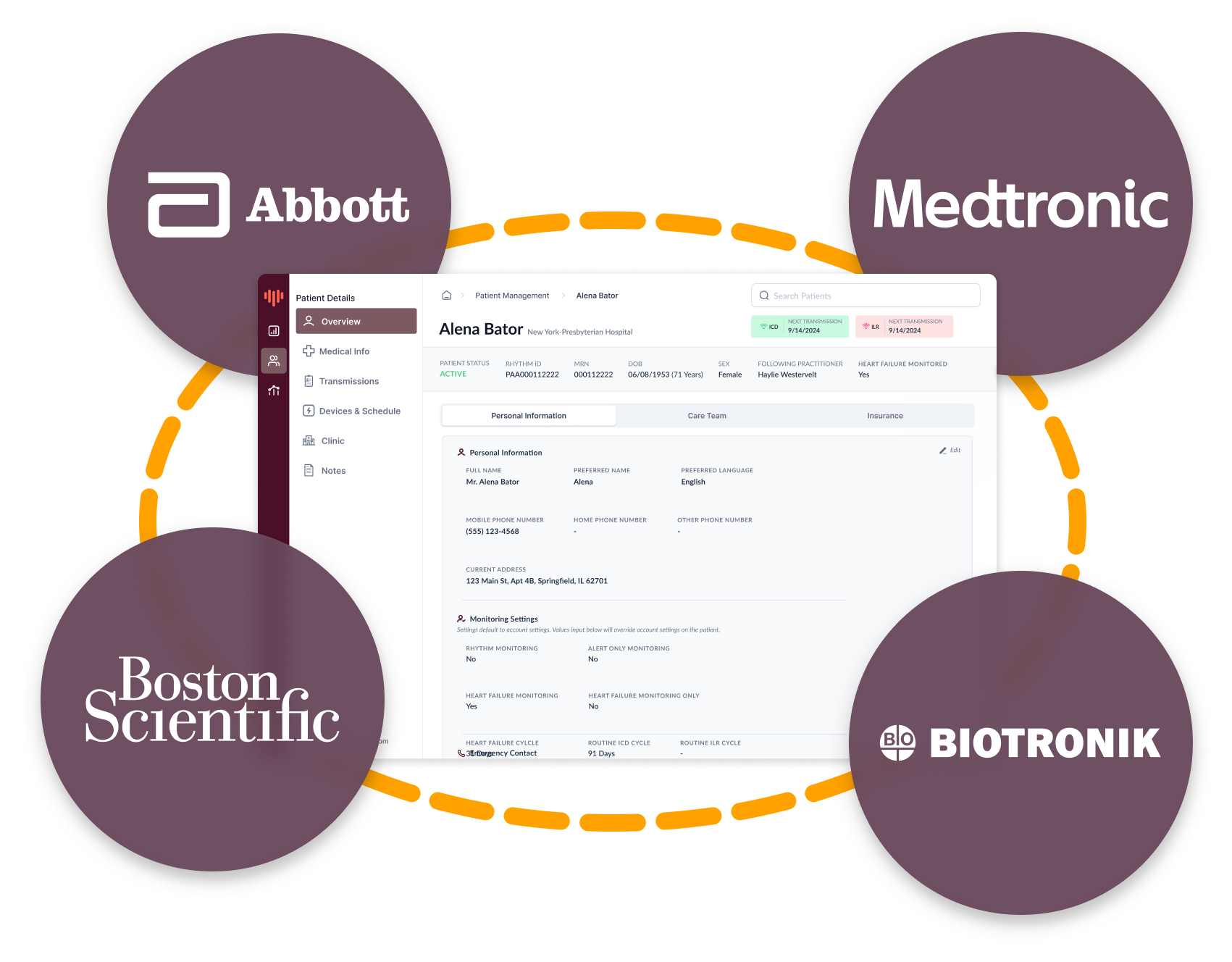
Rhythm sits between implanted cardiac devices and the practices responsible for following their patients. Its platform combines transmissions from Abbott, Medtronic, Boston Scientific, and Biotronik. Remote reports and in-clinic device checks share a workflow. The aim is to let a device team work through a common queue instead of repeatedly moving between manufacturers’ systems.
The integration layer matters just as much as the inbox. Rhythm describes demographics and diagnoses flowing into its system, with device data, signed reports, and charges flowing back into the patient chart. It lists connections to Epic, athenahealth, Cerner, NextGen, and other electronic health record systems. For a practice, the attraction is less repeated entry between a device check and the clinical record.
- 01Device dataFour major manufacturers
- 02One inboxRemote + in-clinic
- 03Review + actTriage and escalation
- 04Close the loopChart, follow-up, billing
Illustrative process based on Rhythm’s platform and service descriptions.
The company’s current website names Carilion Clinic, Montefiore, Duly Health and Care, and Mercy among the programs it serves. It reports more than 200,000 actively monitored patients and 1.2 million transmissions annually. Those are company figures, best read as a statement of operating scale rather than evidence of better clinical outcomes.
This is a competitive neighborhood. PaceMate, Murj, and Implicity also address cardiac device workflows. Aggregating manufacturers and connecting to patient records are shared ambitions. Rhythm’s proposition is the combination of its platform, configurable clinic protocols, patient outreach, and a team available to assume different amounts of responsibility. Buyers should compare the actual handoffs each proposal covers.
The price of finishing the job
The commercial menu reflects that flexibility: software alone, software with administrative help, occasional support, or a fully managed program. Quotes depend on the practice. Published add-ons include roughly 1.6 cents per text, $25 a month for branded caller ID, and 89 cents per mailed letter, with some packages including them. Postage has a place in this software business.
There are also two billing arrangements. Under split billing, Rhythm submits the technical component and the practice submits the professional component. Under fee-for-service, the practice bills the global code and pays Rhythm a fixed amount per completed transmission. The choice determines who handles claims and collections, alongside who handles the monitoring work.
Aldrich Capital Partners’ announced investment in 2021.
2022 → EQUIS ACQUISITIONAldrich Capital Partners invested $34 million in 2021. Rhythm then acquired Indiana-based Equis Consulting Group in a deal that closed September 30, 2022, extending its Midwest presence. The acquisition announcement discussed reimbursement cuts and the commitment to keep expanding. It is a reminder that this model must make sense within healthcare payment economics, however useful the service.
The small fixes tell the story
The most revealing product announcement may be the April 2025 update. Rhythm acknowledged that editing report notes had caused pauses while changes loaded. Customers wanted autosave. The replacement saved changes in the background. A shared activity feed brought calls, notes, alerts, and interventions together, addressing fragmented information and different views for internal staff and clients.
THE OPERATING IDEAConnected care depends on what happens after the data arrives.
That release also introduced SMS patient alerts and adaptive scheduling around patient preferences and monitoring requirements. Rhythm’s current public product pages describe AI-assisted triage and voice agents that call patients about disconnected monitors and information updates. These are specific proposed uses for automation: reduce repetitive review and outreach while clinical findings still have a route to the treating team.
Keep the connection useful
The transferable lesson is to map the entire job before buying tools: who notices a disconnected monitor, who reaches the patient, who reviews the next transmission, and who closes the record? Rhythm packages answers to those questions. A clinic evaluating it can make the same map, then decide which responsibilities to retain.
The arrangement depends on usable connections, compatible records, agreed alert protocols, and clinicians who act on escalations. A platform cannot complete a handoff to a team with no capacity to respond. Rhythm’s patient guidance also keeps remote monitoring alongside regular care. Its opportunity is practical: make the work between appointments sufficiently organized that the connection remains useful.