Before an orthopedic practice could let an AI agent book appointments, somebody had to check the appointment book. The practice’s written scheduling instructions did not quite match the way its appointments were configured in MEDENT. An implementation team working with Assort Health compared the instructions with the actual EHR data and surfaced the differences before automation began. The machine could understand a caller. The harder question was whether everyone agreed on what should happen next.
- One connected system: clinical records, billing and patient engagement.
- A practical AI bet: finish work inside the existing workflow.
- The buyer’s homework: check configuration, interfaces and the full quote.
That small episode, described in an August 2026 partner article, makes a useful introduction to MEDENT. Healthcare software is often discussed as a collection of features. A practice experiences it as a sequence of handoffs. A patient calls. A receptionist chooses a slot. A clinician writes a note. A biller turns the encounter into a claim. Trouble collects in the spaces between those actions.
First came the bill
MEDENT’s predecessor, Community Computer Service, began in 1968, in the Cuthbert living room in Auburn, New York. Its four founders rented time on an IBM 360 in Syracuse. Billing and payroll came before medical records. By 1981, customers wanted software that would let them handle billing on their own microcomputers. The early ambition included medical and dental offices, which supplied the name MEDENT. The dental focus eventually disappeared. The name stayed.
There is a useful product lesson in that sequence: follow the recurring request. Customers were pulling computing closer to their daily work. Today, MEDENT is a privately held developer serving medical practices, with both cloud and client-server options. It says development, support and services are handled in-house. The appeal is continuity: the people responsible for the software also help practices put it to work.
The chart has to reach the cash register
The core product joins electronic health records, practice management and patient engagement. Clinicians can document visits, prescribe, review results and access records on mobile devices. Administrative staff can work through scheduling, charge entry, posting and reporting. The practice-management system carries information from the chart into the electronic superbill and billing workflow. That connection matters because a completed appointment still leaves administrative work behind.
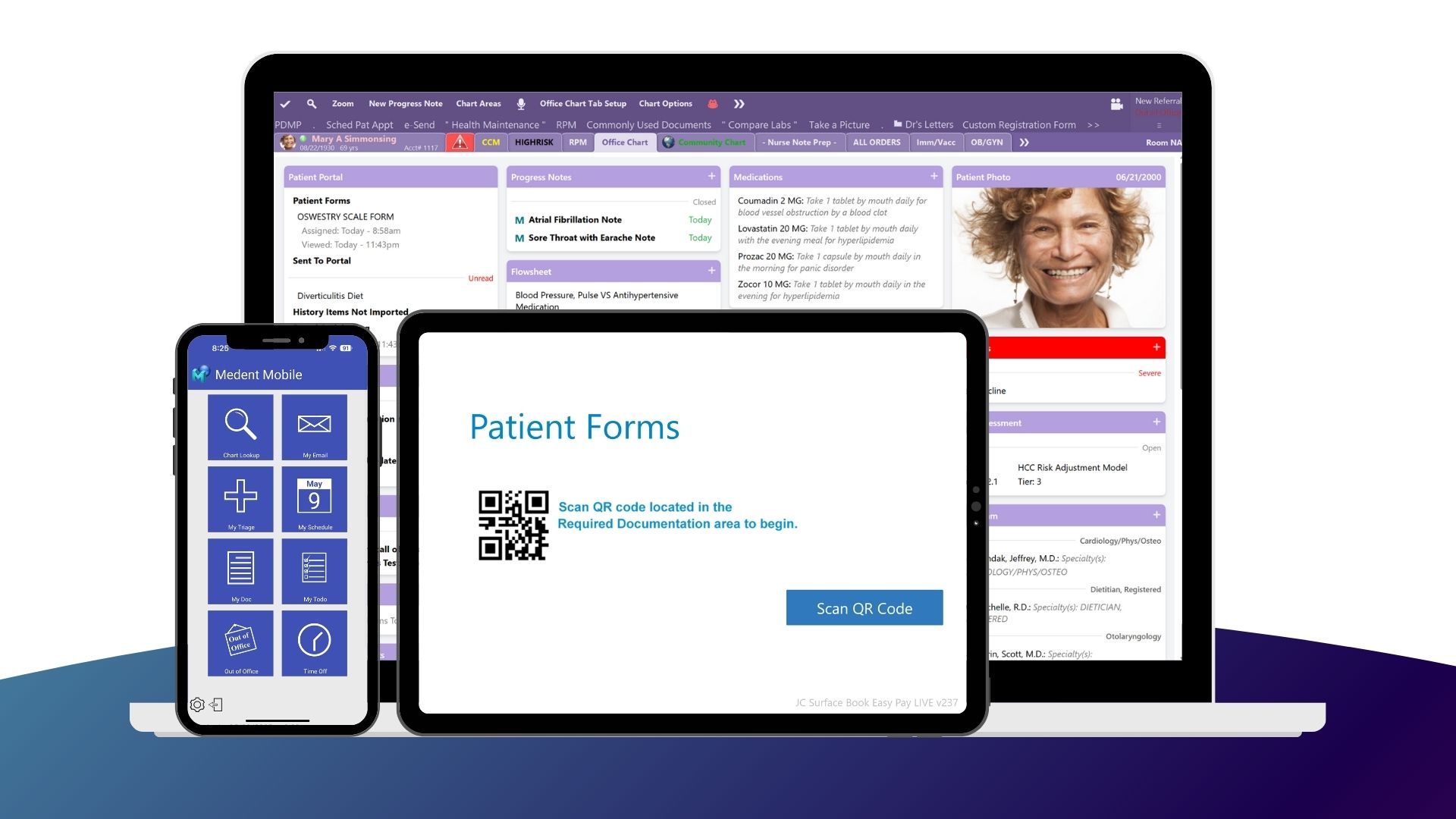
The patient-facing tools extend the chain outside the building. People can schedule online, update information, complete forms before arriving, use a portal and join video visits without installing an app. An office that collects information before a visit has fewer details to chase at reception. Whether patients use those tools, and whether staff act on what arrives, determines how much of that convenience becomes saved work.
The job is complete when the next person can use the information.
MEDENT also addresses the less visible side of practice operations: quality reporting, risk assessment and care gaps. Its ACO tools can identify patients for chronic care management, organize diagnosis-based care tasks and exchange records through networks including CommonWell and Carequality. This places it in the market for ambulatory clinical and business software, serving independent offices, specialty groups and larger practice networks.
Alternatives such as athenaOne and Tebra also combine clinical and practice operations. Integration alone therefore gives a buyer little basis for choosing. MEDENT’s more specific pitch combines deployment choice, in-house support and connections to specialist services. Those are concrete items a practice can examine in a demonstration, alongside the way the software handles its own specialty and billing requirements.
The note comes back home
The Suki partnership applies the same handoff logic to AI documentation. The system can listen to a clinical conversation and generate a note. Providers can accept, reject or edit suggested diagnoses and chart content before sending the result back to MEDENT. Relevant chart sections are updated without a copy-and-paste routine. The useful unit of automation is the reviewed note in the record.
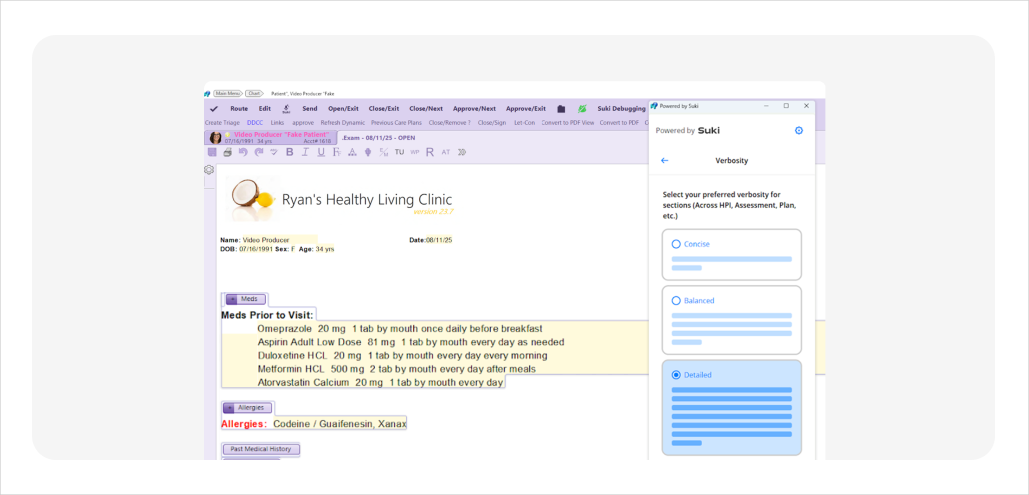
Suki’s account of the partnership says MEDENT wanted embedded integration, an established healthcare partner and room to scale. The choice explains a boundary in the company’s expertise. MEDENT builds the clinical and administrative environment; a specialist supplies the voice AI. An all-in-one product can still depend on other companies, particularly when their work fits into the existing record.
Consider Marble Valley Healthworks, an independent, multi-location practice that has used MEDENT since 2019. Its published case study says Bruce Bullock, a physician and former chief medical information officer, had worked with three EHRs during his career. He began using Suki-powered ambient listening in May 2026. The practice describes value in seeing across locations and keeping clinical and business operations together.
“medent allows me to optimize relationships with my patients.”
Bruce D. Bullock, MD
Marble Valley Healthworks · MEDENT case study
The price of making things talk
Buying this kind of software means buying an implementation. MEDENT describes six stages: a welcome meeting, system setup, workflow consultation, configuration, training, then go-live and follow-up. Practices have tasks alongside the vendor. A sensible buyer would bring actual encounters and awkward exceptions to those sessions, then watch how the proposed configuration handles them.
MEDENT quotes pricing for each practice and says chart conversion, setup and startup training carry no additional charge. Deployment changes the bill: its certification disclosures say the patient portal and advanced prescribing are included for cloud users, while non-cloud practices face monthly charges for those features. A data-export module also has an additional cost.
Custom connections have their own clock. MEDENT’s new-interface request process requires feasibility review, a quote and initial development fees before programming. It describes development, testing and implementation as taking four to eight months or more. Existing integrations can differ substantially: Octagos’ August 2026 partner article says most practices using its cardiac-monitoring connection go live within 20 business days, without setup or maintenance fees.
Check the rules before pressing go
The orthopedic scheduling example offers something any practice can copy. Compare the written workflow with the system’s actual settings. Resolve disagreements. Decide which requests need a person. Then automate. When appointment types, referral rules or provider preferences remain inconsistent, faster processing can simply deliver the wrong result sooner.
MEDENT’s proposition rests on those ordinary details. A practice needs the note to land in the chart, the charge to reach billing and the follow-up to reach the patient. The software earns its place when the next person can get on with the job.