Heidi Jannenga was looking for an expense to cut. In 2006, the physical therapist and clinic director was examining the economics of her practice. Dictation and transcription stood out. Every patient needed a record; producing those records consumed money that the practice could use elsewhere. It was an ordinary managerial irritation. The sort of thing that ends up on a spreadsheet, then on next month’s spreadsheet.
- Start with the note. Software built around outpatient rehab documentation.
- Follow the money. Connect care to scheduling, claims, and collections.
- Check the fit. Judge the complete workflow, including training and cost.
A bill before a business
Jannenga and technologist Brad Jannenga built an alternative. WebPT launched in February 2008, from the back of a coffee shop, with one employee. In her later SaaStr account, she described existing server-based options as expensive and poorly matched to therapy. The initial mismatch was between the work therapists did and the systems available to record it.
That distinction matters. A rehabilitation practice follows progress across repeated visits. The software has to accommodate changing function, treatment plans, and the documentation supporting payment. Knowing that routine gives a builder a useful starting point. Jannenga brought the view from the treatment room; Brad brought the technical means to turn it into software.

Follow the note
Today, WebPT sells cloud software and services to outpatient physical therapy, occupational therapy, and speech-language pathology practices. A therapist uses its EMR to document treatment. Reception staff manage appointments and intake. Billers work on claims. Owners inspect reports. Its customers range from solo practices to organizations operating multiple locations.
The interesting unit here is the handoff. Patient information gathered before an appointment becomes part of the record. A completed note supports a claim. A payment becomes a financial result the owner can examine. WebPT’s proposition is that these steps should connect. Every time somebody retypes information or chases a missing detail, the practice spends effort getting back to where it thought it already was.
- 01IntakeKnow the patient
- 02NoteRecord the care
- 03ClaimSupport the bill
- 04PaymentSee the result
Conceptual workflow, not measured product performance.
This also explains the product range: scheduling, digital intake, reminders, patient engagement, home exercise tools, reporting, billing software, and optional revenue cycle services. Under the Practice Experience Management name introduced in 2023, WebPT makes the whole practice its territory. The ambition is broad, but the customer remains specific: people operating rehabilitation businesses.
The price of getting bigger
Expansion required more than another feature. Battery Ventures took a majority stake in 2014. Its account describes roughly 5,500 clinics at investment and more than 15,000 by its 2019 exit. Along the way, Battery helped recruit executives and execute acquisitions. Therabill, Strive Labs, and BMS Practice Solutions brought capabilities in billing, engagement, and revenue management.
There was a price beyond the undisclosed investment amount: the founders sold control. In an Inc. interview, Heidi described how having so much personal wealth tied to the company made bold decisions harder. Outside capital also brought operating expertise. Warburg Pincus agreed to acquire Battery’s majority interest in 2019. The growth story involves a deliberate exchange of ownership for resources.
Investor-reported clinic counts at investment and exit. Approximate, historical figures.
For a buyer today, the price question is more prosaic. WebPT’s public pricing page offers Starter, Enhanced, and Ultimate plans, with increasing billing and reporting capabilities. It directs prospects to a demo rather than publishing dollar rates. A cash-pay startup and an insurance-heavy group need different combinations. The sensible comparison is the complete subscription, service, and implementation commitment.
A new scribe, an old problem
The original documentation headache has acquired an AI vocabulary. In August 2025, WebPT announced a partnership with Comprehend Health for in-EMR scribing, documentation feedback, and coding guidance. Conversations or dictation can become structured notes. Missing sections can be flagged before sign-off. These are assistance features; the clinician still has to check whether the record represents the care delivered.
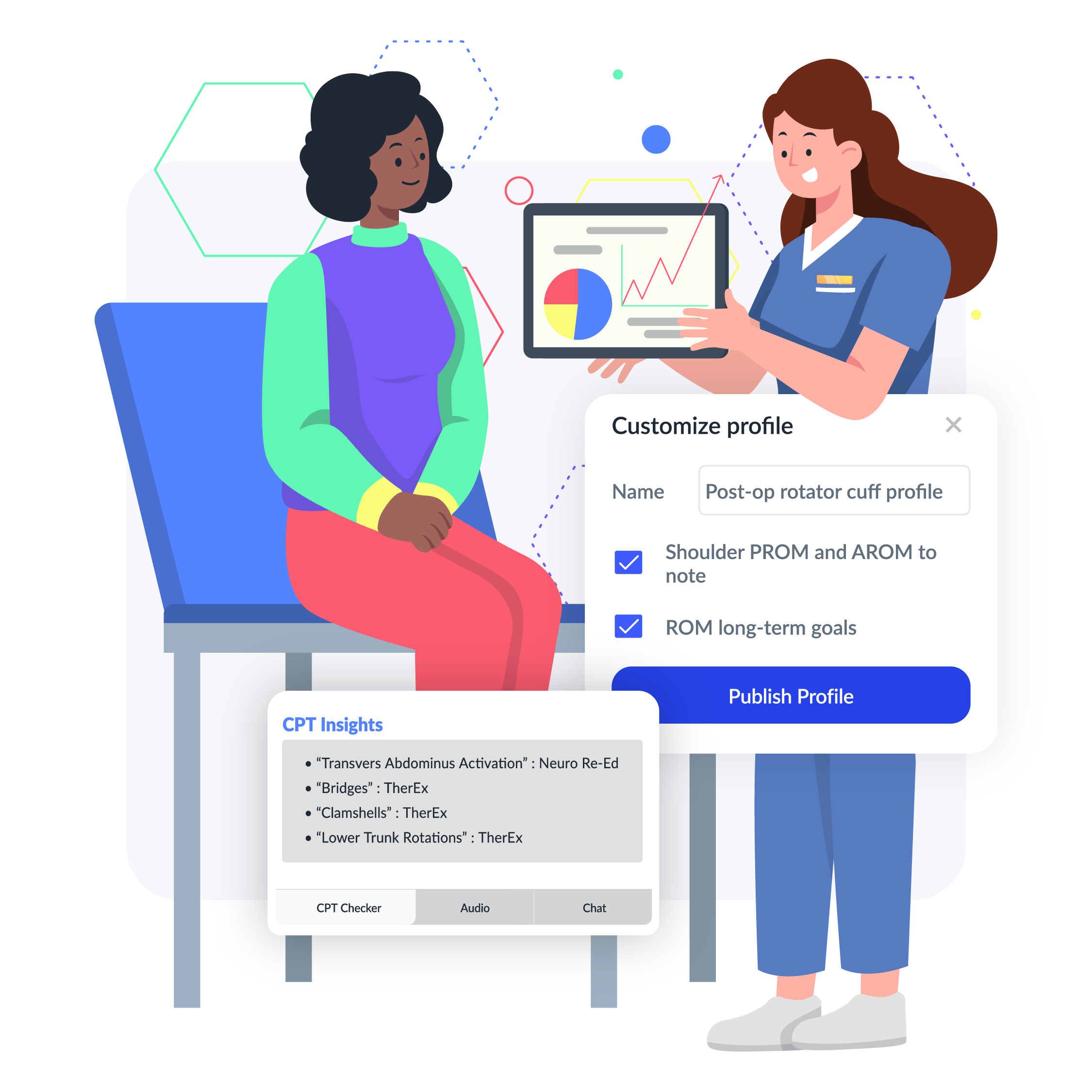
In July 2026, WebPT extended that argument into revenue cycle management, combining AI-driven workflows with billing specialists. Its announcement described predictive denial signals, work queues, and dashboards. More than 40 practices had transitioned at announcement. The practical bet is that experienced people become more effective when software helps them find the claims requiring attention.
“Technology should make experts more effective, not replace them.”
Monte Sandler, WebPT COO / July 2026
Scale makes the experiment consequential. In February 2026, WebPT reported more than 170,000 users. But breadth also involves partnerships: Net Health acquired WebPT’s Keet Health business in January 2026, with Limber designated a preferred outcomes and remote monitoring solution. In August, WebPT appointed Alex Bendersky head of clinical innovation. Clinical knowledge remains part of the product brief.
Make the demo do the work
WebPT sits among specialty rehab systems, including Prompt Health. Therapy-specific workflows distinguish it from general-purpose records software, but competitors also offer integrated documentation and billing. A feature checklist alone will struggle to settle the choice. Ask each vendor to take a representative patient through intake, treatment, claim correction, payment, and reporting.
Then measure the inconvenient things: staff training time, unfinished notes, payment delays, and work passed between departments. A tightly integrated platform may offer little benefit if its workflows clash with the practice, the necessary integrations are absent, or the total cost exceeds the time recovered. Software cannot make an inaccurate note true or replace clinical judgment.
Consider a hypothetical clinic choosing between a cheaper standalone record system and a broader bundle. The first might win on subscription price. The second could become more attractive if it removes repeated intake entry or gives the biller information sooner. Neither conclusion follows from the number of features. It follows from observing where the clinic currently loses time.
The same discipline applies to billing outsourcing. An owner should establish who handles rejected claims, who contacts patients, and which decisions remain with clinic staff. A dashboard is useful only if someone acts on it. The software purchase changes responsibilities as well as screens, and those responsibilities need names attached to them.
That is why the less glamorous parts of a demonstration deserve patience. Ask a receptionist to try intake. Let a therapist finish a note. Have a biller find an exception. A system that works across those small encounters has made a stronger case than one that merely looks persuasive on the owner’s laptop.
The lesson others can copy is modest and useful. Find a recurring expense close enough to understand. Solve it in the customer’s working language. Follow the work into the next problem. WebPT began with the cost of making a record. Its continuing test is whether connecting everything around that record makes a clinic easier to run.