The revealing detail in RES Systems’ account of Medicaid administration is a code: N1. In the nursing-home conversion process described by the company, an eligibility decision and the entry of that code are separate tasks. A case can be approved, yet the resident can fail to appear on the long-term-care roster. Someone has made a decision. Someone else still has to make the decision visible.
For a provider waiting to bill, that distinction matters. RES works in this awkward interval, where a completed application is only one part of a financial outcome. Its customers include nursing homes, hospitals, clinics, and managed long-term-care plans; it also markets services to law firms and community agencies. The common problem is keeping eligibility information, supporting documents, and payment systems in agreement.
- MEDS submits and tracks NYC Medicaid applications.
- Batch checks flag changes in ongoing eligibility.
- Specialists pursue case problems and unpaid claims.
The man who knew the machinery
Founder Lou Lista came from inside the machinery. RES identifies him as a former Medicaid Director of Systems who worked closely on New York’s Welfare Management System. The company says Revenue Enhancement Services has served hospitals and nursing homes since 2000. His background helps explain the business’s particular obsession: understanding what happens to a case after somebody presses submit.
New York City’s introduction of the Eligibility Data and Image Transfer System, or EDITS, created the opening for MEDS, the Medicaid Eligibility Decision System. RES says it began submitting electronic applications through MEDS in 2007 and was the first certified EDITS submitter for the PCAP program. The product translated an administrative process into software, with experienced people available when a case refused to behave.
Give the paperwork a memory
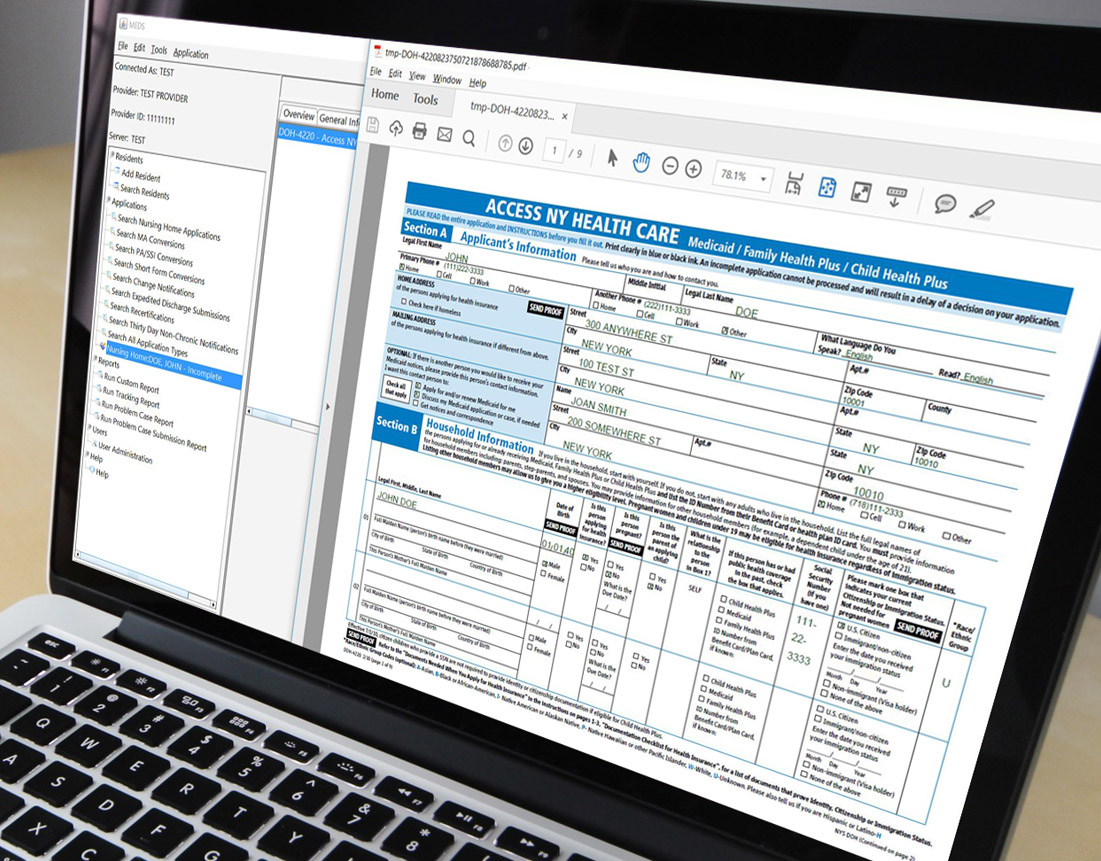
MEDS assembles the ordinary pieces of an application: personal data, forms, signatures, and supporting documents. Users can enter information or import it from existing systems. The software fills forms, accepts electronic signatures, scans documents, checks completeness, and sends the package to EDITS. A submission receives a date stamp. Reports track applications, decisions, and work still outstanding.
The less glamorous promise is continuity. A document stays with its case. A decision returns electronically. An unresolved problem has somewhere to live. For nursing-home cases, RES says it checks approvals for billability and records problems in its own case-management system for follow-up with HRA, New York City’s Human Resources Administration. Software organizes the work; staff pursue the exceptions.
Its 2025 MLTC product sheet describes another layer: daily roster imports, eligibility checks, automatic case creation, and assignment using a client’s distribution logic. Exception reports identify mismatches between roster information, state eligibility responses, and MEDS records. These are practical questions. Is the member still eligible? Does the state show a different plan? Which record needs attention?
- 01AssembleData, forms, documents
- 02SubmitValidate and date-stamp
- 03Follow throughCheck coverage and exceptions
An approval has a tomorrow
RES’s batch inquiry product tackles the problem after enrollment. A nursing home can check its census against state eligibility records in one batch. A health plan can check its membership. Results expose closed cases, changes of plan, provider-file problems, and renewal dates. The product is available independently or alongside MEDS.
The company describes clients discovering lost eligibility only when a managed-care plan reclaimed payments months later. That is the operational failure its monitoring addresses: the warning arrives after the financial consequence. Comparing coverage across dates gives staff a chance to spot a change earlier. RES also offers help resolving the problems those checks uncover. The report is the beginning of the job.
There is a useful lesson here for anyone building administrative software. Recording an event and confirming its consequences are different jobs. A transferable approach is to check the downstream record, compare it with the expected result, and assign discrepancies to someone who can act. RES’s published workflow makes that sequence unusually concrete.
“After all, the point of finding problems is to correct them”RES Systems · Batch Eligibility Inquiry
What gets paid, and when
RES sells software licenses, consulting, and billing services. Its MEDS page advertises no startup fees, a full day of staff training, and free support. Those terms lower the friction of getting started. A prospective buyer still needs a proposal covering ongoing charges, interfaces, equipment, and the services included.
Its service mix also followed customer demand. RES says clients sought help collecting from managed-care plans after New York mandated managed care. It responded by hiring a billing specialist with 30 years of experience. The company’s account describes a staffing decision prompted by a payment problem.
Billing recovery has a different bargain. RES states that it charges a contingency fee, agreed case by case, only after payment arrives, without charging normal business expenses. It also offers a free review of accounts-receivable aging reports. The arrangement ties its fee to collections, while leaving the percentage and scope to the individual engagement.
The billing page reports reducing one client’s pending Medicaid receivable from $6.2 million to $1.5 million in a year, plus recovering more than $1 million previously written off. These are company-reported examples involving unnamed clients. A reduction in pending receivables should not be read as an identical amount of cash collected. For buyers, the useful next step is asking how a proposed engagement will measure results.
A specialist’s place in the stack
RES’s place is beside a provider’s existing systems. In October 2014, ADL Data Systems announced a project to integrate MEDS with OptimumSeries, allowing nursing-home applications, conversions, status changes, and recertifications through that interface. The announcement shows the logic of the product: connect eligibility work to tools facilities already use.
Its alternatives include staff handling inquiries and follow-up manually, other eligibility interfaces, and outsourced revenue-cycle services. RES’s particular proposition combines a New York City application interface, ongoing state eligibility checks, and staff familiar with difficult cases. The advantage depends on how much of a customer’s work falls inside that specific territory.
The same specificity sets the boundary. An organization whose applications follow a different state’s process would need to establish whether RES supports it. Electronic filing cannot supply missing financial documentation or turn an ineligible case into an eligible one. Staff still need a process for gathering evidence and acting on exceptions. The payoff comes when an organization has enough recurring eligibility work to make consistent follow-through valuable.
The N1 example brings the business back into focus. In healthcare administration, a small field can carry a large consequence. RES has made a product and a service out of checking whether the consequence actually followed.