A home care visit can be perfectly successful and financially unfinished. The caregiver arrives. The client receives help. The shift ends. Somewhere else, an authorization has expired, a service code does not match, or an electronic visit record disagrees with the claim. The care happened. The payment may not.
- Paradigm handles VA and Medicaid billing for home care agencies.
- Its work starts with enrollment and approvals, then follows claims through payment.
- It charges on paid claims and has added AI expertise through Careswitch.
This is the territory occupied by Paradigm Senior Services. Think of the distance between doing the work and proving, to a particular payer, that the work qualifies for payment. Paradigm has made that distance its business.
Its origin story is suitably unglamorous. Friends working at a financial services company noticed changes in Veterans Affairs billing procedures. Providers needed someone willing to learn the new rules. The opportunity was in the homework. The company, founded in 2015, subsequently expanded beyond VA billing into Medicaid and other third-party payers.
The first failure can happen before the claim
The revealing detail is that submitting a claim is often too late to prevent the original mistake. An agency can deliver hours beyond an authorization’s limit. A client’s Medicaid eligibility can change. A caregiver can clock in correctly while the record still fails to match the approved service. Fixing the invoice does not automatically fix those underlying conditions.
Paradigm therefore works upstream. Its authorization service reviews hours, rates, service codes and approval periods. For Medicaid clients, it describes weekly eligibility checks and tracking of coverage changes. It monitors renewal dates and matches authorizations to electronic visit verification, usually shortened to EVV. These checks are the practical machinery behind the promise of cleaner claims.
- 01ApprovedCoverage, codes and hours align.
- 02RecordedThe visit matches the authorization.
- 03SubmittedThe claim passes payer checks.
- 04ReconciledPayment returns to the original shift.
For VA agencies, that includes the Standardized Episode of Care, or SEOC, which sets boundaries around the authorized services. Paradigm supports enrollment through administrators Optum and TriWest, reviews referrals and watches for hour caps. Its expertise sits in the relationship between the care plan, the visit and the payer’s requirements.
A billing department with software inside
The product is a combination of people and software. Paradigm scrubs claims, submits them, handles rejections and appeals, follows up with payers and posts payments. Its billing materials say most claims go out weekly once visit data is verified. The work continues after the submit button has had its moment.
For an agency owner, the useful distinction is responsibility. A scheduling platform helps organize visits; billing functionality can help prepare claims. A managed revenue service takes on the repeated work of getting those claims resolved. Paradigm competes with internal billing teams, local billing firms and broader healthcare revenue-cycle providers, while working alongside agency software.
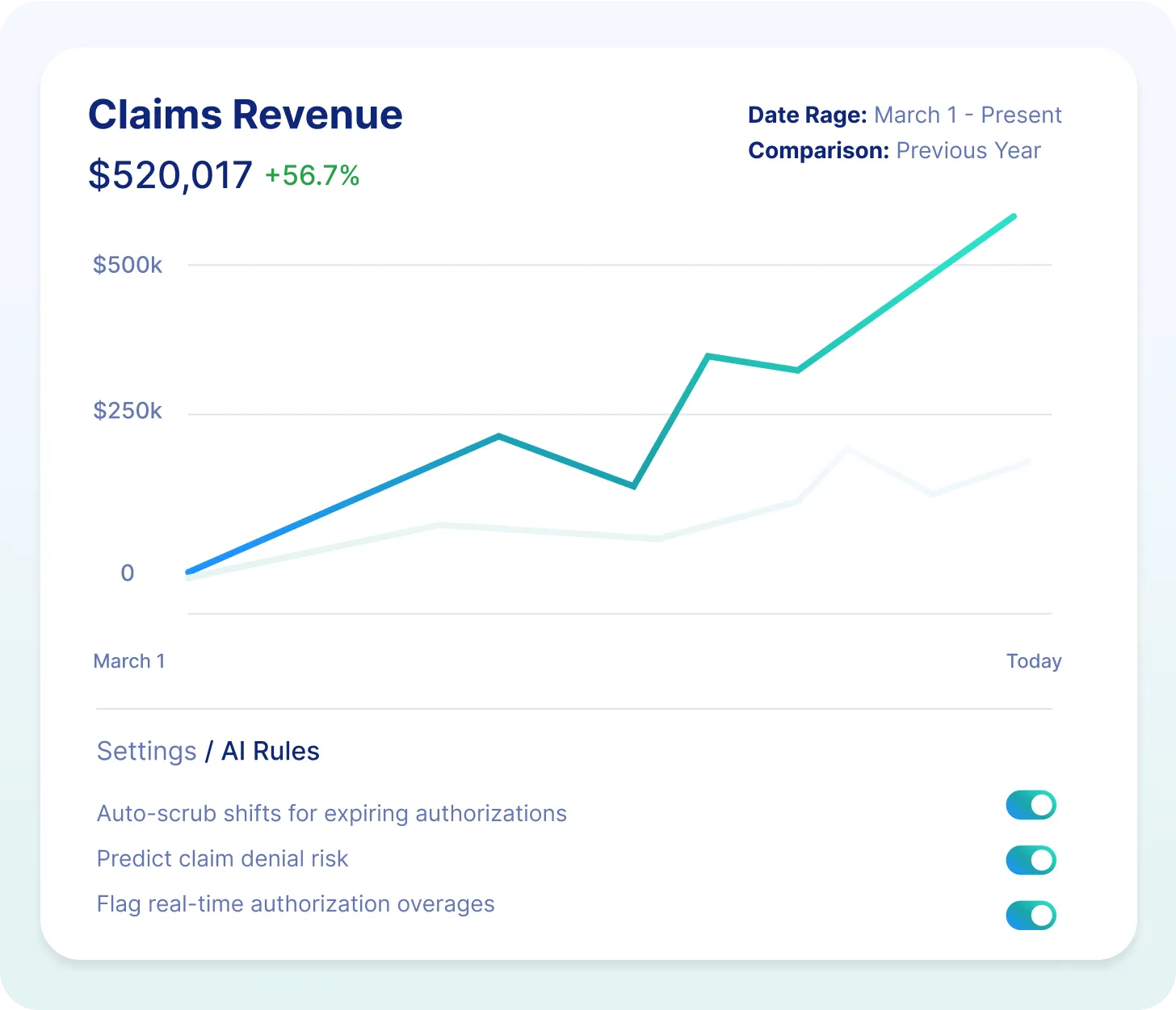
That distinction matters when choosing a vendor. Paradigm says it works with systems including WellSky, AxisCare, AlayaCare, HHAeXchange and Sandata. Compatibility still needs a concrete conversation about the agency’s payer, state and workflow. A familiar software name on an integration list is the beginning of that conversation.
Its reporting connects claims back to shifts and shows submitted, paid and outstanding amounts. Users can filter by client, payer, date or denial type. The value is investigative: an owner can examine which hours produced payment and which remain caught in an administrative queue.
Follow the paid claim
Paradigm’s commercial proposition is unusually easy to remember: it gets paid when the provider gets paid. Its VA page advertises no setup fees and no monthly minimums. Medicaid billing is also described as performance-based. For buyers, the relevant comparison includes the quoted fee, staff time saved and collections recovered.
“We don’t get paid until you get paid.”Paradigm’s published pricing proposition
The incentive helps explain an otherwise curious addition to a billing service: growth coaching. Paradigm offers customers a twelve-week experience with six sessions, beginning with a one-hour discussion and followed by five shorter meetings. Coaches include former agency operators and franchise specialists. More successfully collected care revenue benefits both sides.
The intended customer is an agency handling third-party reimbursement, perhaps adding a payer or struggling with existing receivables. Paradigm can assist before enrollment and after a denial. It does not directly supply VA referrals; its stated role includes helping agencies use referral systems and build relationships with case managers.
First a connection. Then a purchase.
The AI chapter began with a connection. In September 2023, Careswitch and Paradigm announced an integration allowing data to move in both directions. Careswitch handled agency operations; Paradigm brought payer management. Two years later, on September 16, 2025, Paradigm announced that it had acquired Careswitch.

The announcement outlined plans to apply the acquired AI capabilities to claims processing, fraud detection and payment integrity. It also reported more than $1.6 billion in claims processed annually. That number describes money flowing through provider claims, rather than Paradigm’s own sales. The distinction is essential to understanding the business.
A July 2025 SwyftOps partnership and November 2025 Interim HealthCare agreement show another route to distribution: connect with the software and franchise networks agencies already use. By May 2026, Paradigm was publishing guidance on VA authorization mismatches. Payer knowledge remained part of the offering alongside the newer technology.
The lesson is in the exceptions
There is a useful practice here for any operator: inspect the conditions for payment before delivering the work, then assign someone responsibility for the unresolved balance. Automation becomes more useful when the rules and the owner of each exception are clear.
The limits are equally concrete. Billing software cannot supply missing caregivers or make an inadequate reimbursement rate cover the cost of care. Nor does an alert itself renew an authorization. Paradigm’s proposition depends on connecting information to action. In home care, a completed visit is a human achievement. A paid claim requires another kind of follow-through.