René Lacerte had helped put payroll on the internet. Then he went back to his desk and dealt with the bills. There were filing cabinets, checks, invoices and little notes asking little questions that somehow consumed large portions of the day. His company, PayCycle, sold a more efficient future. Its own back office looked uncomfortably familiar.
He recognized the arrangement. His grandfather had run a business much the same way, roughly sixty years earlier. Here was a rather expensive discovery for a software entrepreneur: the family paperwork had outlived several generations of technology. Lacerte founded BILL in 2006 to do something about it. The ambition was plain enough. An owner ought to spend more time running the business than locating the evidence that the business had happened.
That observation connects a Canadian general store, a Florida childhood, a Stanford education and a public company in San Jose. Across those settings, Lacerte kept returning to the same people: owners whose working days did not end when their customers went home. He knew them before he knew what a software market was.
The general store came first
In 1910, his great-grandfather Arthur opened a general store in Ste Anne, Manitoba. His grandparents, Arcel and Rita, went on to try businesses ranging from retail and farming to cars, citrus and financial data processing. His parents, Grant and Karen, helped expand the data-processing operation to seven centers across the country. Later they started businesses serving accountants and processing payroll remotely.
Those ventures gave the family a running conversation. Lacerte grew up hearing about customers, cash flow and the difficulty of getting everything done. After moving to Winter Haven, Florida, at about ten, he continued an education that happened around the dinner table. The family could supply its own business cases, with the added inconvenience that the cases needed resolving before bedtime.
“I grew up talking about starting businesses and running businesses around the dining room table,” he recalled. What stayed with him was the animation in his parents’ and grandparents’ voices when they solved a customer’s problem. He also heard the strain. His father did not press him into entrepreneurship; the choice was supposed to be his.
in Manitoba
and data processing
and remote payroll
and BILL
Different businesses. A recurring interest in the work behind the counter.
A walk around Los Altos
At Stanford, Lacerte studied economics and industrial engineering. His first professional stop was Price Waterhouse, where he worked as a staff accountant and consultant. He then joined his parents’ payroll company, Certa Data Corporation, before moving to Intuit. From 1994 to 1999, his work there included bill payment and connected payroll. He had seen the customer’s problem from the family office, the accounting firm and the software company.
PayCycle began in 1999. One early decision came during a walk with co-founder Martin Gates near their Los Altos office. The original strategy had run into legal complications, and they needed another approach. They talked about accounting firms that handled payroll to retain clients, even when payroll was hardly the work they wanted to do.
The internet offered a way for those firms to provide the service without recreating a payroll operation from scratch. Lacerte visited his accountant that day and began a focus group. The sequence is revealing: a conversation, a change of direction, then a quick trip to someone who would actually have to use the thing. His family experience supplied familiarity. It did not excuse him from asking questions.
By July 2009, when Intuit completed its roughly $170 million acquisition of PayCycle, the service reached more than 85,000 small businesses. It also worked through accountants and financial institutions. Lacerte’s former employer was buying a business he had helped start. By then, he was already occupied with another problem.
“Business is personal.”
René Lacerte, 2019
The bill that refused to disappear
BILL grew from the administrative tangle he encountered at PayCycle. A payment was attached to a document, an approval, an accounting entry and another company waiting to receive it. Moving the money solved only part of the job. The surrounding questions still had to be answered, and they were scattered across desks and systems.
In his explanation of BILL’s beginnings, Lacerte described paper as a symptom of the larger problem. His idea was to bring workflow, accounting and payments together. That required understanding both sides of a transaction: the business sending money and the business expecting it. Each had its own records, deadlines and reasons to telephone the other.
Accountants became an important route into that world. In 2009, BILL partnered with CPA2Biz, an American Institute of Certified Public Accountants subsidiary, to reach accounting firms and their clients. It was a distribution choice with roots in Lacerte’s earlier work. An accountant already knew which clients spent too much time chasing approvals and sorting invoices. The relationship existed before the sales pitch.
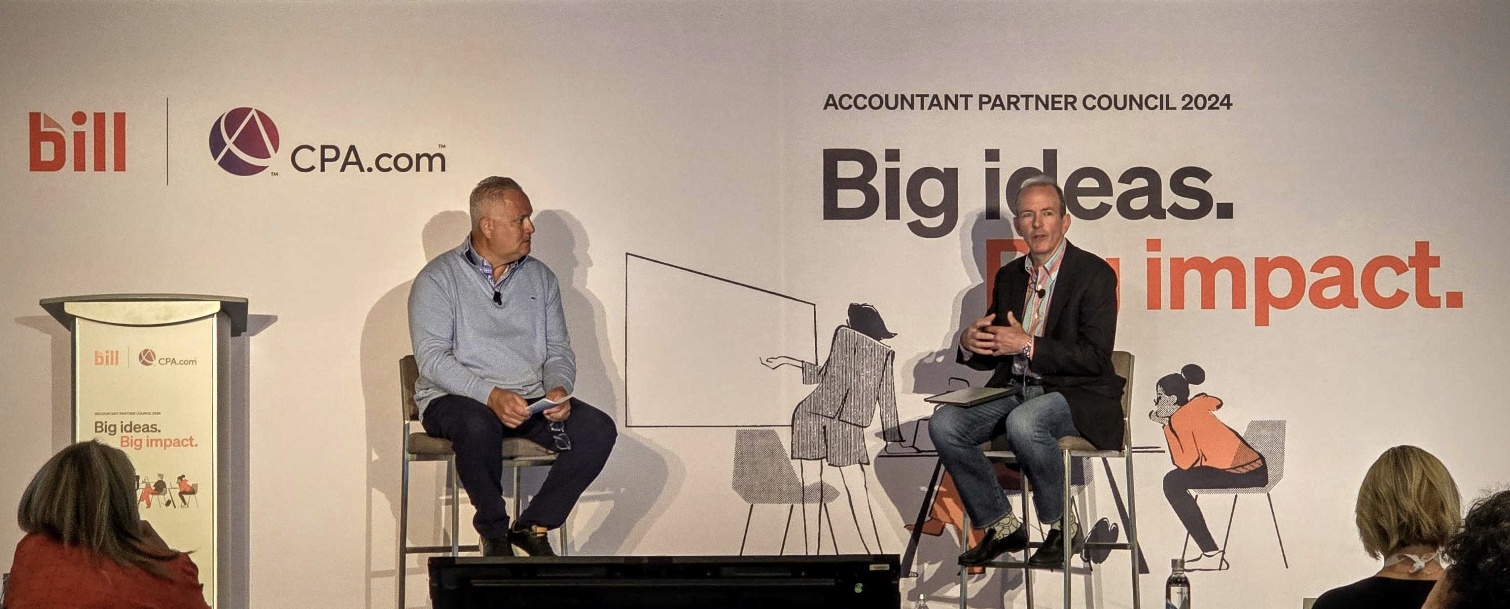
Fifteen years later, Lacerte was still talking with that community. At BILL’s 2024 Accountant Partner Council, he joined CPA.com’s Michael Cerami for a discussion about their partnership and automation. His stated aim for AI was to help accountants spend more time advising clients. The tools had changed; the intended customer was recognizable from the Los Altos walk.
Thirteen years to the bell
BILL went public in December 2019, thirteen years after its founding. The prospectus priced the shares at $22 and set out a company built around the routines of paying suppliers and collecting money. An invoice has limited theatrical possibilities. Put enough of them together, however, and even the stock exchange takes an interest.
Lacerte later described ringing the New York Stock Exchange bell as an emotional moment. He thought about his parents and grandparents, and about the effort business owners poured into their work. The occasion made him reflect on whom the company represented. His account of the day dwells on those owners and their sacrifices.
The company subsequently expanded through acquisitions, adding Divvy and Invoice2go in 2021 and Finmark in 2022. That widened the work BILL could address across spending, invoicing and financial planning. For Lacerte, the original back-office problem had become a much larger operating responsibility. A founder can begin with an irritation at his own desk. A public-company CEO has considerably more desks to consider.
- 1999Co-founds PayCycle
- 2006Founds BILL
- 2019Takes BILL public
Guacamole and the work of listening
Lacerte’s descriptions of leadership include a refreshingly practical detail: he has made margaritas and guacamole for his teams. He also cooks and does dishes at home. He treats those ordinary acts of service as a way to remain connected to other people. There are more elaborate executive rituals. Few come with tortilla chips.
He emphasizes listening, humility and empathy, including the discipline of withholding an opinion when people are waiting for the CEO to speak. An answer from the person in charge can close a conversation before anyone has tested it. Making room for another answer takes effort, especially after years spent being asked for yours.
His version of authenticity also leaves room for disagreement. Employees should be able to bring different experiences and views into a workplace without imposing those views on colleagues. He links that freedom to avoiding groupthink. The aim is a company in which people can contribute what they see, rather than calculate which observations will be welcome.
The next chapter has a human cost
That philosophy now sits beside a difficult set of decisions. On May 7, 2026, Lacerte told employees that BILL would become an AI native company and reduce its workforce by up to 30% by the end of its fiscal fourth quarter. A voluntary separation program would come first, followed by the remaining reduction. He connected the restructuring to both profitability and a different way of working.
The announcement puts weight on his language about service. Automation promises customers less administrative labor. Inside the company building it, the transition means fewer jobs. Those consequences belong in the same account of his career. His stated purpose does not settle the question of how well the change serves everyone affected by it.
In August, BILL reported fiscal 2026 revenue of $1.653 billion, up 13%, alongside a net loss of $11.2 million. For the June quarter it processed $98 billion in payments. Those figures describe an operation far removed in size from the family businesses he watched as a child, while leaving the demand for profitable growth very much present.
Year ended June 30, 2026. BILL reported an $11.2 million net loss for the year.
By October 19, BILL’s new AI features included controls to monitor automated actions and turn tools on or off. The company said 175,000 businesses had used at least one of its AI capabilities. The direction carries an old Lacerte concern into a new interface: people need to understand and control what happens to their money.
The general store and the software platform are separated by more than a century. Both require someone to pay attention after the sale: to the supplier, the books, the money owed and the people doing the work. Lacerte has spent his career trying to shorten that part of the day. The remaining hours are where his customers hoped to live.