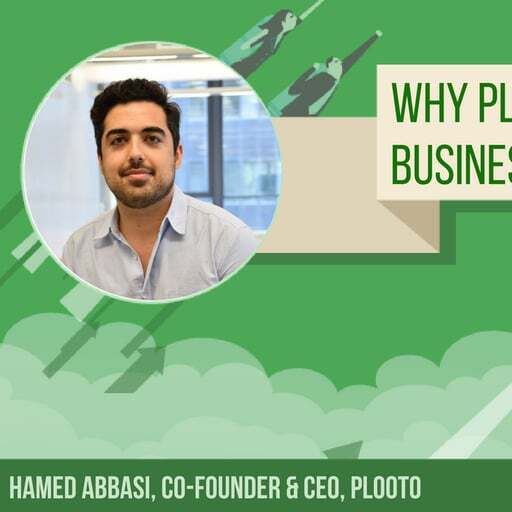
In October 2019, Hamed Abbasi had a question with an expensive answer. Plooto, the payments company he had co-founded four years earlier, was introducing a monthly software charge. The team expected a bruising departure: its forecast allowed for 70 percent of customers to leave. Instead, Abbasi later reported, 82 percent stayed. For a founder accustomed to changing course, this was a useful surprise. Customers were willing to pay for the thing his company had become.
The fee was $25 a month. Hardly the sort of sum that gets a startup onto a magazine cover. Yet it tested something more interesting than the number of people willing to open an account. It asked whether Plooto had become useful enough to keep. Free software can collect compliments with very little difficulty. An invoice makes the conversation considerably more candid.
“When that happened, we knew we had product market fit,” Abbasi said. There is a whole career behind that sentence: an arrival in Canada, a job inside a bank, a gaming business, an early bet on Bitcoin, and several revisions to what customers actually needed. The journey makes more sense when followed through its changes than through its funding rounds.
A new language, then a new line of work
Abbasi was born in Iran and moved to Canada at 14. His father had arrived two years earlier and sponsored the family. Abbasi described arriving without English and spending several years learning the language and how his new surroundings worked. He connected his drive to that experience of beginning again with his immediate family, away from the friends and wider family he had known.
His account is practical rather than ornamental. Learning how things work comes before deciding how to improve them. A new country supplies an unusually thorough education in that order of operations. The familiar becomes something you have to ask about, observe, and practise. Abbasi's later business decisions repeatedly involved that same willingness to reconsider an initial understanding.
His early career included Gemma Communications, followed by Bank of Montreal. An Ivey profile records studies at IADT from 2004 to 2007. Banking brought him into contact with small business owners and the machinery of payments. He liked that part of the work. The layers of approval and the pace of decision-making were less appealing. He would eventually leave the institution while carrying its customers' problems with him.
The banker takes up gaming
Video games supplied the detour. Abbasi and Serguei Kloubkov became business partners at Vast Studios, an independent casual game developer. The partnership would later carry over into Plooto. Their work divided along clear lines: Abbasi handled business and negotiations; Kloubkov handled engineering. Abbasi was direct about his own technical contribution: “I personally couldn’t code.”
In his telling, getting a game distributed meant repeated rejection before a publisher agreed. This was a business education with very prompt marking. A product could be made, a pitch could be polished, and someone still had to want it. The gap between those three events would become familiar in payments, too.
Vast Studios was acquired in July 2014 by ISIS Lab Corporation, which subsequently became Imperus Technologies. The sale gave the partners an exit from one business and an opening for another. It also left Abbasi with firsthand knowledge of something he had previously seen from behind a bank desk: the work of keeping a growing company's finances in order.
Retirement did not appear to suit him. He recalled planning a long break after the sale, then becoming bored during the second week of a trip to Spain. On returning, he met his co-founder to brainstorm another company. It is a pleasingly unglamorous founder anecdote. Spain offered its attractions; a problem still awaiting a solution proved harder to ignore.
The Saturday problem
At BMO, Abbasi had seen business owners arrive with collections of receipts and invoices. At Vast, the arithmetic became his own responsibility. Saturdays could disappear into reviewing the books with a bookkeeper: what had happened during the month, what cash remained, and who needed paying. Making games was one job. Keeping the business capable of making games was another.
That distinction helps explain the eventual shape of Plooto. Paying a supplier is a transaction, but the work around it is a sequence. Someone receives a bill. Someone checks it. Someone approves the payment. Money moves. The accounts then have to reflect what happened. A faster transfer still leaves much of that sequence to be done.
Abbasi and Kloubkov founded Plooto in 2015. Their ambition grew from the friction of running a company, rather than from an abstract interest in financial software. In a 2017 interview, Abbasi described small businesses as caught between consumer banking products with insufficient functionality and commercial systems that were too costly or complex. He wanted owners to recover time for customers, products, and relationships.
“We listen to our customers.”Hamed Abbasi, 2017
The remark is short enough to sound routine. In Abbasi's case, listening would require altering the technology at the centre of the business. A customer can be perfectly satisfied with your intention and entirely unimpressed by your chosen method.
Bitcoin meets the accounts department
The first Plooto used Bitcoin and blockchain. A shared payment network had an appeal for founders trying to connect businesses across banks. But the mechanism created its own friction. Customers had ordinary bank accounts and bills in ordinary currencies. Moving between Bitcoin and dollars complicated the task the product was meant to simplify.
The founders changed the platform in 2016 to work with existing banking infrastructure. Abbasi's BMO relationships helped secure sponsorship and access to Canada's payment network. That is one of the career's small ironies: the banking world he had found frustrating also supplied a route to building a more useful service.
There was an important concession in the change. A business owner did not have to share a founder's enthusiasm for a technology to be a good customer. The customer had a job to finish. Plooto needed to fit that job, including the bank accounts and accounting tools already in place. The usefulness of the service had to survive contact with an actual working day.
- 2015Bitcoin-based paymentsThe original approach
- 2016Existing banking railsFit the customer's bank account
- 2019Monthly subscriptionCharge for the software's continuing value
The value between payments
The next revision concerned what Plooto was selling. Engaged customers pointed toward the recurring work of financial operations. Automation and accounting integration mattered beyond any single payment. A subscription could reflect that ongoing value, though it also risked making customers reconsider their relationship with the product.
The 2019 result put a number on their willingness to continue. It should be read carefully: 82 percent was the customer retention Abbasi reported during a particular pricing change. It is not a present-day churn rate, a measure of revenue retained, or a promise about future results. Its significance lies in the test it answered at the time.
A founder can spend years explaining a product's importance. The decision to renew is a customer's own explanation, delivered without a pitch deck. For Abbasi, it was evidence that the company had moved toward a service businesses wanted to keep using.
Making room for the bookkeeper
Abbasi also paid attention to the people between a business owner and the books. In conversations with accounting audiences, he described a profession moving from manual entry toward advice and relationships. Software that reduced repetitive work could make that shift more practical. Plooto's connection to accounting systems was part of the proposition, rather than an accessory to it.
Centana Growth Partners later identified outsourced accountants and bookkeepers as a distribution opportunity. A professional serving several businesses could bring a useful tool into several sets of accounts. That makes a different kind of growth story from persuading every owner individually. Trust already exists in the relationship; the software has to earn its place within it.
In December 2022, Plooto announced a US$20 million Series B, also stated as C$27 million. Centana led the round, with FINTOP Capital and Luge Capital participating. The company's plans included more integrations, product development, and expansion. By its 2023 year-end account, it served over 10,000 customers and had added a NetSuite integration. Scale brought a larger audience for the same practical question: how much work could the product remove?
When the promise needs an update
Payments software also has to explain itself when the financial system becomes unsettled. In March 2023, following Silicon Valley Bank's closure, Abbasi signed updates distinguishing Plooto's Canadian operations from cross-border and US exposure. The communication described multiple processing partnerships and acknowledged that some payments could face delays while routes were assessed.
This was a less decorative side of the CEO's work. Customers needed to know what could happen to their payments. The answer required distinctions, operational detail, and an undertaking to keep communicating. A service built to remove uncertainty cannot make every uncertainty disappear. It can make the next step clearer.
On March 4, 2024, Plooto announced Abbasi's departure and appointed Kloubkov and Wajdi Ghoussoub interim co-CEOs. Abbasi's farewell credited early investors including Janet Bannister, and described Sam Haffar as a mentor. He reported roughly 10,000 customers and $12 billion in annual payment volume, without specifying the currency. Those were figures from his farewell, not current measurements.
The subsequent record includes a legal outcome. In April 2025, the Ontario Court of Justice acquitted Abbasi of a sexual assault charge arising from November 2023. The court found the charge had not been proved beyond a reasonable doubt. At the time of that report, he had no operational role at Plooto.
His founder story remains most revealing at the point where customers had a choice. After banking, games, Bitcoin, and successive changes to the product, a modest monthly bill arrived. Most customers stayed. For someone who had spent so much time trying to understand what businesses needed, their decision was a particularly useful answer.